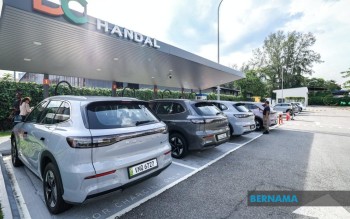
Malaysia's electric vehicle market is poised for significant expansion within the next three to five years, creating substantial opportunities for charging infrastructure providers. Chinese smart charging solutions are increasingly making inroads into this emerging sector, with firms like Xi'an LINCHR New Energy Technology Co Ltd positioning themselves to support the country's EV transition. However, as the industry develops, a critical question has emerged about how international technology can best serve Malaysia's unique environment and infrastructure landscape.
Yuan Qingmin, chairman of LINCHR, articulated a nuanced perspective on this challenge during the Global Automotive and Technology Expo at MITEC from August 26-28. He emphasised that while China has become a global leader in both EV adoption and charging infrastructure deployment, the path forward for Malaysia cannot simply mirror what has worked in China. Instead, he argued, successful technology transfer requires careful adaptation to local conditions, combined with dedicated research and development efforts tailored to the Malaysian market. This distinction between technology transfer and technology replication reflects a growing maturity in how multinational firms approach emerging markets.
The interdependency between vehicle deployment and charging infrastructure creates both opportunities and risks for Malaysia's EV ambitions. Yuan pointed out that delays in either component inevitably constrain the development of the other. If vehicles arrive in dealerships faster than charging stations can be built, early adopters face range anxiety and inconvenience. Conversely, if charging infrastructure expands without corresponding vehicle demand, investment becomes inefficient. This balancing act requires coordination across government, private sector operators, energy utilities, and technology providers—a complexity that underscores why international experience must be thoughtfully adapted rather than wholesale imported.
LINCHR is advancing this localization agenda through a strategic partnership with Swift Bridge Technologies Sdn Bhd, a Malaysian EV charger manufacturer. The collaboration spans multiple dimensions including charging standards development, product design, technology integration, and engineering specifications. This approach acknowledges that meaningful technology transfer involves more than licensing intellectual property or providing technical manuals. Instead, it requires joint development processes where international expertise meets local market knowledge, creating solutions that genuinely address Malaysian conditions.
The company's participation in GATE 2026 reflects a broader engagement strategy aimed at building relationships with Malaysian government agencies, energy companies, infrastructure operators, and industry stakeholders. These connections are essential for LINCHR to understand regulatory requirements, grid capabilities, operational preferences, and long-term infrastructure planning in Malaysia. Such stakeholder consultation also helps international firms navigate the policy environment and contribute meaningfully to standards-setting discussions.
LINCHR's credentials in the global EV charging sector are substantial. The company's testing technology solutions command over 70 per cent of China's market share, demonstrating technological capability and operational scale. However, Yuan candidly acknowledged that such dominance cannot be automatically translated into international success. Overseas expansion demands genuine partnerships with local manufacturers and research institutions capable of adapting solutions to regional conditions. Simply replicating Chinese technology without localization might satisfy minimum functional requirements, but it would likely prove inadequate for Malaysia's specific environmental and operational challenges.
A concrete example illustrates this adaptation philosophy. Malaysia's tropical climate—characterised by high heat, humidity, and salt spray from coastal areas—presents corrosive conditions that standard equipment may not withstand. LINCHR has adopted oil-immersed insulation design for the printed circuit boards in its charging stations, a modification specifically intended to enhance resistance to salt spray corrosion. This technical adjustment demonstrates how international firms must engineer solutions that account for Malaysia's geographical and climatic realities rather than assuming uniform global specifications.
Standardisation and testing protocols form the foundation of any reliable charging infrastructure. Recognising this, LINCHR, Swift Bridge Technologies, and Malaysia's Standards and Industrial Research Institute (SIRIM) formalised a tripartite cooperation agreement in March 2024. Subsequently, the three entities have collaborated on developing charging infrastructure testing and certification standards appropriate for Malaysia, while simultaneously upgrading the equipment testing laboratories necessary to validate compliance. This institutional partnership ensures that Malaysia's EV charging infrastructure meets internationally recognised safety and performance benchmarks while addressing local requirements.
The trajectory of EV charging technology is moving beyond today's relatively static infrastructure model. As vehicles become increasingly connected and intelligent, charging systems will evolve into dynamic, bidirectional platforms. Yuan envisions a future where electric vehicles can be charged at home, workplaces, or public locations, but also serve as distributed energy storage resources. When vehicles are idle—for extended periods or even brief stops—their battery systems could feed surplus electricity back into the grid, transforming private vehicles into "mobile energy" assets. This vehicle-to-grid capability would require sophisticated software, standardised protocols, and grid integration technologies that differ fundamentally from current infrastructure.
For Malaysia, this evolution presents both challenge and opportunity. Implementing bidirectional charging infrastructure requires coordination with Tenaga Nasional Bhd and other utility providers to ensure grid stability and develop tariff structures that incentivise participation. It demands standardised communication protocols that Malaysian charging networks must support. Yet it also positions Malaysia to build modern infrastructure from the outset rather than retrofitting older systems later. Chinese firms like LINCHR, which have experience with such emerging technologies, could facilitate Malaysia's leap-frogging to next-generation systems—provided their solutions are genuinely adapted to Malaysian conditions.
The broader implication for Malaysia's automotive and energy sectors is that technology acquisition and localisation require sophisticated institutional engagement rather than passive technology reception. Government agencies must articulate clear standards and infrastructure requirements. Local manufacturers must invest in R&D capability rather than merely assembly. International partners must commit to genuine adaptation rather than superficial market entry. When all parties align around this principle—as the LINCHR-Swift Bridge-SIRIM partnership attempts to do—the result can be infrastructure that genuinely serves local needs while leveraging global expertise.

