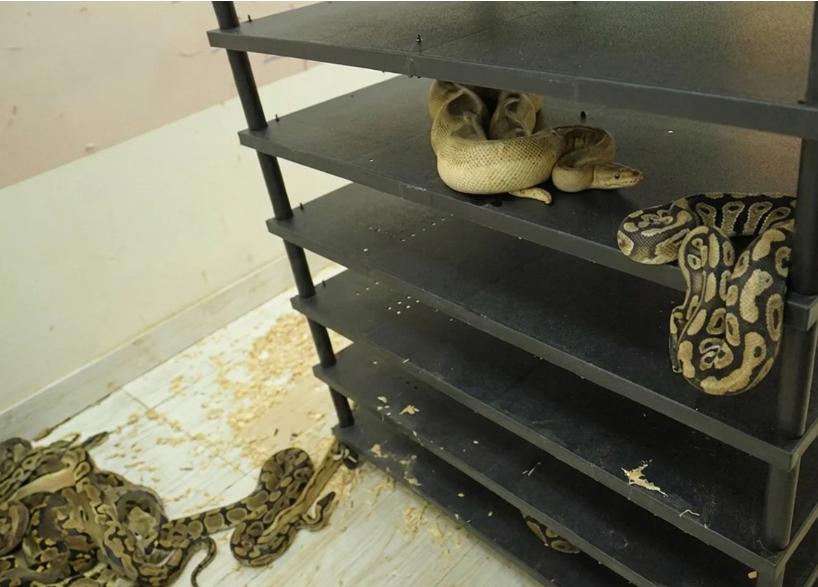
A residential flat in Zhejiang province became an unlikely hub for one of China's more unusual wildlife crimes after authorities discovered a man had been operating an extensive illegal python breeding operation within its walls. The discovery, highlighted by state broadcaster CCTV in late June, exposed a case of what officials described as "serious" harm to protected wildlife, resulting in prison sentences for those involved in what had grown into a multi-million yuan enterprise spanning over a decade.
The investigation began not with a dramatic raid but with a simple observation in the rural foothills of Taizhou. An elderly resident discovered an unfamiliar snake at the base of a mountain in March 2024 and reported it to authorities, suspecting it had escaped from captivity. The sighting proved significant because pythons are not native to the region and are largely dormant during early spring months, suggesting this specimen had originated from a controlled environment somewhere nearby. Police reasoned that the escaped snake provided the initial thread that would eventually unravel a substantial breeding network.
When officers consulted a professional reptile handler about the snake's origins, they received crucial insight into how to locate its source. Pythons demand precise environmental conditions to thrive, requiring sustained warmth and humidity with temperatures maintained between 20 and 30 degrees Celsius. Maintaining such conditions in a residential setting would necessitate continuous electricity consumption at levels significantly higher than normal household usage. This observation prompted authorities to undertake an innovative investigative approach: screening the electricity bills of nearby residents to identify anomalies that might indicate large-scale animal breeding.
The analysis of power consumption data led police directly to a man surnamed Guo, who lived alone and unemployed in the area. Further investigation revealed that a person named Di frequently visited Guo's residence, often collecting parcels from courier stations. When investigators traced the origin of these packages, they discovered the shipments contained large quantities of live mice purchased online from various sellers. When questioned, the suppliers confirmed that their customers typically used such mice to feed exotic pets, particularly reptiles. The pattern of deliveries and their contents suggested an operation requiring substantial food resources, consistent with maintaining a large breeding population.
Additional evidence emerged from Guo's own digital footprint. Police discovered that he had shared photographs of snakes on social media platforms, making oblique references to selling pythons to interested buyers. Transaction records showed that Di had facilitated the sale of at least two pythons to another buyer for 1,000 yuan, indicating that the operation extended beyond personal hobby into commercial enterprise. These financial transactions, combined with the courier activity and electricity consumption patterns, provided authorities with sufficient grounds to execute arrests and search warrants.
When police entered Guo's flat, they encountered a scene that shocked even seasoned investigators. The entire living space had been converted into a breeding facility, with plastic storage boxes stacked throughout multiple rooms, each containing a python. Guo had consolidated all his personal furniture into a single bedroom, effectively surrendering two bedrooms and the main living area entirely to his reptile collection. The scale of the operation far exceeded initial expectations: officers ultimately counted 309 pythons within the residence alone. The snakes were subsequently transferred to a local zoo for care and housing.
Guo himself displayed little concern about his unusual pets and expressed genuine passion for his breeding work. He explained that his interest in snakes dated back to 2014, when he had purchased four pythons and begun a dedicated program of research and selective breeding. "I am capable of cultivating snakes of various colours," he was quoted by authorities as saying, describing himself as feeling like "a creature creator." His self-taught expertise had apparently been sufficient to maintain a breeding colony for over a decade, though his operation ultimately violated China's strict protections for the species.
The investigation expanded beyond Guo to reveal a small network of individuals involved in different aspects of the illegal trade. Di, Guo's associate, faced charges related to the facilitation and sale of snakes. A shop owner named Deng, who had originally sold four pythons to Guo back in 2014, was also apprehended. When authorities searched Deng's residence, they discovered an additional 47 pythons, indicating that Deng had maintained his own unauthorized breeding operation over the years. In total, the coordinated investigation uncovered 436 pythons across multiple locations, with an estimated value exceeding 30 million yuan, equivalent to approximately US$4.4 million.
Under China's Criminal Law, pythons are classified as Grade Two protected animals, placing them in a category that prohibits unauthorized buying, selling, breeding, and transportation without explicit government permission. These restrictions exist to preserve endangered wildlife populations and prevent ecological disruption. Violations of protections for Grade Two species carry severe penalties, with maximum sentences of five years imprisonment. A Taizhou court convicted Guo, Di, and Deng, imposing prison terms, though the specific duration of each sentence remained undisclosed in official reports.
The case underscores how modern investigative techniques, combined with digital footprints and utility records, can expose wildlife trafficking networks that operate within seemingly ordinary residential settings. For Southeast Asian readers, the case carries particular relevance given the region's own struggles with wildlife trafficking and illegal animal breeding operations that supply both domestic and international markets. The investigation demonstrates that environmental crime enforcement, while often focused on large-scale smuggling at borders, can also address smaller-scale operations that accumulate into significant ecological and legal violations. Guo's case illustrates how a single escaped animal can trigger investigations that reveal complex networks operating in plain sight, hidden behind ordinary apartment building facades and obscured only by the difficulty authorities face in detecting specialized electricity usage patterns.

