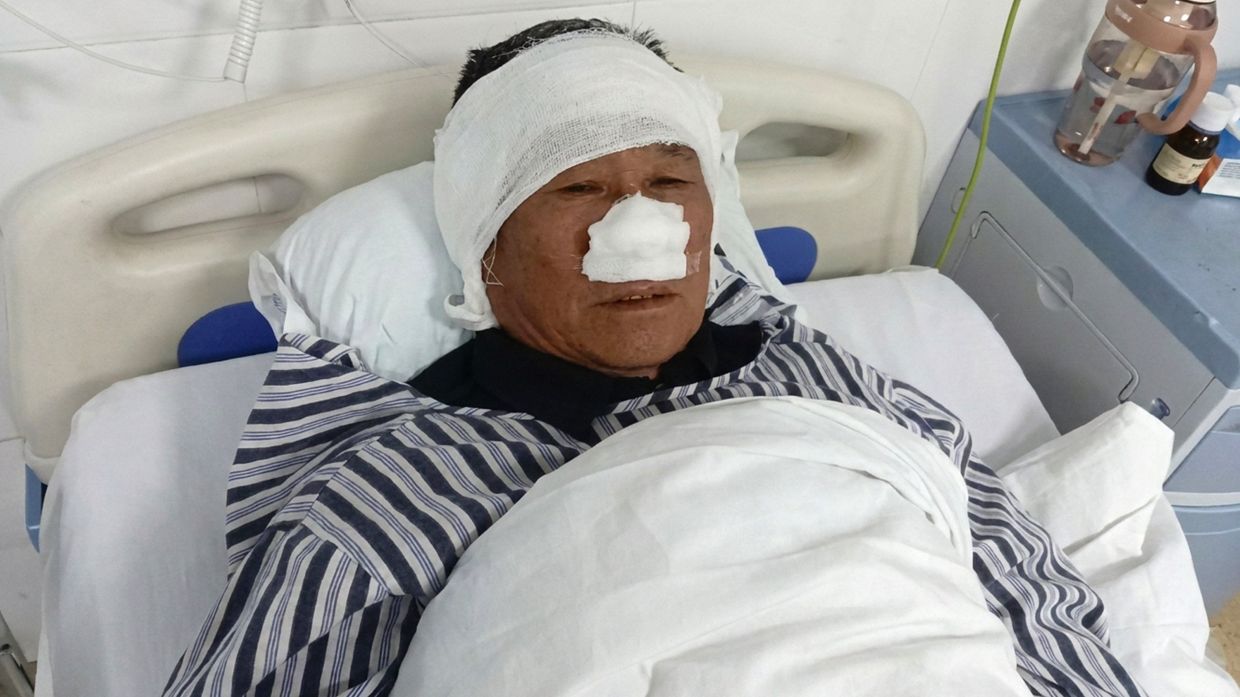
Zeng Fanlin, a 69-year-old from Chenzhou in Hunan province, has been named among China's latest batch of "national heroes for a just cause" after an act of extraordinary bravery that left him permanently disfigured. The honour, bestowed by the Chinese government on July 9 alongside 85 others, recognises his willingness to put his body between a violent aggressor and an innocent victim, despite knowing the personal cost would be severe.
The incident unfolded in April when a man in his twenties appeared in Zeng's village and embarked on a chaotic rampage through the community. The attacker assaulted multiple passersby and violently kicked at residential doors, creating an atmosphere of fear among residents. His behaviour escalated when he confronted a woman riding an electric bicycle, seizing her around the neck and placing her in immediate mortal danger. The situation presented a critical test of character: would bystanders intervene or wait for official help?
Most villagers, understandably frightened by the attacker's unpredictable and aggressive conduct, chose to contact the police rather than physically engage with him. They hoped law enforcement would arrive in time. But Zeng, drawing on a lifetime of community service as a former village official and volunteer mediator, made a different calculation. He charged toward the scene and tackled the attacker, wrestling him to the ground. Two other villagers quickly joined the effort to restrain the increasingly desperate man.
During the violent struggle, the attacker inflicted catastrophic damage. He bit off a substantial portion of Zeng's nose—a facial feature impossible to conceal and essential for normal breathing and appearance. Despite the excruciating pain and shock of such a traumatic injury, Zeng maintained his grip on the attacker until police arrived and took the suspect into custody. He was then transported to hospital where he would face months of gruelling reconstructive surgery.
The severity of Zeng's injury cannot be overstated. Medical professionals informed him that most of his nose had been destroyed, creating extraordinary reconstruction challenges. Doctors warned that even with surgical intervention, Zeng faced the prospect of permanent scarring, disfigurement, and potential long-term complications affecting both his breathing and quality of life. The psychological toll of such an injury—irreversible in its most visible form—would shape the remainder of his existence.
The medical team devised an ambitious reconstruction strategy using a skin graft harvested from Zeng's own scalp to rebuild the damaged facial structures. Two surgical procedures were ultimately performed, with doctors successfully restoring the nasal wings to enable normal breathing function. The total medical costs exceeded 70,000 yuan (approximately US$10,000), a substantial sum that was covered through government assistance. Recovery stretched across a minimum of six months of painful healing, and even after the surgeries were completed, Zeng continued experiencing daily discomfort.
Beyond government support, recognition came from other quarters. The Alibaba Foundation and local media organisations presented Zeng with an additional 20,000 yuan in recognition of his extraordinary courage. Yet no monetary award could truly compensate for the permanent alteration to his face and the ongoing physical suffering he endured. When asked about his sacrifice, Zeng responded with a philosophical perspective that reflected deep values: "Compared with saving a life, everything I have given is worth it."
This philosophy did not emerge from nowhere. Zeng's life has been shaped by experiences of receiving help from others when he had little. Orphaned in his childhood, he was raised by villagers who took him in and cared for him. The government later funded his education, allowing him to attend school free of charge—an investment that transformed his circumstances. These formative experiences created in Zeng a powerful sense of obligation to repay society's kindness through his own actions.
His family members confirmed that Zeng possessed an unyielding sense of justice that compelled him to act when witnessing wrongdoing. His daughter described a man incapable of standing passively by. This character had manifested itself previously: in 2016, Zeng had assisted local police in apprehending a thief, demonstrating a consistent pattern of civic engagement even before the April incident.
Under Chinese criminal law, the attacker faces serious consequences for the brutal assault. Intentionally causing severe injury carries potential sentences ranging from three to ten years imprisonment, a reflection of how seriously the legal system treats such violent crimes. The case remained under investigation at the time of the government's hero announcement, with police indicating that the suspect had lost emotional control before launching his rampage.
The recognition Zeng has received resonates beyond his village. His story encapsulates broader discussions in Chinese society about moral courage, civic responsibility, and the expectations placed on ordinary people to defend the vulnerable. For Malaysian and Southeast Asian observers, the case illustrates both the bonds that hold communities together during moments of crisis and the personal costs borne by those who choose decisive action over self-preservation. Zeng's example challenges individuals everywhere to consider what they would do when facing similar moments of choice.

