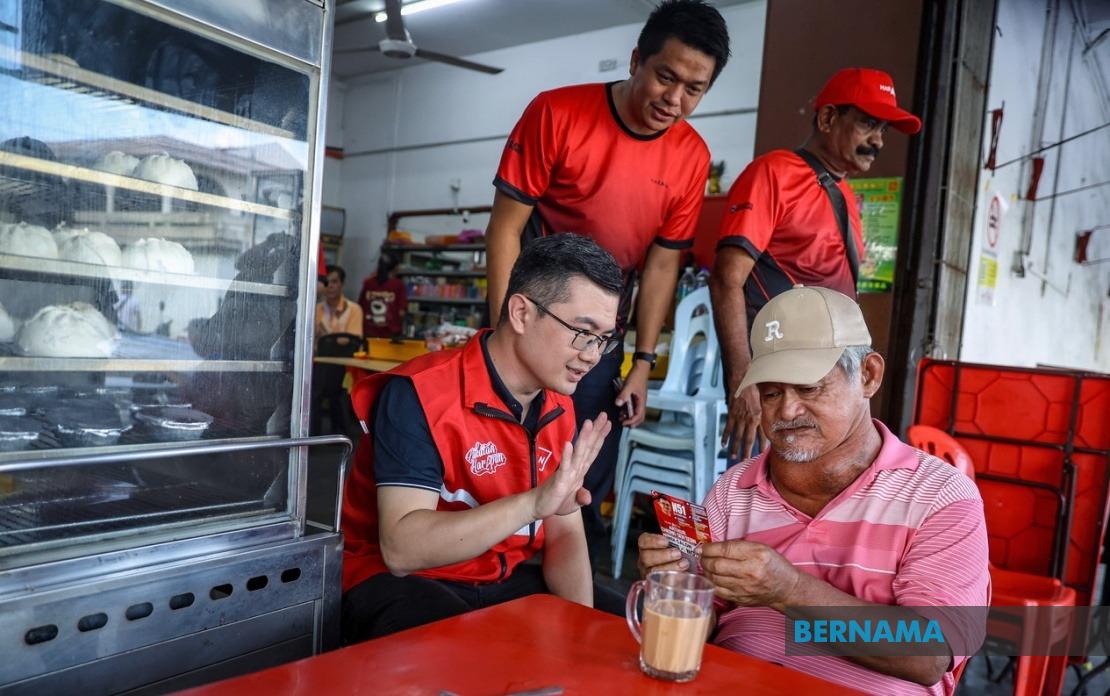
Arthur Chiong Sen Sern, the Pakatan Harapan incumbent representing Bukit Batu, is pursuing a second term in the 16th Johor State Election by emphasizing his practical work addressing constituent concerns and championing local development. The 36-year-old assemblyman secured the seat just two years ago with an exceptionally tight margin of 137 votes, a result that has evidently shaped his approach to his current tenure and campaign strategy heading into the July 11 polling day.
Chiong's re-election bid rests on demonstrating tangible improvements across his constituency since taking office. He highlights regular engagement with communities across diverse demographic groups, tackling infrastructure deficiencies, and managing the persistent flooding problems that plague several villages. His strategy reflects recognition that his previous wafer-thin victory mandated sustained grassroots presence and visible government action rather than reliance on electoral sympathy or party machinery alone.
A key element of Chiong's pitch involves his accessibility and responsiveness to constituency needs. He describes systematically visiting Federal Land Development Authority (Felda) settlements to address farmer concerns and directing resources toward community amenities. One notable project involved funding RM20,000 for lighting installation at a futsal court in local areas, infrastructure that continues serving young residents. This granular approach—identifying specific community gaps and leveraging his position to secure targeted funding—represents the practical governance model his campaign emphasises to voters.
Flood mitigation has emerged as a defining policy area for Chiong's representation. He points to measurable improvements at flood-prone locations including Kampung Rahmat and Kampung Seri Paya, achieved through sustained collaboration with the Department of Irrigation and Drainage. Rather than merely distributing aid during disasters, Chiong suggests he has worked proactively to reduce the frequency and severity of inundation through coordinated infrastructure interventions. His claim that residents recognise his immediate physical presence during flood emergencies attempts to frame him as an engaged representative rather than a distant politician.
The Bukit Batu electoral contest presents a more complex terrain than Chiong's 2022 campaign. The state seat encompasses 49,963 registered voters and will host a four-way battle involving four candidates representing different political vehicles. Beyond Chiong's Pakatan Harapan candidacy, R. Kumaran contests for Barisan Nasional as the Kulai PKR chief, representing the traditional opposition. Ikatan Demokratik Malaysia (MUDA), the reform-oriented party, has fielded M. Premanand, while Bersama, a smaller coalition partner, nominated G. Tamili. Independent candidate Kamaruzaman Ali completes the field, potentially fragmenting votes across multiple ideological and anti-establishment axes.
Chiong's 2022 victory margin of 137 votes across a four-cornered contest underscores the highly competitive nature of this constituency. He defeated Datuk S. Suppayah from Barisan Nasional, Tan Heng Choon representing Perikatan Nasional, and Lee Ming Wen from Warisan after accumulating 9,439 votes. The fragmentation of the opposition vote benefited the Pakatan Harapan candidate, though his absolute support base—roughly 19 percent of participating voters—suggests limited personal incumbency advantage or deep partisan loyalty among constituents.
Pakatan Harapan leadership has publicly affirmed confidence in Chiong, with Prime Minister Datuk Seri Anwar Ibrahim, simultaneously serving as the coalition's chairman, endorsing his candidacy for the Bukit Batu seat. This institutional backing carries potential organisational and financial benefits but also establishes clear accountability expectations if Chiong underperforms relative to his 2022 result.
The Bukit Batu constituency reflects broader dynamics reshaping Johor state politics. The presence of MUDA and Bersama alongside traditional Pakatan Harapan and Barisan Nasional competitors indicates voter willingness to explore non-establishment alternatives. Chong's campaign narrative—positioning himself as a pragmatic, locally-focused representative—attempts to navigate this fragmented landscape by emphasising competence and accessibility over partisan identity.
Early voting for the Johor state election is scheduled for July 7, with main polling on July 11. The compressed campaign period means that Chiong's visibility record and the tangible infrastructure improvements he cites become the primary battleground. Unlike higher-profile state or federal races where national narratives dominate, state assembly contests often turn on precisely these kinds of local service delivery arguments.
For Chiong, defending his seat requires demonstrating that his narrow 2022 victory reflected genuine constituent support rather than mere opposition fragmentation. His emphasis on regular ground engagement, targeted community investment, and disaster responsiveness aims to convince voters that a two-year tenure has strengthened rather than weakened his connection to Bukit Batu communities. Whether this focus on incremental local improvements resonates amid broader political realignments in Johor will become apparent on July 11.

