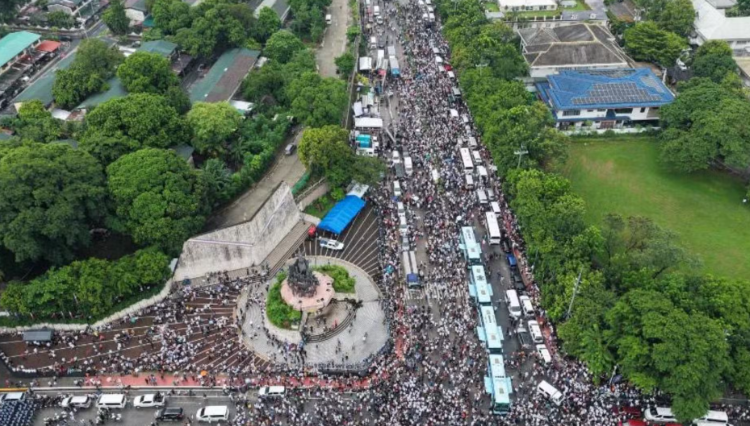
The Iglesia Ni Cristo church flexed its considerable political muscle on Tuesday with a massive demonstration in Manila's central business district, as thousands of devotees descended on the thoroughfare known as EDSA to voice their opposition to impending criminal charges against Senator Rodante Marcoleta. The spontaneous-appearing rally created gridlock across the metropolitan area during morning rush hour, disrupting commutes for workers and students and leaving authorities scrambling to manage the crowd, which regional police spokeswoman Hazel Asilo said had reached 8,000 participants by mid-morning with expectations it would swell further throughout the day. The timing of the protest—announced just a day after the ombudsman's office confirmed Marcoleta would face graft charges related to his alleged failure to properly account for 75 million pesos in unused campaign contributions—appears designed to send a clear signal about the church's willingness to mobilise its estimated three million members for political purposes.
The convergence of religious fervour and political calculation in Tuesday's demonstration underscores the deep structural role that the Iglesia Ni Cristo has played in Philippine electoral politics, particularly through its decades-long alliance with the Duterte political dynasty. Senator Marcoleta, himself a devoted member, has long been viewed as a reliable vote against conviction in any proceedings against figures aligned with the church's historical patrons, making his legal jeopardy significant not merely for his own fate but for the broader political architecture surrounding Vice President Sara Duterte. Speaking through official church spokesperson Edwil Zabala in a Facebook message, the INC framed its intervention not as crude political calculation but as a defence of abstract principles, with Zabala insisting the church was demanding "transparency" and protesting "selective justice" rather than explicitly opposing the legal process targeting their political ally.
The charges against Marcoleta emerge at a genuinely precarious moment in Philippine politics, arriving just days before Duterte's Senate trial begins on July 6. The Vice President requires the support of at least 16 of the Senate's 24 members to avoid conviction and removal from office, making the retention or loss of even single votes potentially decisive. Marcoleta's loyalty to Duterte has been consistently unwavering, and his absence or incapacity due to legal proceedings could theoretically alter the mathematics of the trial in subtle but meaningful ways. The INC's public mobilisation of its membership thus carries dual significance: it functions simultaneously as protection for a party member facing prosecution and as a warning to other senators about the political costs of voting against figures aligned with the church's preferred faction.
The escalating legal pressures on senior Duterte loyalists in recent months reveal deepening fissures within the coalition that governed the Philippines through much of the previous decade. Senator Jose "Jinggoy" Estrada now faces corruption charges related to his alleged involvement in a massive fraud scheme centred on bogus flood control infrastructure projects that sparked national outrage. Senator Ronald "Bato" Dela Rosa has gone into hiding to avoid arrest on an International Criminal Court warrant for his role in the elder Duterte's notoriously lethal anti-narcotics campaign. Against this backdrop, the INC's vigorous defence of Marcoleta signals that the church retains significant stakes in the political fate of its traditional allies and remains prepared to deploy its organisational capacities to protect them.
The philosophical framing deployed by church spokespersons reveals how religious institutions can blur the line between principled advocacy and factional politics. Zabala's invocation of "selective justice" echoes longstanding grievances within Duterte's political base about what they perceive as politically motivated prosecution by an administration they view as hostile. The statement that "even if they imprison Senator Marcoleta, we will not stop demanding justice" casts the senator's potential incarceration as martyrdom for a broader cause rather than the consequences of individual wrongdoing. This rhetorical move transforms what might otherwise appear as straightforward institutional corruption into a struggle between contending visions of Philippine justice and governance.
The INC's demonstrated capacity to mobilise hundreds of thousands of adherents—evidenced by its massive gatherings in November and January opposing various aspects of the anti-Duterte agenda—represents a tangible asset in the fractious Philippine political landscape. The church's explicit involvement in recent demonstrations against the flood control scandal and the earlier impeachment attempt shows that institutional religious organisations remain willing and able to translate doctrinal loyalty into political action. For Malaysian observers watching Philippine dynamics, the phenomenon illuminates how religious communities can function as organised political machines, fundamentally altering electoral calculus and forcing secular authorities to navigate the intersection of faith and statecraft.
President Ferdinand Marcos notably cancelled a scheduled luncheon with foreign media on Tuesday to personally monitor the unfolding situation, suggesting that governmental authorities regarded the demonstration as sufficiently significant to warrant direct executive attention. The cancellation itself became newsworthy, underscoring the demonstration's success in commanding the attention of the highest levels of government. This response validates the INC's calculation that public mobilisation could amplify their message beyond what ordinary institutional channels might accomplish, forcing the sitting president to acknowledge and respond to the church's grievances.
The broader context reveals how the intersection of Sara Duterte's impeachment, the legal vulnerabilities of her coalition allies, and the INC's protective mobilisation creates genuine uncertainty about the coming Senate trial. The trial begins in just days, and the outcome remains genuinely unpredictable—a 16-vote threshold for conviction in a 24-member chamber offers multiple paths to acquittal, and any defections by Duterte loyalists could prove decisive. The INC's public stance, coupled with the legal pressures on other potential swing votes like Marcoleta and Estrada, suggests that this trial will unfold against a backdrop of intense political pressure and institutional conflict.
For students of comparative Philippine politics, the demonstration exemplifies the countermajoritarian power that well-organised, motivated constituencies can exercise within democratic systems. Despite apparent public disapproval of key Duterte figures—evident in criminal charges, ICC warrants, and impeachment proceedings—the institutional power of the INC and the remaining coherence of the Duterte coalition ensure that this episode will not constitute a simple or decisive reckoning. Rather, it illustrates how democracy in the Philippines must constantly negotiate between competing organisational forces, none of which possess absolute dominion, resulting in protracted political contests whose outcomes remain uncertain until institutional votes are finally recorded.

