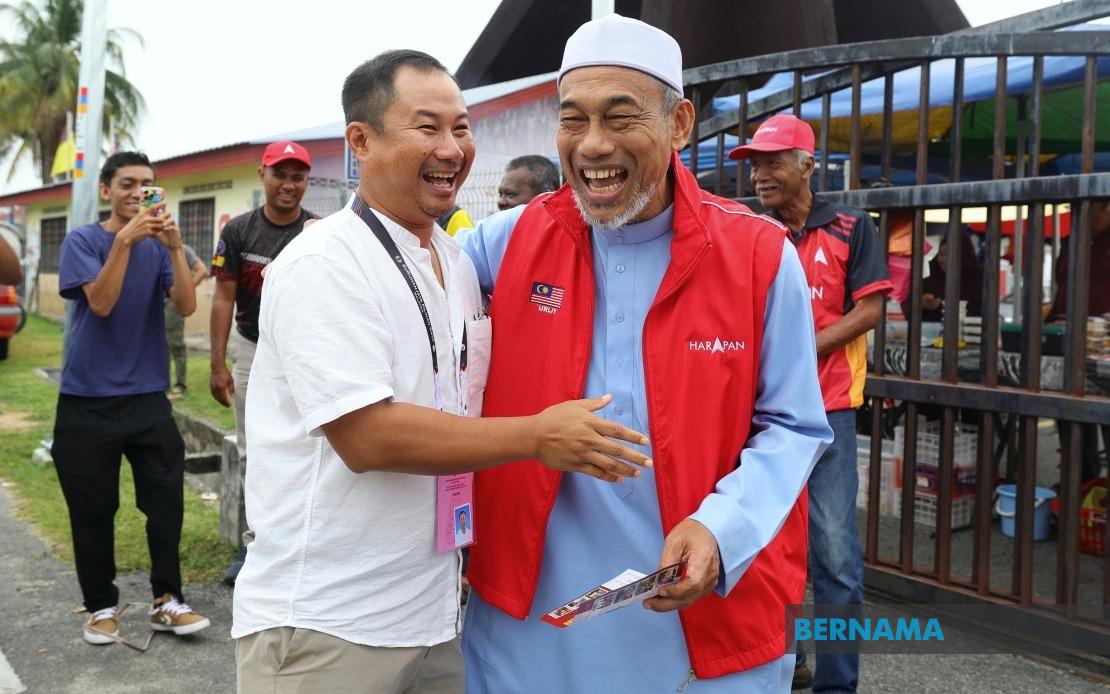
The campaign landscape in Negeri Sembilan's Klawang state seat took a compelling personal turn on the second day of polling efforts when incumbent Datuk Bakri Sawir and his cousin Danni Rais found themselves working the same crowd at Kuala Klawang weekend market in Jelebu. The two candidates, representing opposing political coalitions, drew considerable public fascination as they navigated through the market's bustling vendor stalls and shopper gatherings, prompting onlookers to seize the unusual moment by capturing photographs and video footage of the familial political rivals.
Datuk Bakri Sawir, the current holder of the Klawang seat under the Pakatan Harapan ticket, encountered his cousin Danni Rais, who carries the Perikatan Nasional standard, at nearly identical times as both worked to secure voter support. Their shared appearance at the marketplace created an unexpected spotlight that underscored the competitive nature of Malaysian electoral contests, where family bonds often intersect with partisan allegiances. The electorate, perhaps starved for novelty in state-level campaigns, seized upon the spectacle, with many voters stopping to engage both candidates and document the unusual political reunion.
What distinguished this encounter from typical campaign rivalries was the notably relaxed and respectful tone that characterised their interaction. Rather than the acrimonious exchanges that sometimes punctuate Malaysian politics, the two cousins maintained cordial relations throughout their respective canvassing activities. Both continued their separate campaign efforts without hostile overtones, and remarkably, managed to share light-hearted remarks with one another—a refreshing counterpoint to the increasingly polarised nature of domestic politics. The peaceful nature of their competition spoke to a deliberate commitment to maintaining decorum during the election period.
When engaging with local media representatives, Datuk Bakri articulated a measured perspective on his electoral contest against a family member. He framed the competition not as a personal or familial confrontation but rather as a shared opportunity for both candidates to present their respective visions and service commitments to the constituents of Klawang. This philosophical stance suggested that despite their opposing political affiliations, both candidates viewed the election primarily as a legitimate democratic process through which voters could choose their preferred representative based on policy platforms and personal qualifications.
Datuk Bakri placed particular emphasis on the importance of conducting campaigns according to established regulations and ethical standards. He recounted a recent incident in which his campaign team was instructed by Jelebu District Council to remove campaign flags that had been installed on stadium fencing. Rather than viewing this correction as an imposition, he characterised it as a necessary reminder of the need to respect municipal authority and legal frameworks. This demonstrated a commitment to establishing a precedent whereby political aspirants themselves adhere strictly to electoral guidelines, thereby demonstrating to voters that respect for law and institutional authority begins with those seeking public office.
The broader implications of maintaining campaign discipline extend across the entire political ecosystem in Negeri Sembilan. Datuk Bakri explicitly called upon all parties and their organisational machinery to ensure that the campaign period proceeded in an orderly, harmonious fashion that would enhance rather than damage social cohesion throughout the electoral cycle. Such appeals for structured and respectful political engagement reflect a recognition that the manner in which campaigns are conducted significantly influences public confidence in democratic institutions and the electoral process itself.
The Klawang state seat represents a competitive battlefield in the Negeri Sembilan State Election, with 13,355 registered voters constituting the electorate that will ultimately determine the constituency's representative. However, the contest extends beyond a simple two-way race between the dominant political coalitions. A third candidate, Muhammad Adib Musa representing Bersatu, entered the fray, creating a three-cornered competition that could potentially fragment the vote and introduce strategic voting considerations for those voters aligned with either of the major coalitions.
This multi-candidate scenario adds layers of complexity to the electoral calculations facing Klawang residents. Voters must now evaluate not merely their preference between Pakatan Harapan and Perikatan Nasional, but also whether their political sympathies align more closely with Bersatu's distinct positioning. For those undecided or moderately aligned with either major coalition, the presence of the third candidate creates additional options that might better reflect their specific policy preferences or regional concerns. The fracturing of votes across three candidates typically increases the importance of voter turnout and campaign momentum in the final days preceding polling.
The Election Commission has structured the voting schedule to facilitate maximum participation, establishing July 28 for early voting—a provision that accommodates those unable to participate on the general polling date of August 1. This staggered approach reflects recognition that contemporary voting patterns increasingly require flexibility to ensure representative participation across diverse voter demographics and work schedules. For the Klawang constituency specifically, the early voting provision may prove particularly significant if a tight three-way race develops, potentially allowing narrower victory margins to determine the ultimate outcome.
The harmonious manner in which Datuk Bakri and Danni Rais conducted their respective campaigns provides a potential template for how electoral competitions can proceed without sacrificing democratic intensity or policy differentiation. Their demonstrated ability to campaign vigorously while maintaining personal respect and constitutional propriety offers broader lessons for Malaysian politics at a time when polarisation and divisive rhetoric frequently characterise competitive political environments. The Klawang race thus becomes not merely a local contest to determine state representation but also a test case for whether Malaysian politics can accommodate spirited democratic competition within a framework of institutional respect and personal civility.
For regional observers tracking Malaysian electoral dynamics, the Klawang constituency encapsulates several important tensions within contemporary Negeri Sembilan politics. The strength of Pakatan Harapan's incumbent position, the growing appeal of Perikatan Nasional in peninsular state contests, and the persistent influence of Bersatu's political positioning all manifest within this single three-way race. The outcome will provide insights into voter sentiment regarding both incumbent performance and the comparative appeal of opposition alternatives, thereby informing broader assessments of political trajectories within the state and potentially influencing calculations for future federal-level political realignments.

