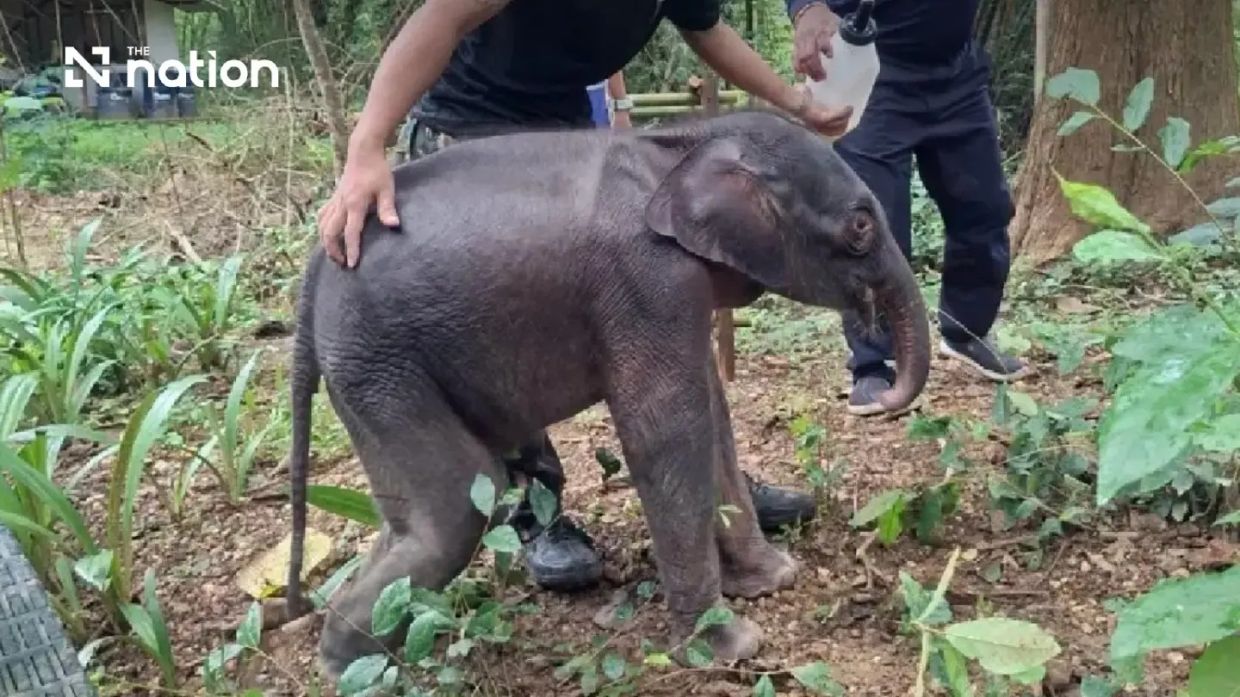
A young male wild elephant, estimated at less than two weeks old and weighing approximately 40 kilograms, has been rescued from a precarious situation along a riverbank in Sai Yok district, Kanchanaburi province, Thailand. The calf was found alone and in severe distress after apparently becoming separated from its herd, triggering an urgent mobilisation of veterinary teams and park officials across difficult terrain and treacherous weather conditions. The discovery, made on July 30, 2026, has become a focal point for Thailand's wildlife conservation efforts and underscores the ongoing challenges facing elephant populations in Southeast Asia, where habitat loss and environmental pressures continue to threaten the survival of these iconic animals.
The circumstances of the calf's abandonment suggest a tragedy born from environmental upheaval. Residents of Ban Mae Nam Noi first spotted the distressed animal on the banks of Huai Mae Nam Noi, where the calf appeared to have been stranded for approximately two days. Local villagers alerted Sai Yok National Park Protection Unit No. 5, whose officers faced a gruelling journey to reach the location, requiring a boat to navigate the swollen waterways—a journey that consumed one to two hours under hazardous conditions. Officers who arrived at the scene discovered the calf trapped in an extremely confined space, with only about 1.5 metres of movement available on the riverbank, the river itself blocking any escape route. This claustrophobic situation, combined with the calf's obvious weakness and distress, presented rescuers with an urgent challenge that demanded both precision and speed.
The physical toll of the calf's ordeal became evident through detailed veterinary examination. Veterinarians from Protected Areas Regional Office 3 (Ban Pong) and its Phetchaburi branch conducted a comprehensive assessment on July 31, identifying critical health complications requiring immediate intervention. The calf exhibited severe dehydration, with urine manifesting as a dark yellowish-red colour—a telltale sign of either systemic infection or profound fluid loss. Multiple wounds covered its body, including ulcerous lesions in its mouth approximately the size of a Thai 10-baht coin, traumatic injuries to its navel, and blistered areas along its trunk showing signs of dead tissue. The calf's mouth wounds were so painful that it resisted drinking milk provided by rescuers, creating an additional concern about nutritional intake during a critical developmental period.
Beyond the visible injuries, the calf faced secondary complications that threatened its survival. Conjunctivitis caused by bee-like insects swarming around its eyes indicated possible infection and environmental stress. Loose, foul-smelling stools suggested gastrointestinal disturbance, potentially linked to either infection or the physiological stress of separation and abandonment. The combination of these symptoms painted a picture of a severely compromised immune system in an animal at perhaps its most vulnerable life stage. Medical teams at the national park headquarters have initiated intensive treatment protocols, with particular attention directed toward screening for elephant endotheliotropic herpesvirus (EEHV), a potentially fatal pathogen that has devastated captive and wild elephant populations across Southeast Asia in recent years.
The rescue operation itself demonstrated both the commitment and the logistical challenges facing Thailand's wildlife management agencies. Officers spent the night of July 30 monitoring the calf's behaviour, hoping that its periodic calls for its mother might eventually prompt the herd's return. The extended calls echoing through the night, met only with silence, gradually confirmed the heartbreaking reality that the herd had moved significantly beyond earshot, likely having crossed the river during the heavy rainfall that had raised water levels dangerously. The decision to transport the animal to park headquarters rather than attempt reintegration reflected an assessment that the calf's condition had deteriorated beyond the point where wilderness survival was feasible without intervention. Heavy downpours over two consecutive days had swollen Huai Mae Nam Noi, probably triggering the initial separation and explaining why the mother herd could not return to retrieve the struggling juvenile.
Suchart Chomklin, Thailand's Minister of Natural Resources and Environment, issued a statement on Saturday August 1 that underscored the political significance of the rescue. His words emphasised not only concern for the calf's welfare but also gratitude toward the field teams who had worked under genuinely hazardous conditions—negotiating flooded terrain, navigating swift currents, and operating in relentless downpours. Chomklin instructed the Department of National Parks, Wildlife and Plant Conservation (DNP) to deploy specialist veterinarians to oversee every stage of the treatment protocol, signalling a high-level commitment to ensuring the calf's survival. This ministerial involvement reflects broader recognition within Thai government that elephant conservation has become a matter of national importance, particularly as wild populations continue to face mounting pressures from habitat fragmentation and climate-related environmental extremes.
Attapol Charoenchansa, director-general of the DNP, provided detailed operational context, explaining that the rescue unfolded across three separate operational phases. The initial alert came from local residents at 6am on Thursday July 30, followed by an exploratory visit by park protection officers who confirmed the calf's critical condition and decided to maintain overnight observation. The second phase involved veterinary teams arriving on Friday July 31 to conduct comprehensive medical assessment, a process complicated by the same access difficulties that had hindered the initial rescue—the boat journey to the site again required one to two hours, and continuous rainfall created evolving risks of flash flooding that could have swept both the calf and rescue personnel downstream. The third phase involved transporting the animal under controlled conditions to the national park headquarters, where proper medical facilities, trained veterinary staff, and monitoring equipment could be deployed.
The medical intervention strategy reflects international best practices in elephant triage and rehabilitation. Veterinarians have prioritised stabilising the calf's hydration status, addressing the painful mouth ulcers that impede feeding, and initiating prophylactic treatment for likely infections while simultaneously conducting diagnostic testing for EEHV and other pathogens. The navel wound carries particular concern, as contamination in this area can lead to serious systemic infections in young animals whose immune systems remain underdeveloped. The trunk blistering and tissue necrosis require careful wound management to prevent secondary bacterial colonisation, especially given the foul-smelling discharge already evident in the calf's stools. Round-the-clock monitoring has been instituted to track the animal's response to treatment and to identify any deterioration requiring immediate intervention.
The broader implications of this incident extend well beyond the individual animal's fate. The separation event itself—likely triggered by environmental stress from heavy rainfall—demonstrates how climate variability is directly impacting wildlife survival in Southeast Asia. Elephant herds are becoming increasingly fragmented as traditional migration routes are disrupted by infrastructure development and climate-induced environmental changes. Young calves separated from protective maternal bonds face almost certain death in the wild, making human intervention increasingly necessary even as it raises complex questions about the sustainability of wildlife populations that have become dependent on active management. Thailand's response to this particular case will influence regional approaches to wildlife conservation and may establish precedents for future interventions.
For Malaysian observers, the Kanchanaburi incident carries particular resonance given Malaysia's own significant wild elephant populations, particularly the Asian elephant herds found in peninsular Malaysia's national parks and forest reserves. The veterinary protocols being deployed in Thailand—particularly screening for EEHV, which has affected Malaysian elephant populations—offer valuable data for regional wildlife management agencies. The challenges faced by Thai rescue teams in accessing difficult terrain during monsoon conditions mirror those that Malaysian park rangers confront when managing wildlife in remote forest zones. As climate patterns become increasingly unpredictable across Southeast Asia, the capacity to mount rapid, coordinated rescue operations for distressed animals may become an essential competency for all regional conservation agencies.

