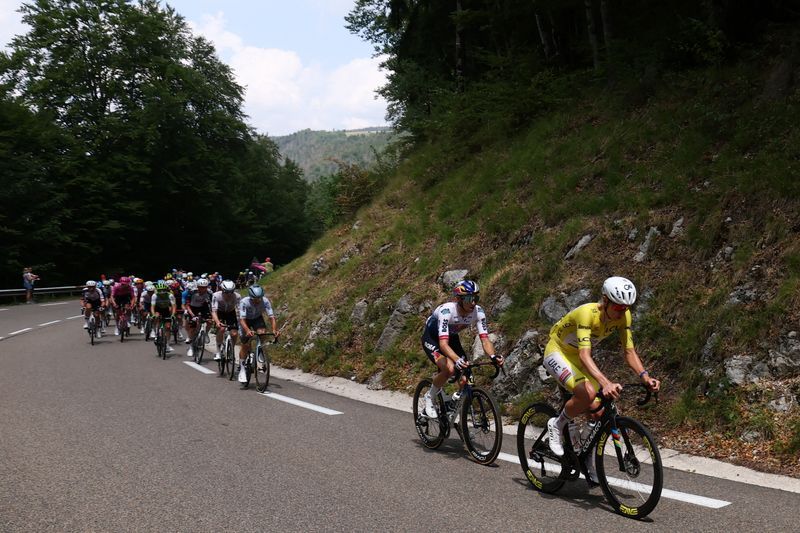
Jonathan Vaughters, the former professional cyclist who now leads the Cannondale-EF team, has waded into the contentious debate surrounding early-morning doping controls at the Tour de France, contending that had such rigorous testing protocols existed during cycling's darkest chapter, the sport could have avoided a quarter-century of doping scandals. His intervention brings credibility to the testing regime, given his insider perspective on both the mechanics of drug abuse and the mechanics of reform.
The controversy erupted following surprise pre-dawn tests conducted on riders ahead of the 15th stage of this year's Tour. Race leaders Tadej Pogacar and Jonas Vingegaard found themselves roused in the middle of the night—Vingegaard at 2 a.m. and Pogacar at 5 a.m.—for unannounced anti-doping examinations. The sudden disruption to the athletes' sleep schedules sparked immediate criticism, with multiple competitors arguing that sacrificing rest before a grueling mountain stage constituted an unreasonable burden that could compromise both performance and safety.
Vaugthers, who competed as a professional during the late 1990s and early 2000s before transitioning into team management, deployed his personal experience and credibility to defend the International Testing Agency's approach. He emphasized that testing at 2 a.m. represents "one of the very effective ways" to detect peptide-based substances including EPO and human growth hormone, as well as the micro-dosing of testosterone that has long vexed anti-doping officials. More provocatively, he suggested that had such testing been implemented during his own racing years, the systematic cheating that defined that era would have been exposed immediately.
Vaugthers' position carries particular resonance because his career path embodied both the problem and the solution in professional cycling. As a teammate of Lance Armstrong on the U.S. Postal Service team, he was intimately familiar with the mechanics and culture of the doping program that Armstrong orchestrated. Later, Vaughters admitted his own use of performance-enhancing drugs, including EPO, and subsequently cooperated with the U.S. Anti-Doping Agency's investigation into Armstrong. That investigation ultimately resulted in Armstrong's unprecedented stripping of seven Tour de France titles in 2012, following USADA's conclusion that Armstrong had orchestrated what the agency characterized as the most technically sophisticated doping operation professional sports had ever witnessed.
Since those revelations, Vaughters has repositioned himself as an advocate for clean sport, using his team ownership to champion transparent anti-doping practices. This history transforms his defense of 2 a.m. testing from mere commentary into something closer to a confession-turned-mission: a reformed participant in cheating now using his platform to ensure that future cyclists cannot exploit the same loopholes he once benefited from.
However, the riders tested during the Tour de France stage have offered a counternarrative focused on the physical toll. Vingegaard, whose early-morning test cost him approximately 40 minutes of sleep, subsequently crashed during the mountain stage and sustained a fractured collarbone—an injury that forced him from the race and raised uncomfortable questions about whether the testing regime had contributed to a safety incident. Pogacar reported managing only four hours of sleep after his 5 a.m. examination, while stage winner Remco Evenepoel dismissed the entire practice as "inhuman."
The International Testing Agency has acknowledged the disruption inherent in their approach, issuing a statement recognizing that "night-time testing may be disruptive to riders' rest and recovery." Yet the agency insisted that effective anti-doping work must, in carefully limited and justified circumstances, occur during hours when athletes normally sleep. This reflects a fundamental tension in modern sport: the gap between what testing can detect and what testing disrupts.
The scientific rationale underlying pre-dawn testing rests on the behavior of micro-dosed substances. EPO, human growth hormone, and carefully calibrated testosterone injections can leave a rider's system within hours—creating a window of vulnerability during traditional daytime testing hours but a more detectable presence during sleep when the body's metabolism operates differently. Anti-doping authorities view this pharmacological reality as non-negotiable: predictable, daytime-only testing effectively becomes a schedule that sophisticated cheaters can work around, establishing their own windows for substance administration and clearance.
For Malaysian and Southeast Asian readers, the cycling governance dispute reflects broader questions about the balance between athlete protection and sport integrity that resonate across the region's growing sporting ambitions. As Southeast Asian nations invest increasingly in hosting major international sporting events and developing elite athletic programs, the conflict between athlete welfare and anti-cheating enforcement becomes directly relevant to tournament planning and athlete management.
Vaugthers' argument ultimately positions pre-dawn testing as a necessary price paid to prevent a return to the Armstrong era. His contention that such testing in 2001 would have "suspended us all and saved the sport 25 years of drama" encapsulates the philosophical stakes: whether the disruption experienced by clean athletes justifies the deterrent effect on would-be cheaters. The broader cycling community remains divided on where that equilibrium should be struck.

