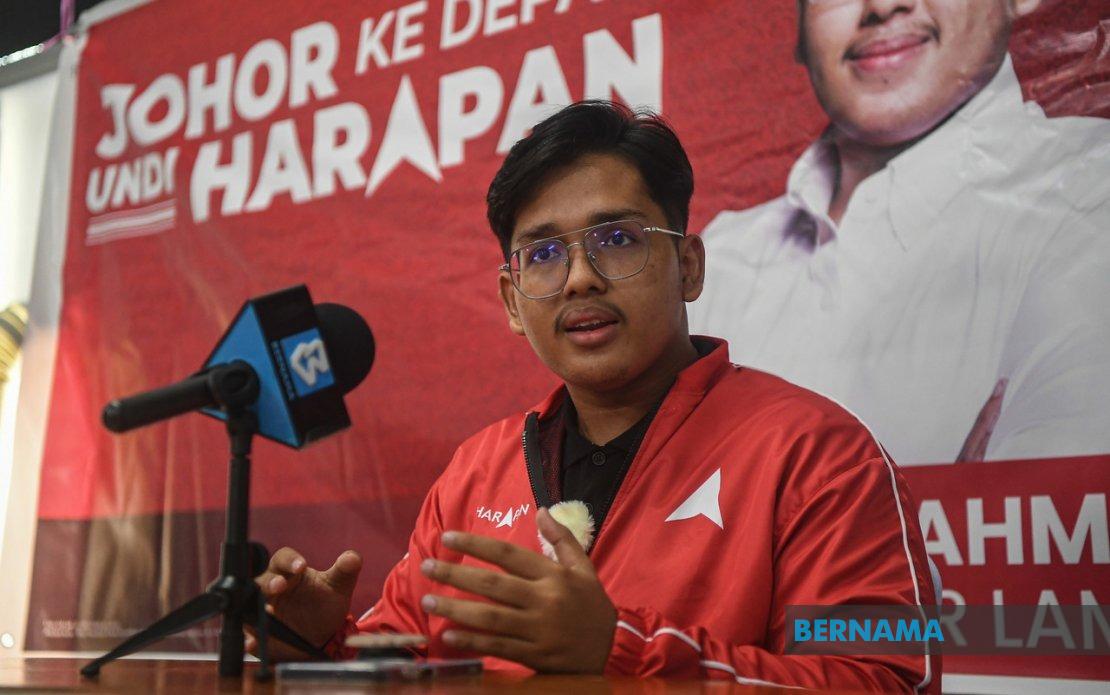
The youngest candidate contesting in Johor's state election, Danish Hossman Abd Rahman from Pakatan Harapan, is making a direct pitch to voters in Johor Lama centred on economic revitalisation and reducing youth migration from rural communities. Running under the campaign banner "Wajah Baharu, Johor Lama" (A New Face, Johor Lama), the 23-year-old has identified a persistent challenge affecting the constituency: the drain of young talent from Felda settlements and outlying areas seeking better prospects in Johor Bahru, Singapore, and beyond.
Danish's vision hinges on closing the development gap between the state's established urban centres and its peripheral regions. He contends that concentrated investment in high-profile areas such as Johor Bahru, Tebrau, and Kulai has inadvertently marginalised Felda communities, forcing successive generations of young people to abandon their hometowns in search of viable employment. By redirecting investment flows towards Johor Lama itself, Danish argues that the constituency can become economically self-sustaining, allowing residents—particularly youth—to build careers and livelihoods without geographic displacement.
Integration between state and federal administration stands as a cornerstone of his policy framework. Danish emphasises that effective implementation of development initiatives and economic programmes requires seamless coordination between Putrajaya and the Johor state government. This approach acknowledges a reality familiar to Malaysian policymakers: ambitious projects often stumble at the junction between different levels of governance when bureaucratic silos prevent aligned action. By elevating this issue in his campaign, Danish is signalling an understanding of the institutional mechanics required to translate election promises into tangible results.
Beyond macro-economic strategy, Danish is addressing specific administrative grievances that constrain daily life for residents. The absence of an Immigration Department branch office in Kota Tinggi—the constituency's administrative hub—forces residents seeking passport renewal, visa applications, or immigration queries to undertake lengthy journeys to Johor Bahru, Kulai, or Mersing. This seemingly bureaucratic inconvenience carries real consequences for working-class families and small business owners who lose productive hours navigating the system. Establishing a local immigration centre would lower transaction costs for residents and reduce friction in accessing federal services, a tangible improvement in government responsiveness.
His campaign methodology reflects contemporary electoral dynamics in Malaysia, where candidates increasingly operate across both traditional and digital platforms. Danish combines ground-level community engagement—meeting constituents face-to-face and hearing concerns directly—with sustained social media presence targeting the constituency's more than 32,000 registered voters. This hybrid approach recognises demographic diversity within the electorate: older voters who expect in-person candidate interaction and younger voters who follow campaigns online. Early feedback from social media engagement has been encouraging, suggesting receptiveness to his message among digitally connected segments of the population.
The electoral contest itself shapes the strategic environment. The three-way race between Danish, incumbent Barisan Nasional candidate Norlizah Noh, and Perikatan Nasional's Aisah Esa creates incentives for differentiation and targeted messaging. As the youngest candidate in a field representing established political machines, Danish occupies a distinct positioning as a representative of generational change, a narrative that resonates particularly in constituencies experiencing youth exodus.
The Johor state election on July 11, with early voting on July 7, occurs amid broader recalibration of Malaysian politics. The emphasis on rural and Felda community concerns reflects shifting electoral calculations, where demographic and economic anxieties in peripheral regions can determine election outcomes. Johor Lama represents precisely this terrain: a constituency where local voters confront tangible pressures—limited job markets, rural-to-urban migration, and administrative inconvenience—that political candidates must address substantively to gain traction.
For Malaysian observers, the campaign illustrates how development inequality within states receives heightened attention during electoral periods. The disparity between well-connected urban constituencies receiving consistent infrastructure investment and peripheral areas experiencing gradual neglect remains a persistent feature of Malaysian governance. Candidates like Danish who foreground this disparity are acknowledging voter frustrations that accumulate quietly until electoral moments create forums for expression.
The promise to generate local employment and attract investment to Johor Lama also touches on structural challenges in Malaysian economic geography. Felda schemes, established as land settlement programmes for rural poor, increasingly struggle with viability as agricultural commodity cycles face headwinds and younger residents lack farming skills or interest. Without economic diversification and alternative employment creation, these communities face further deterioration and outmigration. Candidates addressing this challenge directly engage with real constraints affecting voter welfare.
Danish's campaign also illustrates generational transitions within political parties. At 23, he represents a cohort of young politicians seeking entry into state and federal politics, often running in less competitive seats as party investment in emerging talent. His emphasis on connecting with younger voters through social media and his focus on youth employment reflects awareness of demographic shifts that will reshape electoral coalitions in coming elections. Whether this generational infusion translates into legislative effectiveness depends on post-election capacity to deliver on pledges, a challenge all first-term candidates face regardless of political affiliation.

