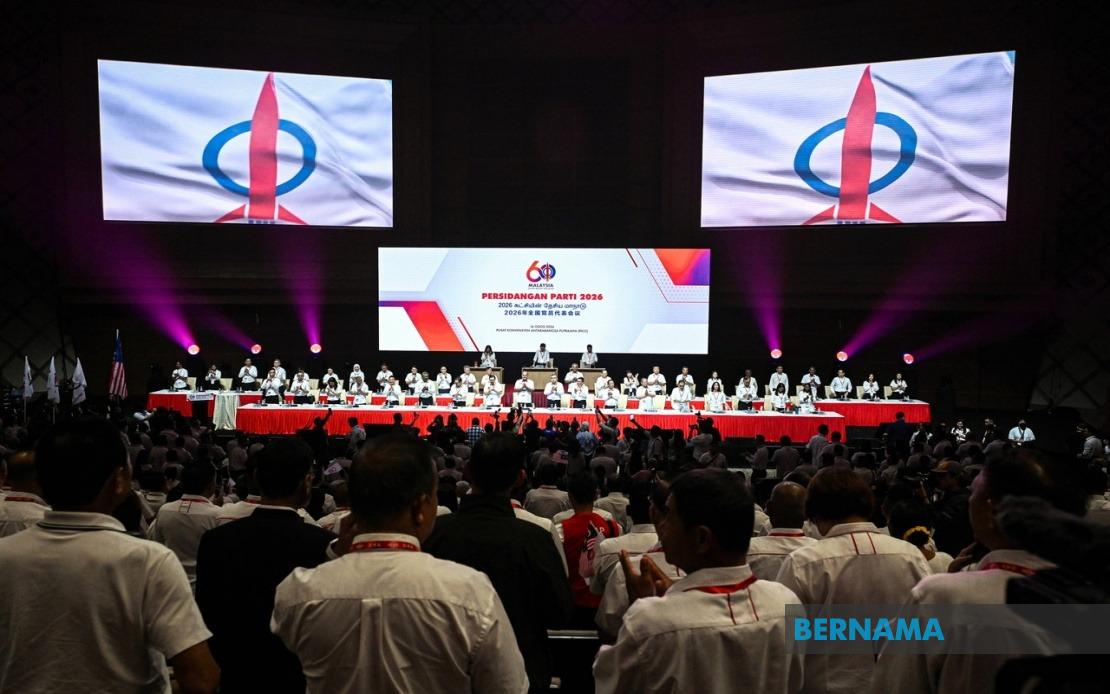
The Democratic Action Party's 2026 National Conference at the Putrajaya International Convention Centre witnessed substantial backing from regional representatives for the party to maintain its place within the federal Unity Government framework. Fourteen state delegates articulated their support during formal debate proceedings, framing continued participation as essential to fulfilling commitments made to voters and preserving Malaysia's political equilibrium during the current parliamentary cycle.
The coalition of supporting delegates represented a geographical cross-section of DAP's membership, spanning Perak, Pahang, Selangor, Melaka, Sabah, Kelantan, Terengganu, Sarawak, Kedah, Negeri Sembilan, Johor, Kuala Lumpur, Perlis and Penang. Their collective position underscored a pragmatic argument that remaining within the administrative bloc offered superior opportunities to advance the party's policy agenda compared to opposition positioning. This geographic breadth suggested that support for continued coalition participation transcended merely urban or peninsula-based constituencies, extending into East Malaysian representation and traditionally challenging electoral terrain.
Those advocating for the party's continued involvement identified several interconnected strategic objectives justifying their stance. Delegates emphasised the imperative to pursue institutional reform initiatives, intensify anti-corruption mechanisms, address cost-of-living pressures affecting ordinary Malaysians, safeguard the interests of diverse ethnic communities within a multicultural democracy, maintain consistency in government policy direction, and forestall the prospect of early general elections that would disrupt governmental continuity. These rationales positioned the debate beyond mere procedural coalition management, framing it instead as instrumental to delivering substantive governance outcomes.
Perak's Jason Ng Thien Yong articulated a nuanced defence of the coalition strategy despite the party's electoral setbacks in various state-level contests. He contended that DAP could orchestrate meaningful reform implementation from within governmental structures while simultaneously planning to regain electoral confidence during the next general election cycle. His remarks acknowledged institutional limitations within the coalition whilst advocating that these constraints could be navigated through strategic internal advocacy and demonstration of tangible policy achievements.
Pahang veteran Leong Ngah Ngah invoked a maturity argument, suggesting that delegates should recognise the documented accomplishments of Prime Minister Datuk Seri Anwar Ibrahim's administration across its three-year tenure. The delegate framework positioned continued participation as necessitating realistic assessment of governmental capacity to implement promised reforms rather than ideological purity or opposition-based messaging. This characterisation reflected tension between aspirational party principles and pragmatic governance outcomes within coalition constraints.
Selangor's Muhammad Shakir Amerr Mohideen articulated faith in the party's organisational capacity to rebuild electoral standing through demonstrable good governance performance in government. His contribution suggested that voter confidence recovery in previously lost constituencies depended upon visible DAP engagement in delivering policy benefits rather than rhetorical opposition positioning. This analysis implied that governance participation itself constituted a necessary condition for constituency relationship rebuilding.
Melaka's Jason Tze-Xi Nathan presented the alternative scenario proposition, arguing that explaining to constituents why DAP had abandoned governmental participation would generate greater political liability than remaining within the coalition structure. This framing transformed the calculus from purely legislative achievement metrics to communications and voter management considerations, suggesting that the party faced reputational costs regardless of its coalitional choice.
Sabah's Yap Wui Lip introduced the additional dimension of subnational governance considerations, emphasising that continued federal participation should not preclude vigorous advocacy for Malaysia Agreement 1963 rights implementation. His intervention highlighted how East Malaysian delegates conceived of federal governmental participation within frameworks acknowledging subnational constitutional provisions and historical power-sharing arrangements. This perspective expanded the debate beyond narrow coalition stability concerns to encompass federal-state constitutional relationships and indigenous rights considerations.
Secretary-General Anthony Loke's closing remarks established important parameters for interpreting any eventual affirmative vote on continued participation. He explicitly stated that supporting the motion would not constitute granting the Central Supreme Committee or Prime Minister unfettered discretionary authority. Instead, Loke positioned any such decision as conditional upon demonstrable commitment to reform implementation and electoral confidence recovery among the Malaysian electorate. This framing attempted to reconcile coalition loyalty with maintenance of party independence in policy critique and advocacy.
The conference assembled 4,264 delegates representing 1,704 eligible branches to determine the motion's outcome through secret ballot balloting following the debate phase. The voting mechanism's confidentiality provisions presumably enabled delegates to exercise autonomous judgment without immediate peer pressure considerations. The final determination would substantially influence not merely DAP's coalition positioning but broader Pakatan Harapan coalition stability, given DAP's status as one of three principal component parties alongside PKR and Amanah alongside the framework's overall governance viability through the sixteenth parliamentary term's conclusion.
This conference proceeded concurrent with DAP's sixtieth anniversary celebrations, situating the coalition participation deliberation within historical continuity frameworks. The party's six-decade organisational trajectory provided contextual backdrop for evaluating whether continued governmental involvement represented strategic evolution or departure from foundational principles. Delegates thus confronted questions transcending immediate coalition calculations to encompass the party's longer-term institutional identity and positioning within Malaysia's evolving political architecture.

