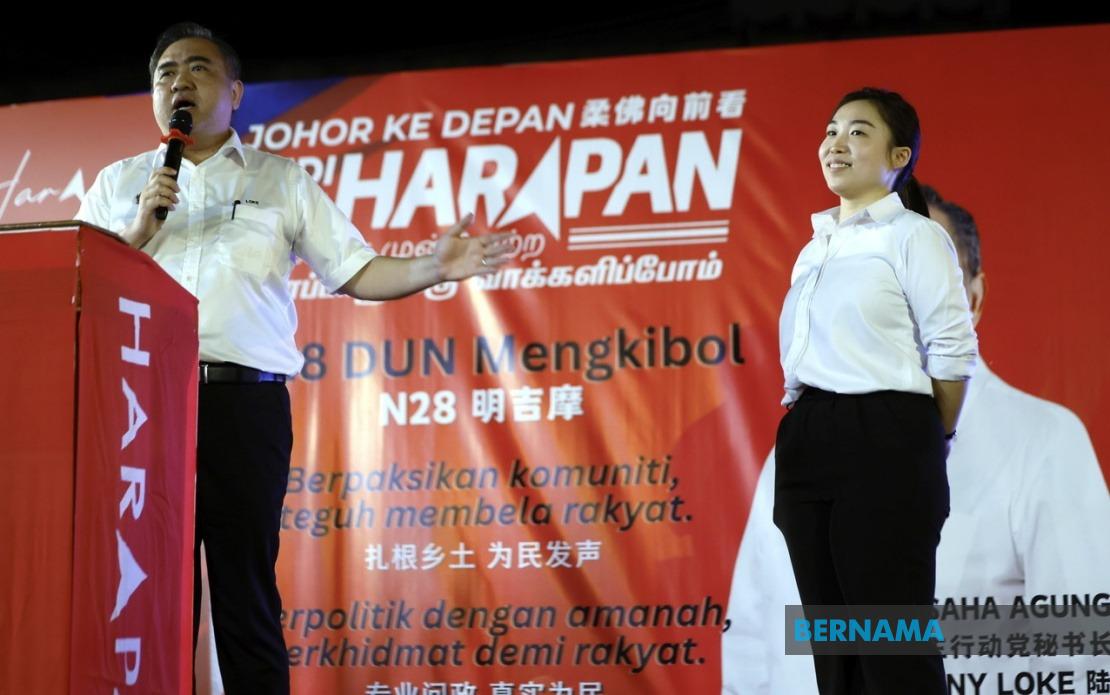
The Democratic Action Party has tapped 33-year-old legal practitioner Chu Poh Yee to contest the Mengkibol state seat in the upcoming Johor election, marking the party's first candidate announcement for the crucial state-level contest. The nomination signals DAP's strategic pivot toward youth and gender diversity in its electoral lineup, positioning the party to strengthen its appeal among younger and progressive voters in Johor, a state where it commands significant Chinese community support but faces persistent challenges in securing Bumiputera-majority constituencies.
Party secretary-general Anthony Loke unveiled the candidacy at a ceremony in Kluang, explaining that Chu's selection represents a deliberate generational shift in the party's political strategy. The move creates space for incumbent Mengkibol assemblyman Chew Chong Sin, who has represented the constituency across two legislative terms, to advance his political career to the federal level. This succession planning reflects DAP's broader approach to nurturing political talent and managing the aspirations of both established and emerging party members within its organisational hierarchy.
Chew's transition from the state assembly to a potential parliamentary seat embodies the common pathway through which Malaysian opposition parties develop their cadres. With Labis MP Pang Hok Liong signalling his intention to step away from electoral politics, the seat has opened for recalibration. Loke articulated the party's reasoning, framing Chew as a candidate possessing the necessary credentials and political maturity to contest at the parliamentary tier, where constituencies typically demand broader appeal and established political networks.
Chu brings substantial legal credentials to her candidacy, with particular expertise in legal aid work and her demonstrated commitment to supporting local representatives in resolving constituent grievances. Loke emphasised that the party's selection process prioritised candidates with proven community engagement, noting that Chu's legal background equips her to address the practical concerns of residents in an increasingly complex social environment. Her multilingual abilities—a significant asset in the ethnically diverse Johor context—position her to communicate effectively across the state's varied demographic groups.
The appointment reflects DAP's explicit commitment to elevating female participation in electoral politics, a priority that resonates with evolving expectations around gender representation in Malaysian political institutions. By positioning Chu as a credible alternative to male candidacy, DAP signals responsiveness to societal demands for inclusion and demonstrates that its selection criteria centre on competence rather than defaulting to traditional gender patterns. This positioning carries particular weight in constituencies like Mengkibol, where female voters constitute a substantial electoral force.
Chu's deep connections to the Mengkibol constituency address a longstanding challenge for opposition parties seeking to project authenticity in their candidate selection. Rather than parachuting an outsider into the seat, DAP has identified someone with existing community ties and familiarity with local conditions. This approach attempts to counter narratives that portray opposition parties as disconnected from grassroots realities and susceptible to central dictates on candidate deployment.
The broader scale of DAP's Johor electoral efforts encompasses seventeen state seats across the state, a substantial commitment representing both retained constituencies and ambitious attempts to recover previously lost ground. The candidate roster includes ten assemblies presently held by the party, four seats that party strategists believe are recoverable despite earlier electoral setbacks, and three additional constituencies where DAP senses opportunity. This configuration suggests the party believes it can expand its parliamentary footprint in Johor, though realistic assessment suggests DAP's strongest prospects remain concentrated in urban and Chinese-majority areas.
The staggered announcement of DAP's full candidate slate—with additional nominees for Tiram, Johor Jaya, Senai, and Bukit Permai forthcoming before a comprehensive presentation alongside broader Pakatan Harapan partners—reflects the coordination required among opposition coalition members. The involvement of the Prime Minister in the formal unveiling of the remaining candidates underscores the electoral significance Putrajaya attaches to Johor's political direction. As Malaysia's second-most populous state and a traditional kingmaker in national politics, Johor's electoral outcome carries implications extending well beyond state governance into federal stability and parliamentary dynamics.
The timing of these announcements, materialising months ahead of the actual election campaign period, allows DAP sufficient runway to build public recognition for candidates like Chu and undertake grassroots mobilisation. Early nomination provides candidates opportunity to establish independent political profiles rather than appearing merely as party functionaries. For Chu specifically, the extended campaign period permits her to translate legal expertise into tangible policy platforms addressing constituent concerns around housing affordability, commercial justice, and workplace rights.
DAP's strategic emphasis on fresh faces and particularly female candidates positions the party in contrast to rival political formations that maintain more conventional candidate demographics. In an electoral environment where younger citizens increasingly question establishment politics, the selection of candidates under forty with professional credentials outside traditional career trajectories—politics, business, military service—offers substantive differentiation. Chu's legal background and gender combine to project an image of competence and progressive values that DAP calculates will resonate with expanding middle-class voter segments in Johor's urban corridors.
The Mengkibol contest itself represents a meaningful test of DAP's electoral viability in state assembly constituencies where the party retains incumbency. Retaining seats constitutes the foundational challenge for any opposition formation, as losing previously held ground typically accelerates momentum favourable to ruling coalitions. Success with candidates like Chu—younger, female, professionally accomplished but community-embedded—could provide DAP a replicable model for candidate selection across other regions, potentially influencing organisational approach in upcoming electoral cycles across Malaysia.

