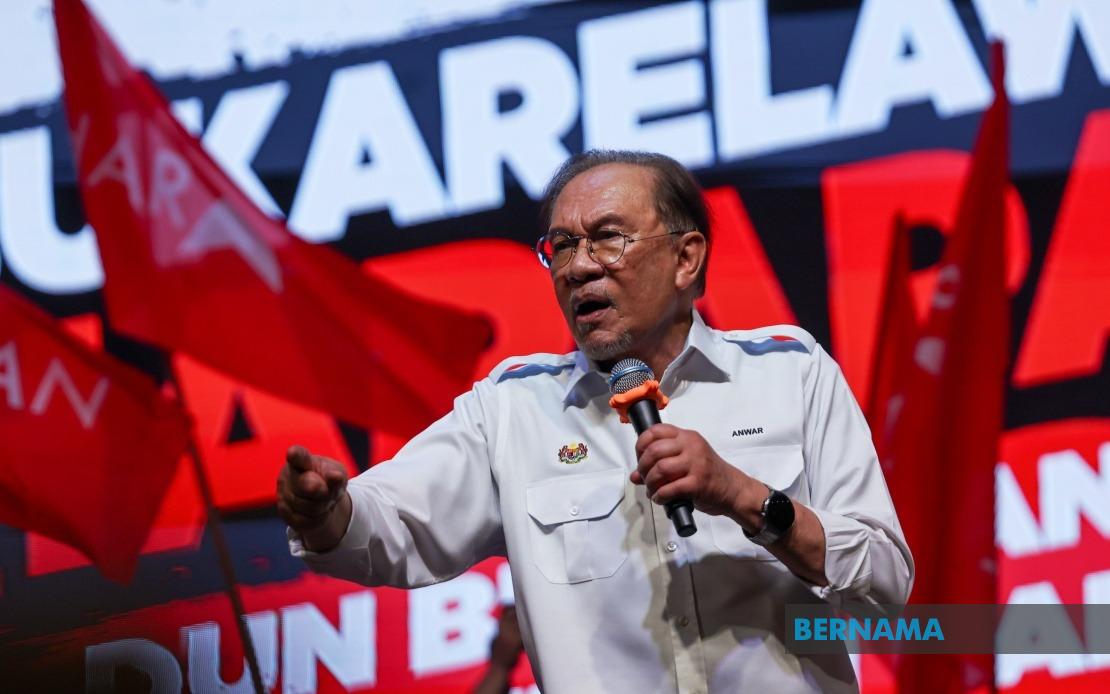
Prime Minister Datuk Seri Anwar Ibrahim moved to counter a persistent political narrative during a campaign stop in Muar, insisting that the Democratic Action Party has never challenged the constitutional position of Malays and rejecting portrayals of the party as driven by racial animosity. Speaking at a grassroots gathering, the Pakatan Harapan chairman used concrete examples to substantiate his assertion, emphasizing that the party's track record demonstrates its willingness to support policies benefiting the Malay-Muslim majority without resistance or obstruction.
Central to Anwar's defense was the DAP's acceptance of plans to designate 20.23 hectares of land in Bandar Malaysia as Malay Reserve Land, a decision that underscores the party's recognition of constitutional safeguards for indigenous communities. This tangible acknowledgment, he argued, should dispel skepticism fostered by political opponents seeking to weaponize racial anxieties for electoral gain. The Prime Minister portrayed this as evidence of good faith, suggesting that the absence of opposition to such measures proves the party's ideological commitment to respecting established legal protections rather than dismantling them.
Beyond defending his coalition partner, Anwar articulated a broader vision of governance rooted in equitable resource distribution and inclusive development. He positioned his leadership of the Unity Government as fundamentally different from narrowly sectarian approaches, emphasizing that fairness toward all communities represents both moral imperative and practical necessity for national advancement. This framing recast the political debate from abstract arguments about racial rights into concrete discussions about who benefits from economic growth and state resources.
The Prime Minister outlined programmatic commitments targeting various communities, noting that support for Bumiputera initiatives and increased allocations to Perbadanan Usahawan Nasional Berhad encounter no resistance from DAP. Simultaneously, he stressed that preventing targeted assistance to other communities—whether directed toward struggling Chinese or Indian Malaysians—would contradict principles of inclusive governance. This dual emphasis suggested that legitimate community interests need not be zero-sum propositions where advancing one group necessitates disadvantaging another.
Anwar's comments arrive amid broader concerns about Malaysia's economic trajectory and wealth distribution. He contended that the country's current economic expansion, while encouraging, requires deliberate mechanisms to ensure prosperity reaches ordinary citizens rather than accruing exclusively to political elites or connected interests. This critique implicitly challenged existing patterns where growth statistics mask stagnant living standards for middle and lower-income households across all demographic groups.
The Prime Minister articulated a development philosophy emphasizing tangible improvements in material conditions rather than abstract economic indicators. He prioritized comfortable housing, functional infrastructure, and quality education as measures of successful governance, suggesting these benchmarks should guide policy-making more than GDP growth rates alone. This approach resonated with long-standing grievances among Malaysian voters concerning the disconnect between headline economic figures and everyday financial pressures.
Crucially, Anwar framed political leadership as custodianship rather than opportunity for personal enrichment, distinguishing his approach from perceptions of earlier administrations where political power allegedly facilitated individual accumulation. This moral dimension elevated the debate beyond technical governance questions, appealing to voters' desire for leaders motivated by service rather than self-interest. His direct address to younger Malaysians reinforced this message, suggesting that power represents responsibility rather than entitlement.
The remarks came amid campaign activities for the sixteenth Johor state election, scheduled for July 11, with 172 candidates competing for 56 state assembly seats. Early voting was set for July 7, reflecting intensifying political competition in a crucial state for both the ruling coalition and opposition forces. Anwar's intervention in Johor campaigns underscored the strategic importance of state-level contests for the broader political balance in Malaysia, particularly given the state's substantial electoral weight.
Anwar's defensive positioning regarding DAP reflects lingering sensitivities about the party's role within Pakatan Harapan and broader concerns among Malay-Muslim voters about non-Bumiputera influence in government. Despite DAP's substantial parliamentary representation and ministerial positions, residual skepticism about the party's intentions persists in certain constituencies, occasionally amplified by opposition rhetoric. By proactively addressing these concerns, Anwar attempted to inoculate his coalition against erosion among traditionally supportive demographics.
The emphasis on equitable development across racial lines represents a governing philosophy distinct from zero-sum identity politics that has historically dominated Malaysian discourse. Rather than defending DAP through abstract appeals to non-racism or constitutional pluralism, Anwar grounded his argument in material evidence of policy acceptance and practical commitments to addressing poverty regardless of beneficiaries' ethnic background. This pragmatic framing sought to move political conversations from divisive identity terrain toward shared economic interests.
For Southeast Asian observers, Anwar's approach illuminates challenges facing diverse democracies attempting to balance constitutional protections for specific groups with inclusive governance frameworks. Malaysia's constitutional architecture, which enshrines Bumiputera privileges and Islamic provisions, creates ongoing tensions with democratic principles of equal citizenship. Anwar's navigation of these tensions through claims of good-faith implementation while preserving protective mechanisms suggests a middle path, though whether this satisfies all constituencies remains uncertain.
The broader implications for Malaysian politics involve questions about whether multiracial coalitions can sustain credible commitments to equitable governance while acknowledging constitutionally entrenched communal interests. Anwar's framing suggests yes, provided leadership articulates clear philosophical distinctions between respecting established rights and perpetuating exclusionary practices, and translates these principles into material policy outcomes benefiting disadvantaged populations across all communities. The Johor election results would indicate whether voters find this approach persuasive or whether underlying anxieties about community interests remain politically potent.

