The stage is set for a competitive four-way electoral contest in the Rahang constituency as Negeri Sembilan prepares for its 16th state election, with DAP treasurer Siaw Meow Keong seeking to retain his seat against a diverse field of challengers from the major coalitions. Siaw, who won the constituency in 2023 under the Pakatan Harapan banner, faces opponents representing Barisan Nasional, Parti Sosialis Malaysia, and Perikatan Nasional—a reflection of Malaysia's increasingly fragmented political landscape where single-dominant contests have become rare even in ostensibly safe constituencies.
Competing against Siaw is Yap Siok Moy, the Rasah MCA Wanita chief representing Barisan Nasional, whose nomination came fourth during the candidate filing process on Thursday morning. Also in the running are S. Thinagaran, the Parti Sosialis Malaysia candidate, and Tang Jay San from Perikatan Nasional's Bersatu faction, each bringing their own ground organisational strengths to what promises to be a closely watched battle in this Selangor-adjacent state. The nomination process was conducted swiftly, with all four candidates filing their papers within a seven-minute window between 9.06 am and 9.13 am, as overseen by returning officer Mohamad Najib Mustafa at the Seremban City Council Hall.
The Rahang contest exemplifies a broader pattern emerging across Negeri Sembilan's state election landscape, where multi-cornered fights have become the norm rather than the exception. Across the state's constituencies, the results of Thursday's nomination deadline reveal an electoral environment marked by genuine three and four-way contests, suggesting that no coalition can take voter loyalty for granted even in areas where they hold current representation. This fragmentation of support—with Pakatan Harapan, Barisan Nasional, Perikatan Nasional, and smaller parties all fielding competitive candidates—reflects underlying shifts in voter sentiment and the continued vitality of electoral competition in Malaysia's component states.
In the neighbouring Bukit Kepayang constituency, DAP Wanita chief Nicole Tan Lee Koon faces a more straightforward electoral challenge, defending her seat in a direct confrontation with Lee Boon Shian of Perikatan Nasional. This straight fight presents contrasting dynamics from Rahang, with just two candidates competing for voter support, which typically favours incumbent candidates with established ground machinery and constituency awareness. Tan's positioning as the incumbent DAP representative in a bipolar contest may translate into structural advantages, though the prominence of Perikatan Nasional as her sole challenger indicates that this opposition bloc has strategically focused resources on certain battleground constituencies.
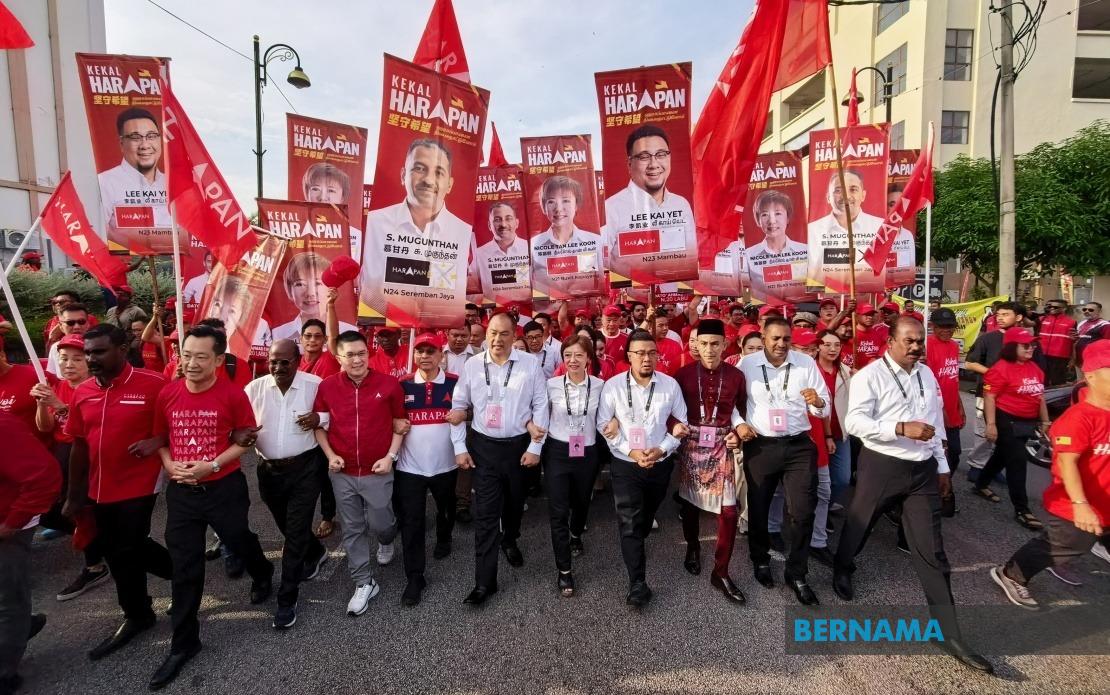
The state election also encompasses three-cornered contests that will test the capacity of all three major political blocs to expand their respective support bases. In Labu, Pakatan Harapan's Datuk Ahmad Faez Abdul Razak confronts both Mohamad Hanifah Abu Baker of Bersatu and Siti Nur Umaira Hasim representing Barisan Nasional, creating a genuinely open race where vote-splitting among constituencies with diverse demographic profiles could prove decisive. Similarly, the Mambau contest pits PH's Lee Kai Yet against Bersatu's N. Sarawanan and Perikatan Nasional's Eric Michael, illustrating the manner in which the political landscape has diversified beyond the traditional two-coalition framework that dominated Malaysian elections through much of the previous decade.
Seremban Jaya presents a particularly intricate three-way contest where Pakatan Harapan fielded S. Mugunthan, who squares off against Datuk T. R. Thinalan of Barisan Nasional and R. Mahendran from Bersatu. This configuration of candidates reflects the demographic complexity of urban-suburban constituencies where Indian Malaysian voters comprise a substantial portion of the electorate, and where multiple parties compete earnestly for support across class and ideological divides rather than accepting predetermined outcomes. The presence of Bersatu candidates across multiple constituencies underscores that faction's determination to establish itself as an independent political force rather than simply serving as a satellite party to larger coalitions.
The electoral schedule released by the Election Commission provides a structured timeline for the state election process, with early voting set for July 28 and the main polling day scheduled for August 1. This calendar permits all candidates approximately two weeks for intensive campaigning and ground engagement, a period that in the contemporary Malaysian context encompasses substantial digital and grassroots outreach. The compression of the nomination-to-election timeline, while familiar to Malaysian voters accustomed to rapid electoral cycles, nonetheless presents logistical challenges for party machinery across the state, particularly for smaller parties operating with limited financial and human resources.
The Rahang seat itself carries particular significance within Negeri Sembilan's political economy, serving as an urban-leaning constituency where DAP has established credible representation but where traditional BN support networks remain structurally intact. Siaw's tenure since 2023 has been relatively brief, providing limited opportunity to accumulate the incumbency advantages that longer-serving elected representatives typically enjoy. His challenge is further complicated by the presence of not just Barisan Nasional but also Perikatan Nasional and Parti Sosialis Malaysia, which collectively fragment the anti-DAP vote, but simultaneously indicate that the constituency is contested rather than predetermined terrain.
From a Malaysian political perspective, the four-cornered Rahang contest and related multi-way races across Negeri Sembilan reflect the maturation of electoral competition beyond the historic PH-BN duopoly that shaped the 2022-2023 period. The emergence of Perikatan Nasional as a consistent third force, combined with the persistence of smaller parties, suggests a more fractious political environment where coalition arithmetic becomes more complex and where state-level politics increasingly diverges from federal patterns. For Southeast Asian observers monitoring Malaysian political trajectory, these Negeri Sembilan contests provide a revealing snapshot of internal dynamics within a federation where sub-state elections often function as crucial testing grounds for national political movements.
The Election Commission's administration of the nomination process on Thursday demonstrated the institutional capacity required to manage increasingly complex electoral contests. The orderly filing of nominations across multiple constituencies, despite the compressed timeframe and multi-candidate scenarios, reflects an election administration apparatus capable of handling sophisticated electoral mechanics. However, the proliferation of multi-cornered contests also raises questions about vote efficiency and whether the Malaysian electorate's distribution across multiple competing parties might produce outcomes where winning candidates command relatively modest vote percentages, potentially complicating questions of electoral legitimacy and voter preference clarification.
For Negeri Sembilan voters, the August 1 election presents substantive choices across multiple issues including development priorities, constituent services provision, and positioning relative to federal politics. The Rahang contest in particular offers urban and semi-urban voters three alternative political visions beyond the incumbent DAP candidate, though the quality and substance of these alternatives remain to be evaluated through campaign discourse. As the state election approaches, the intensity of campaigning in constituencies like Rahang will likely intensify, with all parties mobilising their resources to convert this diverse and contested terrain into electoral victory.

