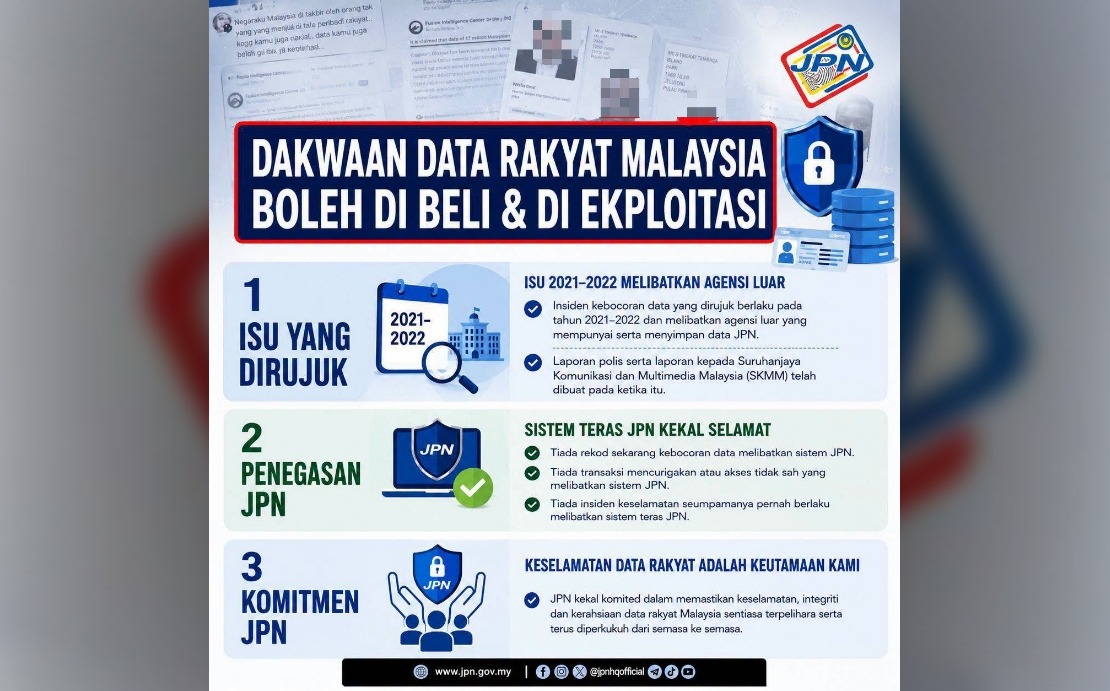
The National Security Council (MKN) moved swiftly to address public concerns about a data leak circulating on social media, issuing a clarification on June 21 that the compromised information stems from cybersecurity incidents occurring prior to 2022 and bears no connection to any active digital platforms currently in operation. Through the National Cyber Security Agency (NACSA), the council disclosed that unauthorised actors had obtained personal information via cyber intrusions targeting various computer systems in the past and are now republishing this stolen data across online channels without proper authorisation.
The disclosure raises important questions about data persistence in the digital age and the ongoing risks posed by historical security breaches. Information harvested through criminal cyber activities years earlier can resurface and be weaponised long after the initial incident, creating a persistent threat environment where victims remain exposed to potential misuse even decades later. This phenomenon is particularly concerning in Malaysia's rapidly digitalising economy, where personal data represents valuable currency for fraudsters and identity thieves operating across borders.
NACSA emphasised that any action facilitating the distribution, provision, or access to unlawfully procured data constitutes a criminal offence under Malaysian law, a principle that applies regardless of whether the hosting servers are located within national boundaries or abroad. This statement underscores the government's determination to prosecute those involved in the supply chain of stolen data, not merely the original hackers but also intermediaries who profit from redistribution. The legal framework aims to disrupt the entire ecosystem enabling data crimes rather than targeting only the initial perpetrators.
Responding to the breach with coordinated enforcement measures, NACSA has mobilised resources alongside MyNIC and the Personal Data Protection Department to engage international service providers in removing access points and blocking websites hosting the compromised information. This multi-agency approach reflects the transnational nature of contemporary cybercrime, where Malaysian authorities must collaborate with foreign technology companies to effectively contain threats. The removal efforts, however, highlight a persistent challenge: once data is leaked online and distributed across multiple platforms, complete eradication becomes nearly impossible.
Parallel to containment efforts, NACSA is partnering with the Royal Malaysia Police to conduct detailed digital forensic investigations aimed at identifying and prosecuting individuals responsible for the leak's circulation. These investigations leverage advanced technological analysis to trace digital fingerprints, identify perpetrators, and build evidential foundations suitable for criminal prosecution. The partnership represents Malaysia's integrated approach to cybersecurity, combining preventive agency oversight with law enforcement capabilities.
The council issued a public advisory cautioning Malaysians against patronising services that grant access to illegally obtained data, framing such participation not as a victimless transaction but as active contribution to cybercrime proliferation. By purchasing or using stolen data, individuals directly fund criminal enterprises and create economic incentives for future breaches. This consumer-focused messaging attempts to address demand-side factors in the data trafficking economy, recognising that supply exists primarily because markets exist.
MKN seized the opportunity to highlight pending legislative reforms that will substantially strengthen Malaysia's cyber defence architecture. The forthcoming Cyber Crime Bill, scheduled for parliamentary presentation, introduces more rigorous offence definitions and elevated penalties for diverse cybercriminal activities, encompassing system intrusions and wholesale data theft. The proposed legislation will specifically criminalise unauthorised computer system access or damage undertaken without lawful authorisation or legitimate justification, and will formally designate identity theft—the unlawful deployment of another person's identity to facilitate criminal acts—as a distinct statutory offence.
Complementing legislative reforms, the Cyber Security Act 2024, which commenced operation in August 2024, establishes mandatory protective obligations for operators of National Critical Information Infrastructure (NCII). These requirements mandate implementation of comprehensive safeguarding protocols, including adherence to established codes of practice, systematic risk evaluations, and recurring security audits designed to elevate national cyber resilience. This regulatory framework acknowledges that critical infrastructure operators bear special responsibility for data protection given the potential systemic consequences of compromise.
Addressing specific public concern, MKN clarified that MyDigital ID—which has achieved over 16 million active registrations—functions fundamentally as an identity authentication mechanism rather than a personal data repository. The system validates users through direct communication with the National Registration Department, establishing user authenticity rather than storing sensitive information. This architectural distinction proves crucial for public understanding: MyDigital ID's security properties differ substantially from traditional centralised databases, as the platform itself does not accumulate or maintain the confidential data it verifies.
The extensive deployment of MyDigital ID across governmental and commercial sectors—spanning telecommunications, banking, and numerous digital services—promises enhanced transaction security and strengthened defences against identity fraud. Widespread adoption creates network effects favouring legitimate users while simultaneously raising barriers for fraudsters attempting to circumvent identity verification systems. As financial institutions and telecommunications companies increasingly integrate MyDigital ID authentication, the cumulative security benefits multiply across Malaysia's digital economy.
The government reaffirmed its strategic commitment to ensuring that digital transformation benefits reach all Malaysians while maintaining robust cybersecurity protections. MKN and NACSA emphasised their preparedness to confront emerging cyber threats, signalling active rather than reactive engagement with the threat landscape. This posture reflects recognition that cybersecurity constitutes not a peripheral administrative concern but rather a foundational requirement for successful digital economy development and public trust in digital services.
For Malaysian citizens and businesses navigating an increasingly complex digital environment, the clarification provides reassurance that current platforms and systems have not been compromised by the leaked data. However, the incident reinforces the importance of practising digital hygiene—maintaining strong authentication credentials, monitoring financial accounts for suspicious activity, and remaining vigilant against phishing attempts that may exploit knowledge of historical data breaches. The government's coordinated response, combining law enforcement, international cooperation, and legislative reform, demonstrates institutional commitment to protecting Malaysia's digital ecosystem, though security experts note that prevention ultimately requires cooperation between government agencies, private technology companies, and individual users.

