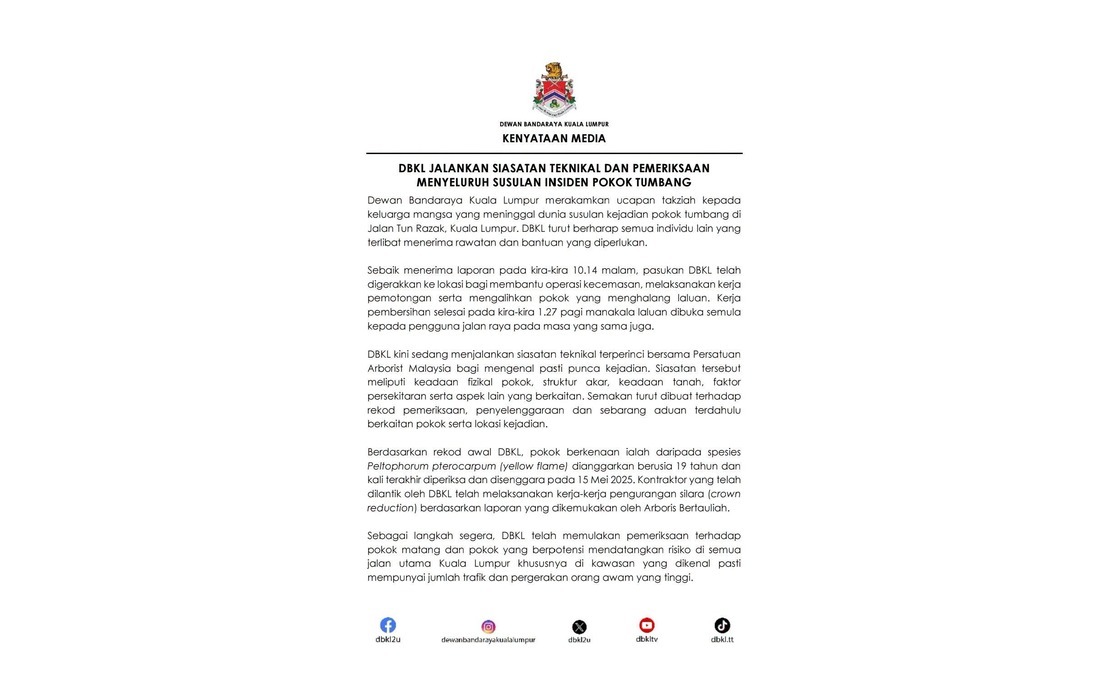
A detailed forensic investigation has been launched into the collapse of a mature tree on Jalan Tun Razak that resulted in a fatality, with Kuala Lumpur City Hall (DBKL) working in conjunction with tree specialists to establish precisely what caused the incident. The multi-faceted inquiry will examine the fallen Peltophorum pterocarpum, commonly known as a Yellow Flame tree, from multiple angles including its physical integrity, root system architecture, soil composition, and broader environmental influences that may have contributed to its structural failure.
The investigation team will also scrutinise maintenance records, inspection documentation, and any historical complaints lodged about the tree and the surrounding area. DBKL issued a statement expressing deep sympathies to the bereaved family and pledging comprehensive support to all those affected by the tragedy. The local authority has committed to full transparency with police and other relevant government bodies throughout the investigation process, underscoring the seriousness with which it treats the incident.
Emergency responders reacted swiftly to the incident, which was first reported at 10.14 pm the previous evening. Specialised teams arrived on scene and immediately set about removing the fallen timber and clearing debris that had obstructed traffic. Through coordinated effort, the road was successfully reopened within roughly three hours, by 1.27 am, allowing normal vehicular movement to resume along this major arterial route.
Records maintained by DBKL indicate that the fallen tree was approximately 19 years old at the time of collapse. Most significantly, the tree had undergone professional inspection and maintenance work as recently as May 15 of the same year, suggesting that deterioration occurred relatively rapidly or that underlying conditions were not detected during routine assessment. In addition, a contracted arborist had previously overseen crown reduction operations on the tree based on specialist recommendations, meaning the tree had received contemporary care interventions.
This raises questions about the adequacy of current inspection protocols and whether existing maintenance schedules are sufficiently frequent to catch developing problems in mature urban trees. The relatively short interval between the last documented maintenance and the fatal collapse indicates that current preventive measures may require strengthening or modification to capture sudden structural changes that can occur in trees subjected to urban stressors.
In immediate response to the tragedy, DBKL has activated an accelerated inspection programme targeting mature trees and those assessed as presenting elevated risk throughout Kuala Lumpur's major thoroughfares. Priority has been assigned to areas experiencing high volumes of vehicular and pedestrian traffic where a fallen tree could cause maximum harm. Initial assessment sweeps are being conducted on Jalan Ampang, Jalan Sultan Ismail, Jalan Raja Laut, Jalan Datuk Keramat, and sections of Jalan Tun Razak itself, with completion anticipated within ten weeks using eight dedicated teams, five of whom are certified arborists.
Beyond this immediate response, DBKL is pursuing a medium-term technological solution that could represent a significant advancement in urban tree management across Malaysia. The authority is awaiting approval from SIRIM, the Standards and Industrial Research Institute of Malaysia, to deploy approximately 400 sophisticated tree sensors across high-risk locations throughout the city. These instruments would represent a paradigm shift from periodic manual inspection to continuous real-time monitoring of tree health and structural stability.
The proposed sensors are engineered to continuously track multiple parameters that directly influence tree stability and health. These include ongoing measurement of soil conditions, moisture content at the root zone, structural movement that might indicate developing weakness, and the specific impacts of adverse weather events such as heavy downpours and flooding conditions. By providing early warning of deteriorating conditions, these sensors could theoretically identify problems long before they reach critical failure points, allowing preventive action before public safety is jeopardised.
The first phase of this sensor deployment is targeted at four strategically significant locations: Jalan Bangsar, Dataran Merdeka, Jalan Ampang, and Jalan Raja Chulan. These areas have been selected based on their importance as high-traffic zones and their existing concentration of mature tree specimens. Successful implementation at these locations would provide valuable data and operational experience that could inform broader rollout across the city's tree estate.
For Malaysian and regional urban planners, this incident underscores a critical challenge facing rapidly developing tropical cities. As urban landscapes mature and trees that were planted decades ago reach advanced ages, authorities must balance heritage preservation and environmental benefits against escalating safety risks. Urban trees in Malaysia face particular stressors including intense monsoon rainfall, waterlogging, soil compaction from development, and exposure to construction-related damage during their maturation period. Traditional inspection methods, reliant on periodic visual assessment by human specialists, increasingly appear insufficient to manage these risks reliably.
The deployment of sensor technology represents a logical adaptation of urban forestry management to modern technological capabilities. However, successful implementation will require sustained funding, technical expertise for data interpretation, and rapid response protocols to act on sensor alerts. The Malaysian approach, if successfully rolled out, could serve as a model for other Southeast Asian cities wrestling with similar challenges in managing ageing urban forest assets within densely populated areas.
The incident also highlights ongoing questions about liability and accountability in urban tree management. Understanding precisely why the Jalan Tun Razak tree failed despite recent maintenance remains crucial not only for compensating the victim's family but for systematically improving prevention protocols citywide. The thoroughness of DBKL's investigation, in collaboration with arborist specialists, will substantially influence public confidence in the safety of urban public spaces and the adequacy of municipal tree management standards throughout the region.

