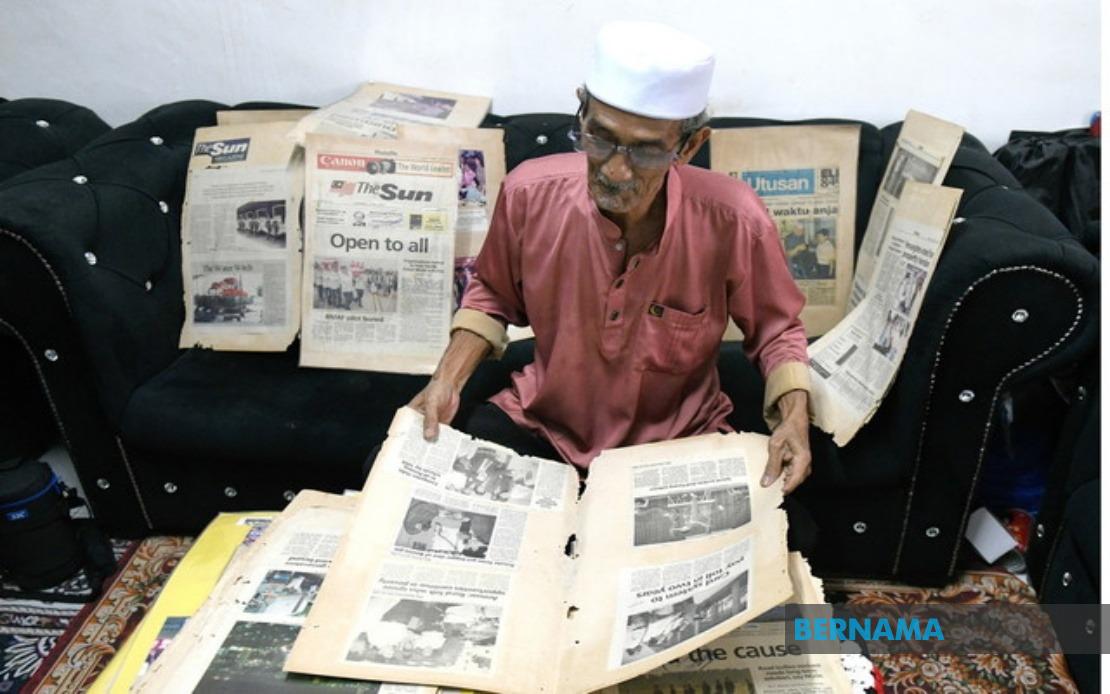
Azmi Sapiei's career in visual journalism spans more than three decades, a journey marked by defining moments both triumphant and perilous. The 64-year-old veteran photographer and cameraman has witnessed the transformation of Malaysian media from the analogue era to the digital age, yet remains most animated when recalling the physical toll that comes with pursuing breaking news. Being assaulted—kicked and spat upon by a suspect—while covering a court case around 2001 left an indelible mark on his professional memory, a reminder that capturing the nation's stories sometimes demands more than technical skill and timing.
Azmi's trajectory into journalism was unconventional. After working in factory production, he relocated to Kuala Lumpur to chase his passion for photography, working independently with various agencies and women's magazines before his formal entry into news media. In 1993, he joined Bernama, Malaysia's national news agency, where he would spend nearly three years honing his craft. This foundational period proved transformative, not merely in technical training but in developing the instincts necessary to be in the right place at the right moment with the right equipment. When he eventually moved to The Sun newspaper after departing Bernama at the end of 1996, he carried with him the discipline and editorial sensibility that the national news agency demanded of its visual storytellers.
One of Azmi's most significant professional achievements came in July 1994, when he secured exclusive photographs of Shamsiah Fakeh's return from China. Shamsiah, a former member of the Malayan Communist Party, was arriving at her nephew's residence in Gombak, and the story commanded considerable national attention. Azmi and a single journalist managed to gain access to the scene before authorities cordoned off the area—a coup that depended on arriving early and positioning themselves strategically. This assignment exemplified the kind of competitive advantage that separated veteran photojournalists from their peers, requiring not only technical proficiency but also news sense, tenacity, and the ability to anticipate where a story would unfold.
The incident also illuminates the rigours of the film era that defined the first half of his career. Using analogue cameras meant shooting conservatively, as each roll of film represented a tangible cost and the uncertainty of what would emerge during development. After returning to the office following the Shamsiah assignment, Azmi's editor questioned why he had used only three rolls of film, expressing evident displeasure. The criticism stung, compounded by the fact that the editor discarded the rolls into a bin, seeming to suggest the coverage was inadequate. Yet the professional humbling proved instructive: when the negatives were processed, every major newspaper in Malaysia ran his photographs the following day. The lesson embedded itself into Azmi's approach—that experience and institutional knowledge, tempered through rigorous editorial feedback, ultimately separates publishable work from the rest.
Azmi's assessment of Bernama as a training ground for serious photojournalists carries weight when examined against the broader trajectory of Malaysian media. The national news agency functioned as a school that prioritised not only technical excellence but editorial discipline, instilling in its practitioners the importance of accuracy, news value, and visual storytelling. These principles, learned in the 1990s, would anchor his work through subsequent roles at Bernama TV and The Sun before his transition to radio and television in the Penang market. The institutional knowledge he accumulated—understanding what editors need, what readers respond to, and how to work within the constraints of deadline journalism—became increasingly valuable as the industry evolved.
The physical demands of the profession became even more pronounced once Azmi transitioned into television work. When he joined Bernama TV as a cameraman, he encountered the Betacam format, a standard in broadcast journalism during that period. The equipment, which staff colloquially termed "junk iron," weighed approximately 12 kilogrammes and had to be held and balanced on the shoulder for extended periods during coverage. This contrasted sharply with still photography, where a photographer might position themselves statically for critical moments. Television cameramen required sustained physical endurance, the ability to track moving subjects while maintaining focus and framing, and the flexibility to adapt to changing circumstances in real time. The technical knowledge remained important, but the bodily stamina required to execute assignments often separated committed practitioners from those who drifted toward less demanding roles.
When Azmi transitioned to RTM Penang as a part-time cameraman in 2003, he was entering a regional broadcasting environment with its own editorial priorities and audience expectations. The role kept him engaged with breaking news and special coverage until his retirement in mid-2020, granting him perspective spanning the full arc of Malaysia's evolution from a film-based to a digital media landscape. The transition itself, while technically less demanding on equipment weight, introduced new pressures: the expectation of immediate turnaround, the need to work seamlessly with digital editing systems, and the constant connectivity that meant stories never truly closed. His retirement came at a moment when the pandemic was reshaping how news organisations operated and distributed content, a fitting endpoint for someone who had already navigated multiple technological upheavals.
Recognition for his contributions came in the form of the 2006 Penang State Media Award in the visual electronic media category, an honour that acknowledged his standing within the regional broadcasting community. Yet perhaps more meaningful to Azmi is the continuation of his legacy through his second son, Muhammad Syafiq, now 30 and working with Media Prima Television Network. Syafiq's path into broadcasting followed a natural trajectory shaped by exposure to his father's work. From childhood observations of equipment brought home from assignments, to shadowing his father at coverage locations after completing his secondary education in 2016, to operating cameras himself a year later, the younger Azmi absorbed not only technical skill but the professional discipline that characterises serious broadcast journalism.
Muhammad Syafiq credits his father as mentor and instructor, emphasising that the knowledge transfer extended beyond mechanics to encompass the aesthetic and ethical dimensions of the work—how to select visual angles that convey narrative meaning, how to maintain professional standards under pressure, and how discipline in the field separates competent work from excellence. This intergenerational transmission of craft knowledge is increasingly rare in an era of rapid technological change and career fragmentation. For Malaysian media, the Azmi family represents a thread of institutional knowledge and professional commitment that bridges the analogue and digital eras, anchoring contemporary journalism in the practices and values that made Malaysian news coverage credible during its formative decades.
The broader significance of Azmi's career extends beyond his personal accomplishments. He represents a cohort of Malaysian journalists who built the country's media infrastructure during a period of significant national development and political importance. His access to the Shamsiah Fakeh story, his documentation of court proceedings, his coverage of events across Penang and national assignments, collectively constitute a visual archive of Malaysian public life spanning three decades. Yet his reflections also underscore the less visible dimensions of journalism—the physical risks, the moments of criticism and rejection, the technical frustrations, and the stamina required to show up consistently and capture the moments that matter. For younger practitioners entering the field, Azmi's trajectory offers a model not of glamour but of endurance, continuous learning, and commitment to the principle that news photography and videography serve the broader public interest.

