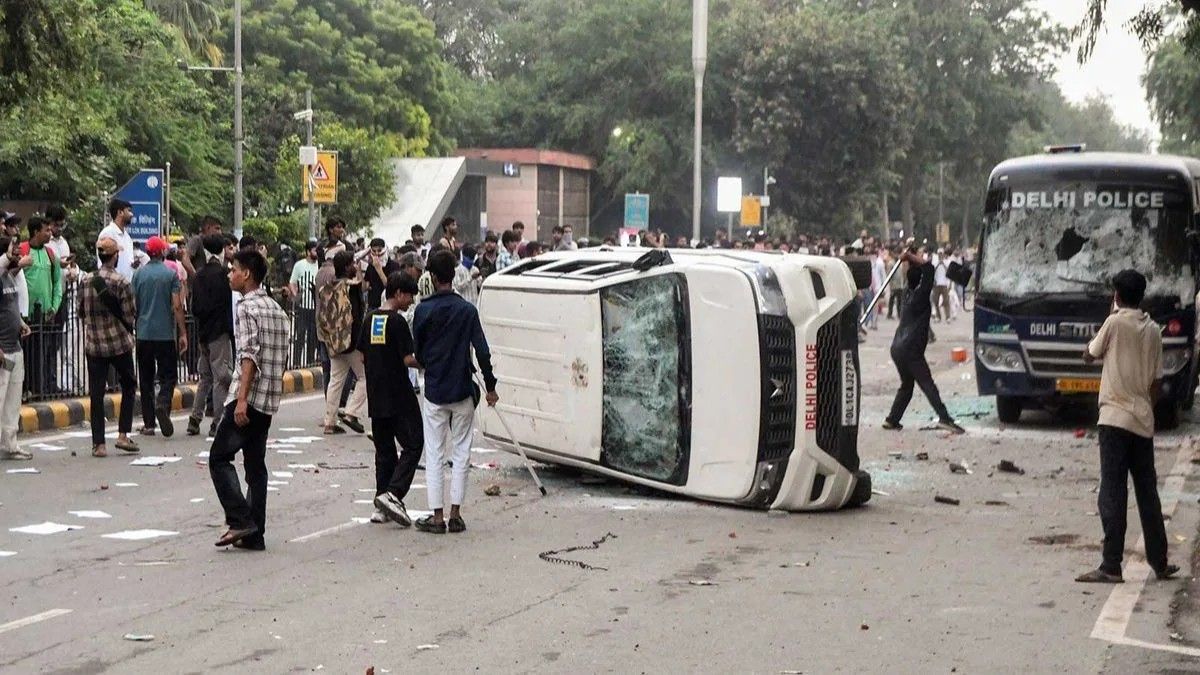
Delhi Police have initiated criminal proceedings against protesters involved in violent incidents during a march organised by the Cockroach Janta Party, with authorities filing 10 First Information Reports across multiple police stations in the New Delhi district. The cases stem from a demonstration that escalated into clashes as the party attempted to march towards Parliament on Monday, demanding the resignation of Union Education Minister Dharmendra Pradhan over allegations of examination irregularities. The filing of multiple FIRs signals that authorities view the incidents as serious enough to warrant parallel investigations, suggesting police are treating various aspects of the protests as distinct offences requiring separate legal proceedings.
Amid mounting social media claims of ongoing violence and police action, Delhi Police moved quickly to issue a public clarification denying that fresh incidents occurred on Tuesday. The Deputy Commissioner of Police for New Delhi posted on the social media platform X, explicitly labelling circulating videos as "false and misleading" and warning citizens against sharing unverified content. This intervention reflects growing concerns within law enforcement about misinformation spreading during political protests, a phenomenon that has become increasingly common across India's major cities during large demonstrations. The police's emphasis on directing the public to "official sources" highlights the tension between citizen journalism enabled by social media and official narratives during politically charged moments.
The geographic distribution of the FIRs provides insight into where violence was most concentrated. Four cases were filed at Parliament Street police station, suggesting significant incidents occurred in close proximity to the seat of government, while three additional cases emerged from the Connaught Place area, a major commercial and protest hub in central Delhi. Individual FIRs were also registered at Mandir Marg, Barakhamba Road, and Kartavya Path police stations, indicating that disturbances were scattered across a wider perimeter rather than confined to a single location. This dispersed pattern suggests either that protesters and police engaged across multiple flashpoints or that authorities are investigating different types of misconduct at separate venues.
The specific charges being pursued reveal the scope of police investigations. One FIR concerns an alleged life-threatening attack on a Rapid Action Force personnel, highlighting tensions between security personnel and demonstrators. Another case addresses the alleged unauthorised flying of a drone over the New Delhi district during the parliamentary session, a charge that suggests authorities view the protest as potentially involving surveillance or documentation efforts. Additional charges invoke sections related to conspiracy, obstruction of government operations, assault on police, and damage to public property, offences that collectively paint a picture of what authorities characterise as a coordinated and destructive demonstration. The invocation of the Bharatiya Nyaya Sanhita, the Arms Act, and the Prevention of Damage to Public Property Act indicates the legal framework through which authorities are pursuing accountability.
Despite the filing of cases, police have acknowledged the investigative challenges posed by the volume of potential evidence. Officers are examining more than 250 videos to identify individuals involved and determine whether the violence constituted a pre-planned operation or arose spontaneously from confrontational crowd dynamics. This forensic approach to protest violence is becoming standard practice in major Indian cities, where authorities routinely deploy video analysis to build cases against protesters. For Malaysian observers, this trend underscores how digital surveillance and social media documentation are reshaping law enforcement strategies during political demonstrations across the region.
The Cockroach Janta Party has maintained its presence at Jantar Mantar, continuing sit-in demonstrations even as security personnel removed tents and protest infrastructure. Party spokesperson Ashutosh Ranka declared that the agitation would persist until the government met the core demand for Dharmendra Pradhan's resignation, signalling that the party views Monday's violence as a setback rather than a deterrent. Ranka further alleged that multiple demonstrators, including students and volunteers, sustained injuries during the clashes, and claimed that female protesters, notably Geetanjali J. Angmo, the spouse of activist Sonam Wangchuk, were subjected to mistreatment by security forces. These counter-allegations add complexity to the narrative, as they present the protests through a lens of government repression rather than civic misconduct.
The heavy deployment of Delhi Police and Rapid Action Force personnel at Jantar Mantar indicates that authorities remain alert to the possibility of renewed confrontation. The visible security presence serves a dual purpose: physically preventing further clashes and signalling to potential participants the costs of renewed violence. In the context of Indian political protests, such security deployments often function as a form of deterrence, potentially suppressing further mobilisation among protesters who have already witnessed police action. For the Cockroach Janta Party, the continued presence of security forces represents both a challenge and an opportunity to frame itself as standing firm against government intimidation.
The examination of examination irregularities that prompted the original protest touches on a sensitive issue in Indian education policy. Allegations of irregularities in competitive examinations have sparked public anger across multiple states, as students view such incidents as emblematic of systemic failures in governance and meritocratic fairness. The decision by the Cockroach Janta Party to target the Union Education Minister suggests that the party recognises this issue resonates with a substantial constituency of young voters and their families. For policymakers across South Asia, including in Malaysia where education governance remains politically significant, the Indian experience illustrates how examination-related controversies can mobilise large-scale protests.
Delhi Police's release of footage purporting to show stone-pelting in the Connaught Place area constitutes part of a broader effort to establish an official record of the violence. By releasing videos contemporaneously with the incidents, police aim to establish evidentiary foundation for prosecutions while simultaneously shaping public perception of protester behaviour. The appeal to protesters to maintain peace and cooperate with authorities represents a standard communication strategy employed by law enforcement, though its effectiveness in de-escalating politically charged situations remains contested among scholars of protest dynamics. The tension between these appeals and the filing of criminal cases suggests that police are pursuing simultaneous strategies of deterrence and negotiation.
The misinformation challenge highlighted by Delhi Police's social media clarification reflects a broader problem afflicting major protests across democratic societies. False narratives spread rapidly during moments of civic unrest, often amplifying existing polarisation and making de-escalation more difficult. For journalists and media organisations in Southeast Asia, the Delhi case provides instructive lessons about the importance of verification protocols during major protests. The circulation of unverified videos claiming fresh violence, even when denied by authorities, demonstrates how digital platforms can distribute contested narratives faster than official rebuttals can be disseminated.
From the perspective of regional observers, the Delhi protest episode illustrates enduring tensions within Indian democracy regarding the boundaries of acceptable protest and the appropriate police response to civil disobedience. While India's constitutional framework protects rights to petition and assemble, security considerations and concerns about public order frequently generate confrontations between demonstrators and law enforcement. The filing of multiple FIRs and the continuation of the protest suggest that both sides view this conflict as significant enough to justify continued investment of resources and political capital. The outcome of the criminal investigations and the government's response to the substantive demands regarding examination irregularities will likely shape future protest strategies among activist organisations across the country.
As investigations proceed, the Cockroach Janta Party faces a strategic choice between escalation and negotiation. The sustained security deployment and criminal charges signal that continued confrontation will carry significant personal costs for participants. Simultaneously, the party's ability to maintain a presence at Jantar Mantar suggests that it retains sufficient mobilising capacity to sustain pressure on the government. The intersection of these factors—legal consequences, physical deterrence, and ongoing civic mobilisation—will determine whether this episode concludes through negotiated settlement or continues as a protracted standoff.

