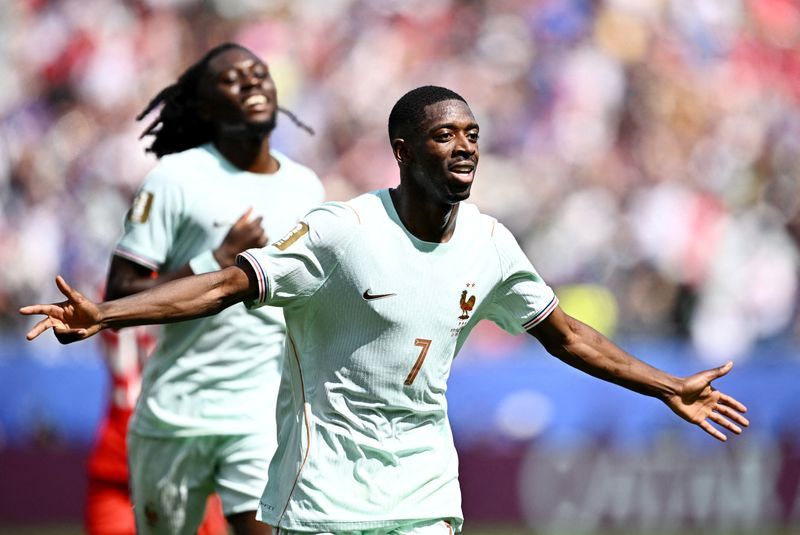
Ousmane Dembele's lethal finishing propelled France to a 4-1 demolition of Norway in Foxborough, Massachusetts on Friday, securing the two-time World Cup finalists' progression from Group I as table leaders. The Paris Saint-Germain winger's extraordinary clinical display—three goals in 25 minutes during an opening-period onslaught—underscored France's formidable firepower heading into the knockout stages while simultaneously exposing the strategic gamble undertaken by the Scandinavian opposition.
France's dominance reflected not merely superior talent but also contrasting team selections on the evening. Coach Didier Deschamps had opted to field his strongest XI in tribute to his late mother, whose funeral had drawn him back to France whilst the squad remained in North America. This emotional motivation, coupled with the tactical advantages of finishing top of the group, drove the defending runners-up to attack relentlessly from the opening whistle. The approach yielded immediate dividends: within 20 seconds, Kylian Mbappe crashed a shot against the crossbar, signalling France's intent to dominate proceedings.
Dembele's first arrival came courtesy of Mbappe's precision cross-field vision in the sixth minute. The winger's movement proved exemplary—cutting infield before shifting back to the outside of his marker—before placing a delicate angled finish beyond Norwegian goalkeeper Egil Selvik. Fourteen minutes later, Mbappe orchestrated the second goal through another searching pass, with Dembele's composure evident as he created yard space to dispatch a dipping shot into the net. These consecutive strikes within the opening quarter-hour reflected France's unwillingness to show mercy despite their qualification to the knockout rounds already being assured.
Norway's technical response arrived swiftly through Thelo Aasgaard's opportunistic finishing, yet the respite proved momentary. By the 32nd minute, Dembele had completed his hat-trick—curling a low drive into the bottom corner with the precision that had characterised his performance. This achievement elevated him to exclusive company within French World Cup history, joining legendary striker Just Fontaine and the tournament's emerging superstar Mbappe as the only Frenchmen to achieve the feat. More remarkably, Dembele's three-goal contribution in 25 minutes represented the second-fastest hat-trick in World Cup history, trailing only Erich Probst's Austrian effort against Czechoslovakia in 1954 by a single minute.
Stale Solbakken's decision to rest the majority of Norway's starting eleven proved consequential throughout. The Norwegian coach had preserved his squad by benching all but one player from the preceding match against Senegal, notably excluding Erling Haaland—the competition's leading marksman threat—and captain Martin Odegaard. This conservative approach, whilst understandable given Norway's assured qualification, left a second-string side substantially vulnerable against France's attacking intensity. The tactical calculus, perhaps reasonable in isolation, backfired spectacularly as Dembele's finishing exploited the reduced quality of defensive marking.
Despite the lopsided scoreline, Norway demonstrated occasional flashes of offensive capability that suggested their group stage exit would not signal complete mediocrity. Jorgen Strand Larsen squandered a promising penalty opportunity in the second half when goalkeeper Mike Maignan produced a decisive save, whilst Oscar Bobb's direct running forced Maignan into further defensive action. These moments illustrated that beneath France's overwhelming performance lay legitimate weaknesses in their rearguard organisation—vulnerabilities that more clinical opponents might exploit during knockout football.
Desire Doue's late header from Bradley Barcola's cross completed the scoring, serving as a coda to France's clinical execution. The substitute's contribution underscored the depth of Deschamps' squad, with even second-tier attacking players capable of converting clear-cut opportunities. This breadth of scoring options—spanning Dembele, Mbappe, Doue, and other capable forwards—positioned France as formidable contenders for a third consecutive World Cup final appearance.
The implications of group-stage positioning will shape knockout round narratives considerably. By securing first place, France's likely opening opponent in the Round of 32 becomes Sweden, a significantly more manageable proposition than top-seeded competitors from other groups. Conversely, Norway's runner-up status dictates a meeting with Ivory Coast—a fixture presenting different tactical challenges. For Malaysian observers and Southeast Asian football followers tracking the tournament's progression, this encounter exemplified the critical importance of resting decisions and group composition in modern World Cup structures, where scheduling and matchup seeding carry consequences throughout the competition.
Dembele's extraordinary individual performance—transcending mere statistical achievement through its elegant technical execution—marked a defining moment in the tournament's early stages. Should France progress deep into the knockout rounds, scrutiny of their attacking potency will inevitably reference this dominant display as evidence of their championship credentials. Conversely, the ease with which a depleted Norway conceded demonstrates that even established European footballing nations require their strongest available personnel to compete credibly against elite opposition, a lesson Solbakken's squad learned expensively on Friday evening.

