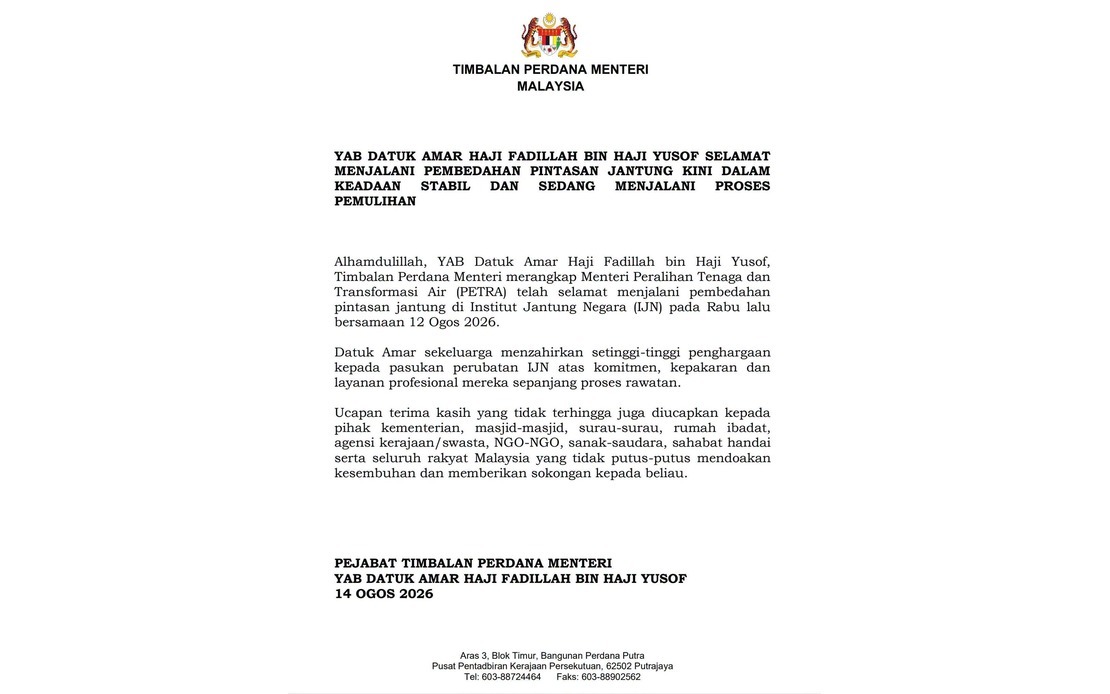
Deputy Prime Minister Datuk Seri Fadillah Yusof, who also serves as Energy Transition and Water Transformation Minister (PETRA), has begun his recovery phase following a successful double coronary artery bypass operation conducted at the National Heart Institute (IJN) in Kuala Lumpur. The procedure, performed on August 12, marks a significant medical intervention for one of Malaysia's most senior government officials, coming after weeks of diagnostic assessment and specialist consultation at the institution.
Fadillah's office released a statement expressing gratitude for the comprehensive medical care provided by IJN's surgical team and acknowledged the widespread public support from religious institutions, government and private sector organisations, along with well-wishers across the country. The statement underscored the family's appreciation for the institute's clinical expertise and the prayers offered by Malaysians from various walks of life throughout his treatment and initial recovery phase.
The pathway to surgery began when Fadillah was admitted to IJN on July 28, followed by a coronary angiogram performed the next day. This diagnostic procedure revealed significant blockages in his coronary arteries, prompting a multidisciplinary medical team to determine that bypass grafting represented the optimal therapeutic approach. Rather than relying on less invasive interventions like stenting, the team's consensus reflected the extent and complexity of the arterial disease requiring surgical correction.
The operation itself was executed by two of IJN's most experienced cardiothoracic surgeons: Prof Datuk Seri Dr Mohamed Ezani Md Taib and Prof Datuk Seri Dr Mond Azhan Yakub, supported by Clinical Fellow Cardiothoracic and Vascular Surgery Dr Ahmad Mahir Shamsuddin. This level of surgical expertise underscores the confidence placed in IJN's capabilities for complex cardiac procedures, particularly those involving senior government figures requiring the highest standards of perioperative care.
What distinguishes Fadillah's recovery trajectory is the application of IJN's Enhanced Recovery After Surgery (ERAS) protocol, a sophisticated multidisciplinary framework designed to accelerate recuperation while minimising post-operative complications. This approach combines surgical precision with targeted rehabilitation, early mobilisation strategies, and comprehensive patient monitoring. Rather than prolonged bedrest, ERAS protocols emphasise functional recovery from the earliest post-operative hours, a significant shift from traditional cardiac surgery management paradigms.
The most striking indicator of Fadillah's progress emerged on August 13, merely 24 hours after his major cardiac operation. He successfully completed a 2.8-kilometre cycling exercise under professional supervision from IJN's clinical team—an achievement that by conventional cardiac surgery standards would be considered exceptionally rapid. This early mobilisation milestone not only demonstrates his physical capacity but also reflects the benefits of structured, evidence-based rehabilitation protocols initiated immediately in the post-operative period.
Following this impressive cycling performance, Fadillah was transferred from the Intensive Care Unit to the general ward on the same afternoon, signalling his transition from acute post-operative monitoring to standard cardiac recovery care. This progression, completed within 24 hours of a major surgical intervention, represents a notable acceleration compared to historical recovery timelines for bypass procedures. His continued engagement in structured cardiac rehabilitation within the general ward setting indicates sustained medical supervision while he builds strength and cardiovascular conditioning.
Prof Datuk Seri Dr Mohamed Ezani Md Taib, serving as IJN Group Chief Executive Officer, publicly affirmed satisfaction with the Deputy Prime Minister's clinical progress, emphasising that his treatment and recovery unfolded precisely according to the surgical team's carefully calibrated expectations. This measured professional confidence suggests not merely the absence of complications but rather the consistent manifestation of positive physiological recovery indicators throughout the immediate post-operative period. For Malaysian observers watching their second-highest government official undergo major cardiac surgery, such authoritative medical reassurance carries significant weight in public confidence and institutional credibility.
Fadillah's surgical experience highlights the sophisticated medical capabilities available within Malaysia's healthcare system, particularly for complex cardiac pathology. The National Heart Institute's track record in managing high-profile patients, combined with its implementation of contemporary surgical protocols and rehabilitation frameworks, demonstrates that citizens requiring advanced cardiac intervention need not necessarily seek treatment abroad. This capacity builds confidence in domestic medical services and validates Malaysia's positioning as a regional healthcare hub capable of delivering world-class cardiothoracic surgical care.
From a governance perspective, Fadillah's situation raises practical questions about ministerial succession and workload distribution during periods when senior officials undergo significant medical intervention. While the Deputy Prime Minister recovers, the continuity of his portfolio responsibilities—particularly the energy transition agenda and water sector management—requires institutional planning to ensure policy momentum remains uninterrupted. Malaysia's government structures typically accommodate such contingencies through delegation and established succession frameworks, though the specifics of operational continuity during this period have not been publicly detailed.
The timing and extent of Fadillah's return to full ministerial duties remain unspecified, though cardiac surgery recovery trajectories typically extend over several weeks to months depending on individual health factors and the complexity of surgical intervention. International best practices suggest gradual resumption of responsibilities rather than immediate full-scale operational engagement, balancing medical recovery requirements against governmental continuity imperatives. This balancing act will likely inform both the Deputy Prime Minister's personal health management and broader Cabinet coordination during his convalescence.
Public expressions of support from religious institutions and civil society organisations underscore the value Malaysian society places on continuity of leadership while respecting the genuine health challenges requiring medical intervention. The mobilisation of prayers and well-wishes across community boundaries reflects a pragmatic national ethos that acknowledges human vulnerability while maintaining confidence in institutional leadership capacity. Such collective expressions of support, communicated through the Deputy Prime Minister's office, serve broader social cohesion functions while offering personal encouragement during recovery.
Looking forward, Fadillah's recovery journey will likely serve as an informal benchmark for cardiac patients in Malaysia, normalising discussions around serious heart disease and advanced surgical treatment within the public consciousness. His willingness to undergo intervention and transparent communication about recovery progress potentially encourages other Malaysians facing similar cardiac pathology to seek timely professional medical evaluation rather than delaying diagnosis and treatment. As the Deputy Prime Minister advances through his rehabilitation programme at IJN, his clinical progress will continue reflecting both his personal resilience and the institutional expertise of Malaysia's leading heart centre.

