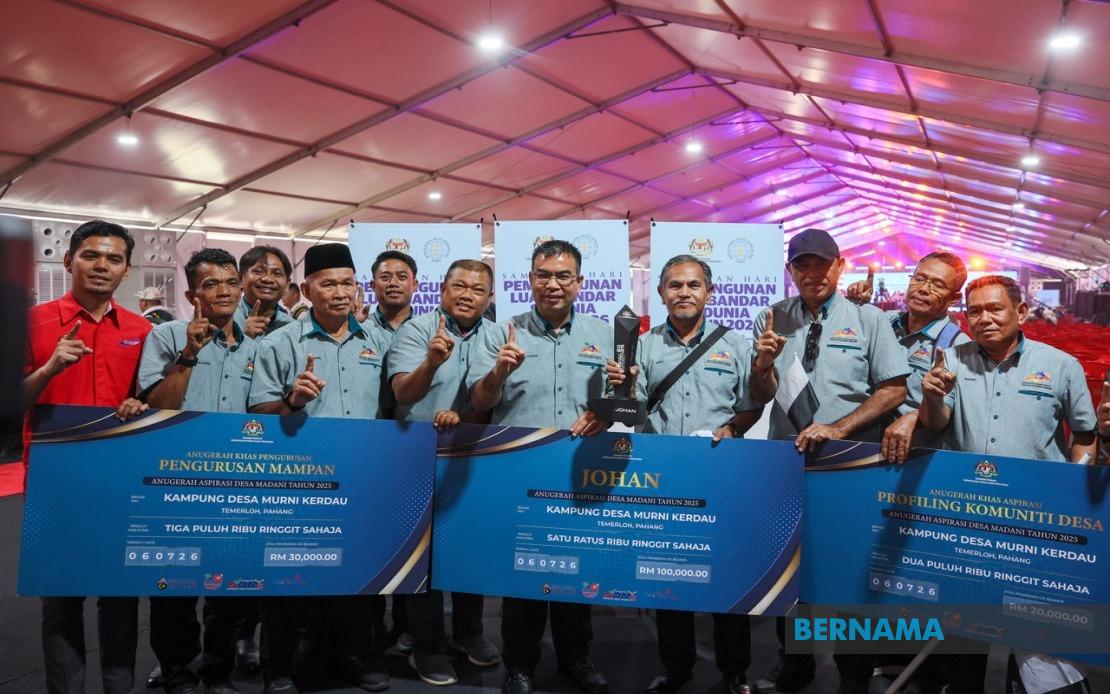
Desa Murni Kerdau, a settlement in Temerloh, Pahang, has claimed three prestigious awards at the World Rural Development Day 2026 ceremony held at Tun Abdul Razak Stadium in Jengka Sentral. The accolades underscore the village's achievements in rural governance and grassroots development, marking a significant milestone for the community's coordinated efforts toward sustainable advancement.
The triple honour comprises the 2025 MADANI Rural Aspiration Award Champion designation, alongside the Rural Community Profiling Aspiration Special Award and the Sustainable Management Special Award. Deputy Prime Minister Datuk Seri Dr Ahmad Zahid Hamidi presented the principal MADANI award, while Deputy Minister of Rural and Regional Development Datuk Rubiah Wang conferred the two additional recognitions. The ceremony reflects the government's commitment to acknowledging exemplary rural development initiatives across the country.
Desa Murni Kerdau encompasses approximately 200 residential structures housing over 600 inhabitants, operating as a traditional yet well-structured settlement that balances heritage with contemporary village administration. According to Mohamad Fazrul Ahmad, the chairman of the settlement's Village Development and Security Committee, the recognition validates the community's approach to collective governance and strategic planning. The awards acknowledge not merely infrastructure achievements but the underlying institutional framework that enables coordinated decision-making at the grassroots level, a critical component in Malaysia's rural development architecture.
The village has cultivated an entrepreneurial ecosystem that has spawned roughly 20 business operators across diverse sectors. These enterprises span small and medium-scale industrial ventures, agricultural production, and automotive services, demonstrating the breadth of economic diversification achieved within the community. Such entrepreneurial vitality is particularly significant for rural Malaysia, where income diversification traditionally remains limited. The emergence of these multiple business streams suggests effective knowledge transfer and possibly structured support mechanisms within the village structure.
Beyond conventional economic activities, Desa Murni Kerdau has positioned itself as a rural tourism destination through its "Kampung Stay" initiative, a homestay-style arrangement that has garnered national recognition. This venture exemplifies how traditional villages can monetise their cultural heritage and natural environment without requiring large-scale industrial development. Rural tourism products like this have become increasingly valuable for communities seeking sustainable income while preserving local character, a model that resonates across Southeast Asia where similar initiatives are proliferating.
Mohamad Fazrul indicated that the monetary proceeds from these awards will be channelled directly to residents and allocated toward further village infrastructure and community welfare projects. This allocation strategy suggests a commitment to distributing benefits equitably rather than concentrating gains within administrative structures. For Malaysian policymakers and other rural communities observing this development, the approach offers a practical template for converting official recognition into tangible improvements that residents experience directly.
The MADANI framework, embedded in Malaysia's current national development philosophy, emphasises prosperity alongside stability and inclusivity. Desa Murni Kerdau's selection as champion under this rubric suggests the settlement demonstrates these principles operationally. The village's balanced approach to economic growth, institutional governance, and community welfare aligns with how policymakers increasingly conceptualise development success in rural contexts, moving beyond purely quantitative metrics toward qualitative measures of social cohesion and institutional effectiveness.
The recognition carries implications for the broader rural development landscape in Peninsular Malaysia. As urbanisation continues and youth migration to cities accelerates, villages that successfully create local economic opportunities while maintaining social structures tend to experience greater population stability and intergenerational continuity. Desa Murni Kerdau's entrepreneurial base and tourism product suggest the community has successfully arrested outward migration, a persistent challenge in Malaysian rural governance.
For other settlements across Pahang and neighbouring states, Desa Murni Kerdau represents a case study in institutional effectiveness and strategic diversification. The village demonstrates that rural development success does not necessarily require external capital injection on a massive scale, but rather coherent internal organisation, leadership commitment, and strategic focus on locally viable economic activities. The multiplicity of awards—recognising governance, community engagement, and sustainability—indicates a holistic development approach rather than narrow specialisation.
The World Rural Development Day platform itself reflects international recognition of rural communities' roles in national and regional prosperity. By honouring exemplary villages, the ceremony generates visibility for rural achievement and potentially catalyses competitive interest among other communities seeking similar recognition. This recognition effect can motivate systemic improvements across multiple settlements, creating demonstration effects that ripple through rural Malaysia's administrative networks.

