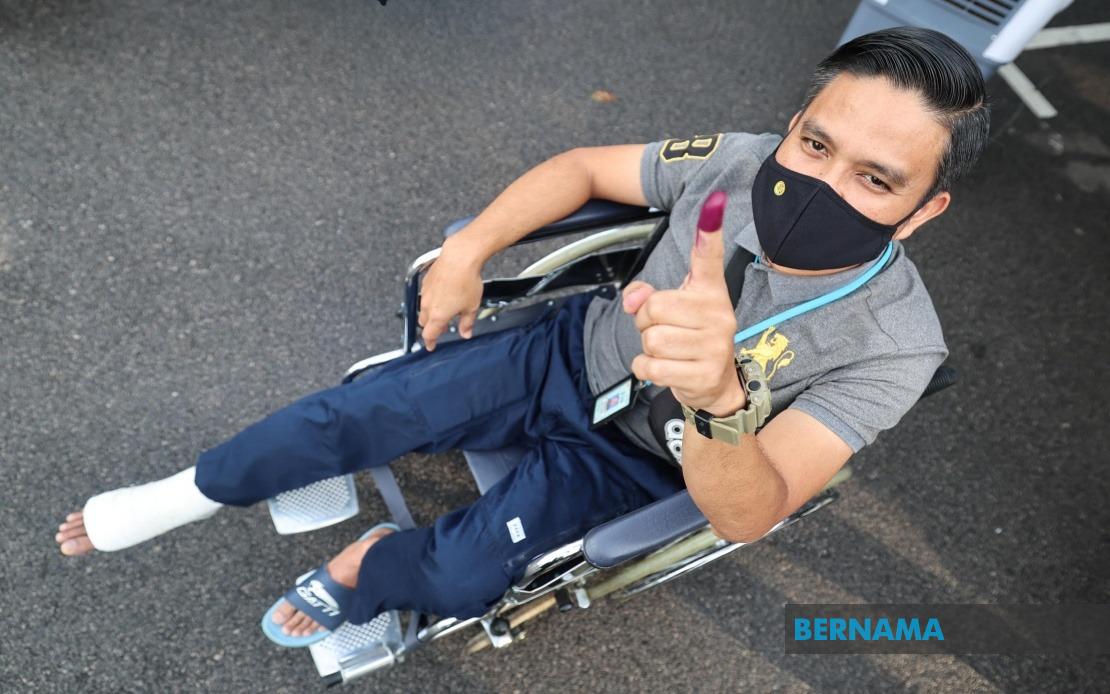
Sergeant Syahrizal Musa's determination to exercise his voting right proved stronger than the physical pain from an Achilles tendon injury sustained just days earlier. The 40-year-old police officer, attached to the Internal Security and Public Order Department at Johor Police Contingent Headquarters, rolled himself to the early voting centre on July 7 despite being confined to a wheelchair and on medical leave until mid-month. His appearance at the polls underscored the importance many Malaysians place on participating in electoral processes, even when circumstances present genuine hardship.
Syahrizal's injury came from a sepak takraw game the previous week—a sport he has actively pursued since childhood and one in which he has represented the police contingent in multiple tournaments. Medical examination confirmed a minor tear to his Achilles tendon, an injury typically requiring several weeks of rest and limited mobility. Yet this diagnosis did not deter him from honouring what he views as a fundamental responsibility. Accompanied by a friend from his residence in the Tampoi police quarters, he navigated the early voting process at the Johor Police Contingent Headquarters facility, making light of the inconvenience and emphasizing his civic commitment over personal discomfort.
In remarks to media personnel at the voting centre, Syahrizal reflected on his lengthy service record within the Royal Malaysia Police force. Over more than two decades with PDRM, he has maintained a perfect attendance record at the ballot box, never allowing any circumstance to prevent him from voting in past elections. This marked the first occasion he had cast a vote from a wheelchair, yet he expressed no regret about undertaking the journey. His perspective carries particular weight given his background and experience; having served nine years at the Muar police district headquarters before transferring to Johor in 2014, he represents the backbone of Malaysia's law enforcement institutions. For Syahrizal, the principle of voting transcended temporary physical limitations.
The 16th Johor state election represented a significant electoral exercise for Malaysia's southernmost peninsula state. A total of 172 candidates competed for 56 seats across the state, with ordinary voters—numbering approximately 2.7 million—scheduled to cast ballots the following Saturday. The early voting process accommodated military and police personnel who might be on duty during the main polling day, a pragmatic administrative arrangement recognizing the security forces' potential unavailability. The early voting centres operated across 64 locations statewide, processing 24,751 early voters consisting of Malaysian Armed Forces personnel and their spouses, numbering 12,041, alongside Royal Malaysia Police and General Operations Force members with their families, totalling 12,710 individuals.
Syahrizal's decision to vote early carried symbolic resonance for the broader Malaysian electorate. At a time when voter turnout patterns and civic engagement remain subjects of ongoing public discussion, his example demonstrated that fundamental democratic participation need not be abandoned when circumstances prove challenging. His message to fellow Malaysians emphasized precisely this point: that voting represents not merely an opportunity but a responsibility that extends beyond convenience or comfort. Coming from someone serving in a security capacity—roles that inherently demand commitment and sacrifice—his words carried additional credibility and moral weight for observers.
The broader context of the Johor election reflected Malaysia's continuing democratic practice in state-level polling. As a major economic hub within the Southeast Asian region and home to significant manufacturing and port facilities, Johor's governance carries implications extending beyond state boundaries. The election outcome would determine which coalition controlled state administration and its resources, potentially influencing regional economic policies and development priorities. For Malaysian voters across the peninsula, Johor elections historically carried demonstrative significance regarding broader political sentiment and shifting voter preferences.
Syahrizal's background as a Perak native who had spent substantial portions of his policing career in different Malaysian states reflected the mobility characteristic of PDRM personnel. Police officers frequently transfer between different state police contingent headquarters throughout their careers, building diverse experience across Malaysia's varied communities and administrative contexts. This mobility, while demanding, reportedly contributed to officers like Syahrizal developing comprehensive understanding of the nation's diverse regions and their distinct needs. His commitment to voting despite injury suggested awareness that electoral outcomes carried consequences for the communities he had served throughout his career.
The physical challenge Syahrizal overcame—navigating polling procedures while confined to a wheelchair—remains a practical consideration for numerous Malaysian voters with mobility constraints. Early voting facilities, while accommodating military and police personnel, theoretically offer greater flexibility than main polling day arrangements. Yet even with such provisions, accessing voting centres from home and managing the polling process itself requires genuine effort for individuals with physical limitations. Syahrizal's participation demonstrated that such barriers, while real, need not prove insurmountable when voters prioritize participation. His example might meaningfully encourage other Malaysians facing health or mobility difficulties to consider their options for participating in future elections.
The injury itself—a relatively common sports-related ailment among individuals who remain physically active throughout their careers—contextualized Syahrizal's situation within the broader Malaysian working population. Occupational injuries and temporary health setbacks affect people across all sectors and professions. His response to his particular circumstance illustrated one possible approach to balancing health considerations against civic responsibilities. While certainly not suggesting that injured or unwell individuals should disregard medical advice, his experience suggested that many Malaysians might accomplish both: following medical guidance while still finding ways to participate democratically when motivated sufficiently.
From an institutional perspective, the police force's accommodation of early voting demonstrated practical recognition that security personnel might legitimately require alternative voting arrangements. This pragmatism, reflected in 64 early voting centres processing tens of thousands of military and police votes, ensured that public servants on duty rosters could still discharge their democratic rights. The system appeared to function smoothly on the day, processing Syahrizal and thousands of his colleagues without reported complications. Such administrative arrangements, while routine, deserve acknowledgment as practical manifestations of Malaysia's commitment to inclusive democratic participation.

