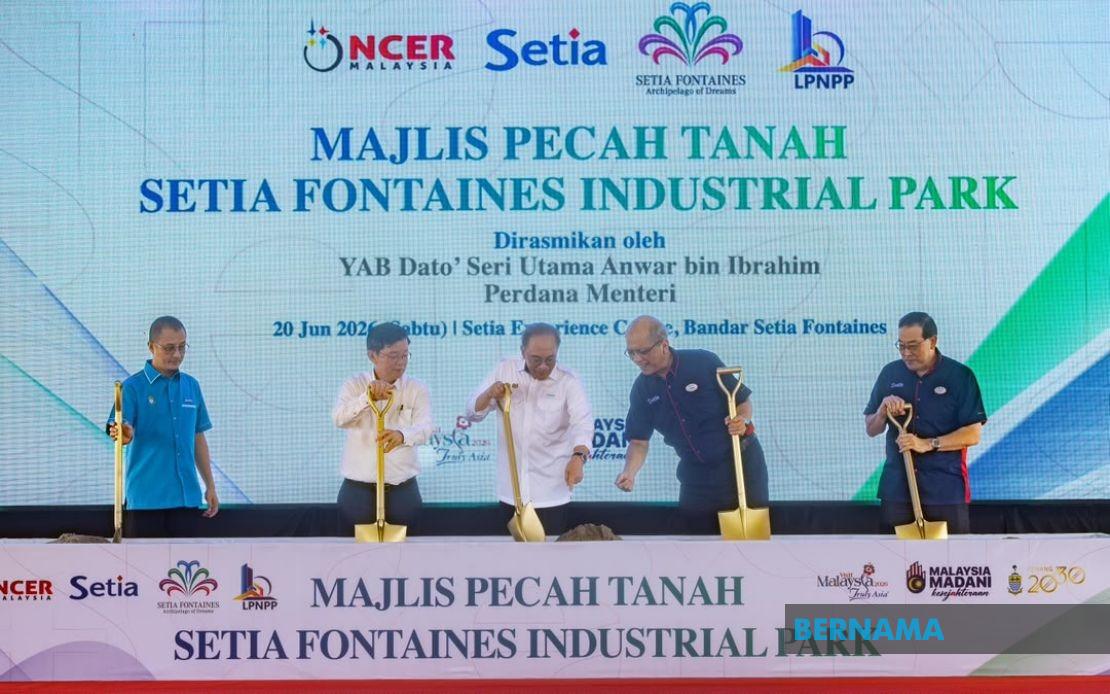
Prime Minister Datuk Seri Anwar Ibrahim has issued a forceful reminder to government-linked entities and private corporations that economic development cannot remain the exclusive preserve of affluent segments of society. Speaking at the groundbreaking ceremony for the Setia Fontaines Industrial Park in Bandar Setia Fontaines, Anwar underscored a critical principle: every major project approval, whether channelled through Khazanah Nasional Berhad, Permodalan Nasional Berhad, the Employees Provident Fund, or private enterprises, must deliberately create pathways for middle- and lower-income households to participate and prosper.
The Prime Minister's intervention reflects growing concern within government circles that rapid capital accumulation and large-scale investment flows risk exacerbating Malaysia's persistent inequality challenge. His framing of the issue transcends mere rhetoric—it signals an expectation that corporate gatekeepers and state-backed investors embed inclusive mechanisms into project design from inception, rather than treating equity considerations as afterthoughts. This approach acknowledges a hard reality: without deliberate intervention, development corridors tend to concentrate wealth among already-privileged groups whilst the most economically vulnerable face constrained opportunities and widening gaps.
Anwar articulated a sophisticated economic argument: headline growth figures and rising investment volumes paint an incomplete picture of national progress. Mere expansion of the economic pie, he suggested, proves hollow if ordinary Malaysians lack meaningful access to the opportunities it generates. This distinction—between aggregate growth and broad-based prosperity—has become increasingly salient as Malaysia navigates post-pandemic recovery and structural transformation. The emphasis on inclusive development reflects recognition that social cohesion depends on tangible economic mobility across income strata, not just rising GDP.
The Setia Fontaines Industrial Park development offers a practical test case for these principles. Located in Bandar Setia Fontaines within Seberang Perai, the project represents an effort to balance economic advancement across Penang, addressing historical disparities between the island and the mainland peninsula. Anwar positioned the initiative as part of broader strategy to ensure Seberang Perai's economic trajectory matches the momentum seen in the island's commercial zones and the state's southern regions. By anchoring advanced manufacturing activities on the mainland, planners hope to generate employment spillovers and wealth distribution beyond traditional business hubs.
The industrial park exemplifies Malaysia's pivot toward higher-value manufacturing as the nation attempts to escape the middle-income trap. Rather than competing on labour cost in conventional assembly operations, the facility targets advanced technology sectors where Malaysia can leverage existing manufacturing infrastructure and growing technical capacity. This sectoral shift carries profound implications for workforce composition: jobs generated will demand sophisticated skill sets unavailable among casual labourers, creating potential for significant wage premiums and career progression—provided workers possess appropriate qualifications.
However, Anwar identified a critical bottleneck that threatens to undermine inclusive benefits: the skills mismatch between labour supply and employer demand. He noted that rapid technological evolution outpaces traditional educational cycles, rendering formal qualifications obsolete within months or years. This observation points to a systemic vulnerability in Malaysia's human capital development architecture. Without coordinated effort among industry, technical vocational education and training providers, and universities, the knowledge gap will persist, forcing employers to recruit from abroad and denying local workers—particularly those from disadvantaged backgrounds—access to emerging opportunities.
The Prime Minister's emphasis on collaboration between industry partners, TVET institutions, and universities, specifically citing Universiti Sains Malaysia, reflects strategic thinking about ecosystem development. Regional universities possess capacity to design curricula responsive to evolving industry needs, whilst TVET institutions offer pathways for workers lacking traditional academic credentials. This multi-stakeholder approach recognises that inclusive development requires solving the supply-side constraint: it matters little that professional-grade employment exists if local talent cannot access it through appropriate training.
Anwar's intervention also signals heightened government scrutiny of how sovereign wealth funds and government-linked companies exercise their investment mandates. These entities, managing vast pools of public resources, face implicit expectations to prioritise development that strengthens broad societal participation rather than narrowly maximising returns. The mention of Khazanah, PNB, and EPF—Malaysia's largest institutional investors—reflects awareness that capital allocation decisions by these funds substantially shape employment patterns and economic structure. By publicly articulating expectations around inclusive development, the Prime Minister applies political pressure to ensure fiduciary responsibilities encompass social outcomes.
For Malaysian businesses and regional investors monitoring government policy, Anwar's remarks carry practical significance. Companies seeking project approvals, partnerships with government entities, or regulatory support would be prudent to demonstrate inclusive employment strategies and local skills development commitments. This represents a shift from purely commercial criteria toward broader stakeholder expectations—a trend increasingly visible across Southeast Asia as governments grapple with inequality and youth unemployment despite macroeconomic expansion.
The timing of these comments reflects broader political economy considerations. Anwar's coalition government faces pressure to demonstrate tangible improvements in living standards, particularly among working-class and lower-middle-income voters whose purchasing power has been squeezed by inflation and wage stagnation. By emphasising inclusive development, the Prime Minister appeals to this constituency whilst simultaneously signalling to investors and corporations that Malaysia remains stable and predictable—merely insisting that growth be structured equitably rather than rejecting capitalism itself.
Seberang Perai's development aspirations also carry regional significance. As a mainland growth corridor, its success could demonstrate replicable models for balanced regional development across Malaysia. Other states facing economic disparities between urban cores and peripheral areas might adopt similar frameworks, using industrial park development as levers for inclusive growth. This demonstration effect potentially extends across Southeast Asia, where uneven development remains endemic and governments seek sustainable approaches to reduce spatial inequality.
The Setia Fontaines project will be closely watched to assess whether inclusive principles translate into actual outcomes. Measurable indicators—labour force composition, wage levels for entry-level positions, proportion of workers from Seberang Perai's lower-income districts, investment in local TVET partnerships—will reveal whether the development delivers on its inclusive rhetoric. Success or failure carries implications beyond Penang, signalling either the viability of inclusive industrial development models or the persistent difficulty of reconciling rapid growth with broad-based opportunity creation.

