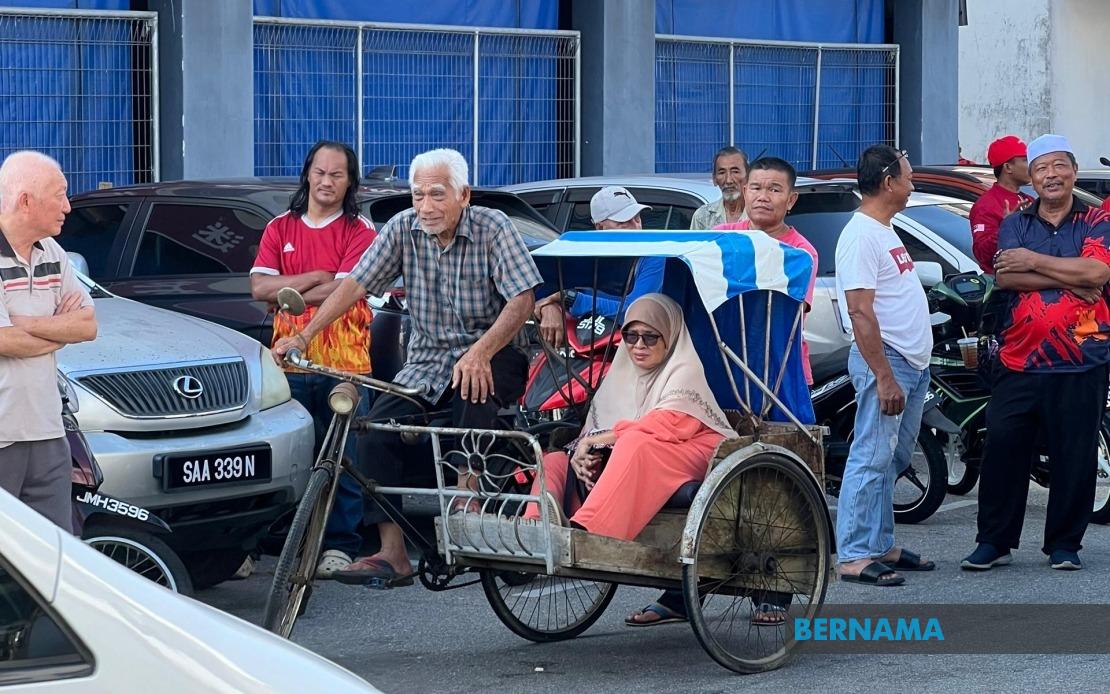
In a touching display of devotion, an octogenarian resident of Batu Pahat took matters into his own hands when he learned that Prime Minister Datuk Seri Anwar Ibrahim would be visiting the small Johor town. Abdul Razak Pelangga, 87, hitched his wife Jamilah Samsudin, 64, onto his trishaw and pedalled nearly a kilometre through the oppressive midday heat from their home in Kampung Parit Bugis to Kedai Kopi Hailam Sri Medan, where the Prime Minister was holding a breakfast session as part of the PMX Meet-and-Greet Programme for the Senggarang state constituency.
The journey itself was no small feat for a man of Abdul Razak's age, particularly given the harsh tropical weather that characterises Johor during July. Yet the motivation driving him forward was deeply personal and rooted in a meaningful encounter from years past. Abdul Razak, who serves as the Imam of Masjid Raudhatul Jannah Parit Bugis, had previously met Anwar during a congregational prayer session at the mosque long before the latter ascended to the country's highest political office. That interaction left a lasting impression on him—one that he had carried with him and frequently recounted to his wife over the years.
When news arrived that Anwar would be in the vicinity, Abdul Razak saw an opportunity to share that lived experience with Jamilah in a tangible way. Though he possessed alternative means of transportation—he could have driven a car or ridden a motorcycle—he made a deliberate choice to use the trishaw. This decision was motivated by pragmatism as much as sentiment: avoiding the inevitable congestion and the difficulty of locating a parking space in the bustling coffee shop area. The trishaw, an iconic symbol of local Malaysian culture, proved the most practical option for navigating the crowded event.
During the breakfast engagement, which lasted approximately 50 minutes, Anwar mingled extensively with residents of Senggarang, a gesture aligned with Pakatan Harapan's grassroots engagement strategy ahead of the crucial Johor state election. Communications Minister Datuk Fahmi Fadzil, who also serves as the coalition's Communications Director, accompanied the Prime Minister during the programme. The event formed part of a broader campaign initiative designed to strengthen connections between leadership and constituents in advance of polling day.
Although Abdul Razak and his wife were unable to achieve a face-to-face meeting with Anwar owing to the sizable crowds that had gathered, the mere proximity to the Prime Minister proved sufficient to fulfill their objective. For Jamilah, who had only observed Anwar through the mediated lens of television broadcasts, witnessing him in person represented a meaningful moment. Abdul Razak expressed contentment with the outcome, emphasising that the sight from a reasonably close distance had validated the effort and the journey.
Beyond this heartwarming human interest angle, Abdul Razak's participation in the public programme carried additional significance for him personally. He anticipated participating in the electoral process scheduled for July 11, a date that holds particular resonance given that it coincides with his 87th birthday. While he has exercised his right to vote on numerous occasions throughout his life, he characterised this upcoming election as uniquely special—a convergence of civic duty and personal milestone that underscored his continued engagement with Malaysia's democratic processes.
The Johor state election represents a consequential political moment for the southern state. The polling is set to occur on July 11, with early voting opportunities available on July 7, allowing voters such as Abdul Razak ample opportunity to participate. The election assumes particular importance given the state's political history and its role in the broader Malaysian political landscape. For many residents, the election campaign has featured visible engagement from national leadership, reflecting the contest's significance within Pakatan Harapan's strategic calculations.
Abdul Razak's determination to bring his wife to witness the Prime Minister's visit, despite logistical challenges and physical strain, encapsulates a broader phenomenon observable in Malaysian politics: the enduring capacity of personal connection and historical memory to motivate civic participation. His earlier encounter with Anwar at the mosque—a moment of simple human courtesy and mutual greeting—had evidently imprinted itself sufficiently to drive action years later. This suggests that the informal, personal dimensions of political leadership often resonate as powerfully as formal policy platforms in shaping citizen engagement.
The story also reflects broader patterns in Malaysian society regarding respect for age and accumulated experience. Abdul Razak's willingness to exert himself physically, coupled with Jamilah's interest in observing national leadership, demonstrates how political engagement extends across demographic lines. Moreover, the choice to employ traditional modes of transport like the trishaw, rather than more modern alternatives, carries subtle cultural significance in an era of rapid modernisation. The trishaw persists as an emblem of Malaysia's heritage, and its deployment in this context—to enable participation in contemporary political processes—symbolises a continuity between tradition and democratic practice.
For observers of Malaysian politics, this vignette offers insight into the motivational structures that animate electoral participation beyond calculations of policy preference or partisan affiliation. The emotions that drive elderly citizens to overcome physical obstacles in order to glimpse national leaders remain powerful forces in democratic systems. Abdul Razak and Jamilah's journey from Kampung Parit Bugis to the coffee shop in Senggarang, undertaken in the sweltering Johor heat, represents an understated but profound commitment to civic engagement and to the symbolic importance of proximity to national leadership.

