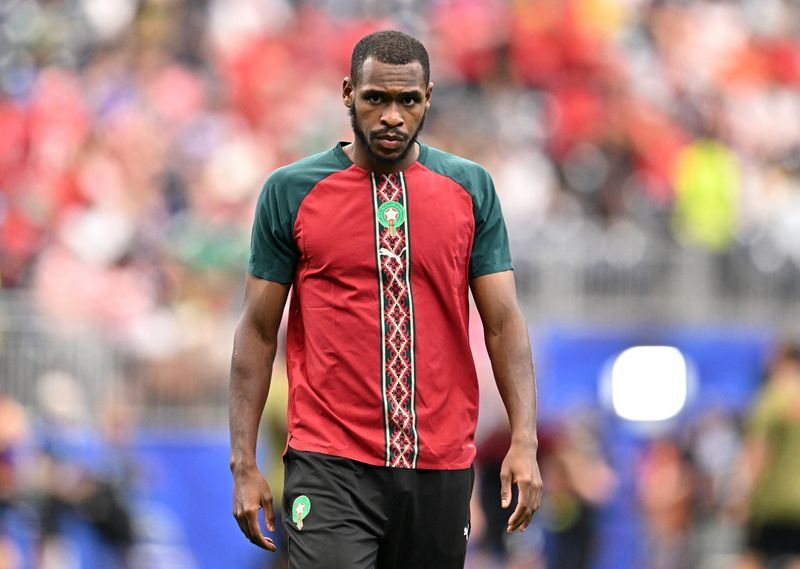
The trajectory of Issa Diop's international career reads like a script crafted for maximum dramatic irony. The 29-year-old Moroccan centre-back, who spent years publicly rejecting overtures from both Morocco and Senegal to represent France, now finds himself tasked with the crucial defensive responsibility of containing Kylian Mbappé when the two nations meet in a World Cup quarter-final in Boston on Thursday. What makes this encounter particularly compelling is not merely the sporting challenge before him, but the remarkable reversal of conviction that has brought him to this juncture.
Diop's background provided multiple pathways to international football, yet he displayed a singular focus that bordered on zealotry. Born in Toulouse to a Senegalese father and Moroccan mother, with a grandfather who had coached Senegal's national team, the defender could have pursued representation for either African nation. Instead, he exhibited an almost defiant attachment to France, his birthplace and the country that had nurtured his development. When speaking to Canal Plus, the French television station, seven years prior to his eventual switch, Diop articulated his position with unambiguous clarity. He stressed that France had given him everything, that his identity was intrinsically tied to his birth nation, and that accepting a call-up from another country merely because he had fallen short of French selection standards would constitute both hypocrisy and a capitulation to circumstances rather than a genuine choice.
Those convictions, expressed with such certainty and emotional weight, generated considerable attention when Diop reversed course in March and committed to representing Morocco. Social media platforms erupted with criticism and accusations of inconsistency, with observers questioning whether his decision reflected pragmatism or opportunism in the face of limited French opportunities. The timing appeared opportunistic to many, coming just months before the World Cup as Morocco sought defensive reinforcement following the departure of captain Romain Saiss, who had stepped back from international duty after the Africa Cup of Nations in January, and the injury suffered by Nayef Aguerd in the same month.
Yet Diop's transformation from outspoken France loyalist to committed Moroccan defender has been validated by his performances on the pitch, most dramatically through his stoppage-time equaliser against the Netherlands in the round of 32 knockout stage. With full time elapsed and Morocco facing elimination, Diop ventured forward in search of space and connected with a cross from Chemsdine Talbi to power a header past the Dutch goalkeeper. That single moment, occurring in the 91st minute, rescued his adopted nation from the edge of defeat and forced the match into extra time, ultimately leading to Morocco's victory via penalty shootout. The goal appeared to rewrite the narrative surrounding his international switch, transforming controversy into vindication through decisive action.
Coach Mohamed Ouahbi, who orchestrated Diop's recruitment to the Moroccan setup, has defended the decision with both pragmatism and philosophical patience regarding the controversy. Rather than dwelling extensively on the public recriminations that followed Diop's commitment announcement, Ouahbi emphasised the importance of assessing present conduct and future potential rather than excavating past declarations. He observed that Diop demonstrated genuine commitment to Morocco, maintained consistent engagement with Moroccan culture, and visited the nation regularly, suggesting that his switch reflected deeper attachment than pure footballing expediency. Ouahbi's measured perspective has allowed the integration to proceed without dwelling on the contentious history, permitting Diop to establish himself as a valued squad member based on current performance rather than historical baggage.
The eight seasons Diop has spent in the English Premier League with West Ham United and Fulham have provided him with elite-level competitive experience and tactical sophistication that serves Morocco well. His debut for his adopted nation came in a March friendly against Ecuador, following which he was installed as the first-choice centre-back alongside Crystal Palace's Chadi Riad. This partnership has developed into Morocco's primary defensive axis, with Diop's experience and composure complementing Riad's technical attributes. The partnership filled the void left by Saiss's retirement and Aguerd's injury, providing coach Ouahbi with the defensive stability necessary to mount a serious World Cup challenge.
The impending encounter with France and Mbappé represents the ultimate test of Diop's commitment to his adopted nation and his ability to transcend the contentious circumstances of his switch. Mbappé, one of the tournament's most dynamic and penetrative forwards, represents precisely the type of elite attacking talent that has proven difficult for most defences to contain. The psychological dimensions of this matchup extend beyond the technical aspects of central defending. Diop must confront not only one of the finest strikers in world football but also the symbolic weight of his own previous declarations about French primacy in his footballing identity. Success against Mbappé would provide persuasive evidence that his transition to Morocco carries genuine substance rather than opportunistic convenience.
Moreover, the larger context of this World Cup has elevated Morocco's narrative considerably. The nation's appearance in the quarter-finals for a second consecutive tournament demonstrates the emergence of African football as a genuine global force beyond tokenistic representation in the latter stages of major competitions. An upset victory over France would represent a seismic shift in the tournament's dynamics and would cement Morocco's status as more than a surprise package in the competition. For Diop personally, such a result would transform his international narrative from controversial pragmatist to unlikely hero who delivered when his adopted nation required him most.
The subplot of Diop confronting France and Mbappé adds narrative texture to what would already be a significant quarter-final encounter. Both nations possess the quality to advance, but Diop's presence on the Moroccan side injects an element of personal redemption and vindication that extends the storyline beyond purely tactical considerations. His defensive positioning and decision-making in the coming match will be scrutinised through multiple lenses: as technical football analysis, as evidence of his genuine commitment to Morocco, and as the ultimate validation or refutation of his dramatic international realignment. The stakes attached to his individual performance transcend typical defensive responsibilities, making his contribution to Thursday's match one of the tournament's most compelling subplots.

