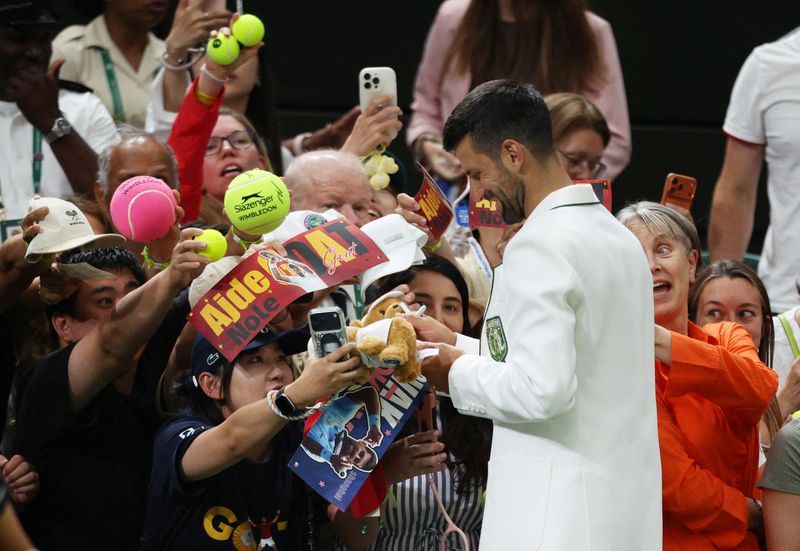
Novak Djokovic's performance against Stefanos Tsitsipas at Wimbledon was so commanding that it left the 24-time Grand Slam champion in a buoyant mood, one he channelled into entertaining the crowd with his trademark humour. The Serbian legend's 6-3 6-4 6-2 victory on Wednesday showcased not just the dominance he continues to exert on tennis's grandest stages, but also the confidence and relaxation that comes from such one-sided dominance in the sport's most prestigious tournament.
The moment that crystallised Djokovic's playful demeanour came during a seemingly mundane courtside interaction. With his lead already insurmountable, Djokovic requested assistance from a ball girl to remove a piece of black tape from his right shoulder using a pair of scissors. As she began carefully cutting away the tape, he suddenly let out a cry of pain that was convincing enough to jolt the young attendant into genuine alarm. Clutching her chest in visible distress, she recoiled, apparently convinced she had accidentally injured one of tennis's greatest ever competitors in front of millions of global viewers. Her momentary panic underscored just how realistic Djokovic's theatrical performance had been.
The prank's climax arrived instantly when Djokovic burst into laughter, dissolving the tension and drawing the young woman into the joke. Her initial shock transformed into relieved giggles as she realised she had been the unwitting subject of some gentle court-side tomfoolery. For Djokovic, such levity served a purpose beyond mere entertainment—it reflected the mental state of an athlete so firmly in control of proceedings that he could afford to embrace the lighter side of competition.
When addressing the crowd during his post-match interview, Djokovic offered a candid reflection on his conduct. He acknowledged that such pranks emerge naturally when a player has established an overwhelming advantage rather than fighting from behind, and he offered a sincere apology to the ball girl for the momentary scare. Yet his tone made clear that the entire exchange had contributed positively to his mental wellbeing on court, providing the kind of spontaneous enjoyment that can actually enhance performance during extended matches.
The afternoon's entertainment did not conclude with the Tsitsipas encounter. Djokovic's attention soon shifted to the Royal Box at Centre Court, where he spotted Rory McIlroy, the twice Masters champion from Northern Ireland, resplendent in his Green Jacket. The presence of one of golf's elite competitors provided Djokovic with an irresistible opportunity for cross-sport banter that would delight the assembled crowd.
Djokovic, dressed in his personalised cream blazer that has become a fixture of his Wimbledon appearance this year, seized the moment to initiate a playful exchange with McIlroy. He vocally admired the golfer's garment, asking pointedly whether it was indeed the famous Masters Jacket. When McIlroy confirmed its authenticity with a nod, Djokovic launched into his proposal with theatrical flair, suggesting a cross-sport wager that would have each competitor stake their respective blazer in a tennis match.
The proposition was delivered with characteristic Djokovic wit and timing. He explicitly stipulated that any such contest would be contested on the tennis court rather than the golf course, thereby ensuring he would have every advantage in the imagined competition. The suggestion that McIlroy might relinquish his Masters Green Jacket—arguably golf's most iconic garment, earned through championship competition at Augusta National—for a cream blazer, even one personalised by a tennis legend, was absurdly lopsided in a way that amplified the comedy.
The crowd's response was immediate and enthusiastic, with laughter and applause filling Centre Court as spectators recognised the humour in Djokovic's audacious proposal. McIlroy himself remained visibly amused by the exchange, his good-natured reaction suggesting he appreciated both the charm and the cheeky presumption inherent in the suggestion. The moment exemplified how Djokovic continues to engage with the broader sporting world while maintaining his position at tennis's pinnacle.
These incidents at Wimbledon reveal dimensions of Djokovic's personality that often remain obscured by the intensity of his on-court demeanour during closely contested matches. When performing at the apex of his capabilities and commanding his opposition as completely as he did against Tsitsipas, he appears almost liberated to display the relaxation and humour that characterise his approach away from high-pressure moments. This capacity to remain composed, connected with his surroundings, and genuinely entertained by the occasion speaks to the psychological maturity that underpins his sustained excellence in professional tennis.
For Malaysian and Southeast Asian sports enthusiasts, Djokovic's performance and conduct at Wimbledon reinforces why he remains among the game's most captivating figures. His ability to dominate opponents while simultaneously engaging audiences through personality and wit creates a compelling narrative beyond the purely technical aspects of tennis. The spontaneous moments—whether pranking ball girls or proposing ludicrous wagers to Masters champions—provide the texture and humanity that transforms championship tennis into genuine entertainment, reminding viewers why these tournaments continue to captivate global audiences year after year.

