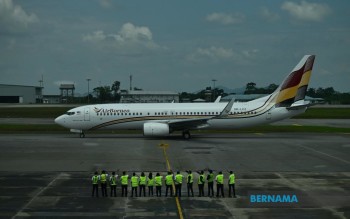
Deputy Prime Minister Datuk Seri Fadillah Yusof presided over a significant milestone for Malaysia's aviation sector on Saturday as AirBorneo Airways launched its inaugural commercial flight at Kuala Lumpur International Airport's Terminal 1. The carrier, owned and operated by the Sarawak state government, commenced operations with flight MY5005 arriving from Kuching carrying Sarawak Premier Tan Sri Abang Johari Tun Openg alongside state ministers and key stakeholders, signalling strong political backing for the venture.
The launch represents a watershed moment in Sarawak's decades-long quest to establish independent control over regional air services. Rather than relying exclusively on private carriers, the East Malaysian state has invested substantially in building its own airline infrastructure. This strategic pivot reflects broader concerns among regional governments about ensuring reliable, affordable connectivity for their populations whilst retaining economic benefits within state coffers. For Sarawak, which comprises Malaysia's largest state by area yet faces geographical challenges in inter-city travel, aviation represents a critical economic enabler.
AirBorneo chairman Datuk Amar Mohamad Abu Bakar Marzuki, who simultaneously serves as Sarawak state secretary, framed the inaugural service as emblematic of the state's commitment to economic self-determination. He emphasised that robust air connectivity functions as an "economic lifeline" underpinning business activity, tourism development, and workforce mobility across Sarawak's vast territory. The dual appointment of the airline's leadership reflects the deepened integration between commercial aviation and state governance in Sarawak's development planning.
Operationally, AirBorneo marks its transition into commercial jet service through wet-leased Boeing 737-800 aircraft, positioning itself competitively within Malaysia's domestic aviation landscape dominated by budget carriers and established full-service operators. The inaugural flight constitutes not merely a symbolic gesture but the commencement of scheduled, revenue-generating operations. From July 21, 2026, the airline will maintain twice-daily frequency between Kuching and Kuala Lumpur, a core domestic route linking Sarawak's capital to Malaysia's primary economic centre and international hub.
Ticketing pricing reveals AirBorneo's positioning strategy within the competitive Malaysian market. Economy fares of RM375 for one-way travel align with budget carrier pricing, whilst Business Class seats commence at RM736, offering a premium option for business travellers and higher-income passengers. This dual-tier approach suggests the carrier intends simultaneous penetration of cost-conscious leisure markets and premium segments, maximising revenue across passenger demographics. The Kuching-Kuala Lumpur corridor represents Malaysia's second-busiest domestic route by passenger volume, indicating substantial demand foundation for the new entrant.
Chief executive officer Megat Ardian Mohd Aminuddin articulated the airline's operational philosophy, prioritising safety and service quality whilst building passenger confidence during its market entry phase. New airlines face substantial challenges establishing customer loyalty and operational credibility; his emphasis on reliability and experience enhancement acknowledges these hurdles. The carrier's ability to retain passengers across its early operational period will substantially influence long-term viability, particularly given entrenched competition from Malaysia Airlines, AirAsia, and regional carriers already operating this route extensively.
The attendance of federal cabinet ministers—Tourism, Arts and Culture Minister Datuk Seri Tiong King Sing, Women, Family and Community Development Minister Datuk Seri Nancy Shukri, and Deputy Transport Minister Datuk Hasbi Habibollah—underscores Putrajaya's diplomatic acknowledgement of Sarawak's aviation aspirations. This ministerial presence signals federal acceptance, if not active endorsement, of a state-owned carrier competing within Malaysia's deregulated aviation sector. Such endorsement proves politically significant, as federal authorities retain regulatory oversight through the Civil Aviation Authority of Malaysia.
AirBorneo's expansion trajectory explicitly targets Singapore as its initial international destination, marking strategic ambition beyond domestic markets. The neighbouring city-state represents an accessible, high-yield international market with established business and tourist flows to Sarawak. Subsequent network expansion will likely encompass other regional capitals and secondary airports, building a network architecture that leverages Sarawak's geographical position as a Southeast Asian cross-roads. This internationalisation pathway mirrors strategies deployed by other state-backed carriers across the region seeking to maximise asset utilisation and revenue generation.
For Malaysian aviation consumers, AirBorneo's entry introduces additional competitive dynamics to the Kuching-Kuala Lumpur market, potentially exerting downward pressure on fares and stimulating service quality improvements across the sector. Enhanced frequency and capacity on this route may also stimulate latent demand for travel, particularly amongst price-sensitive passengers deterred by previous fare levels. However, the carrier's success remains contingent upon sustained operational performance, fuel cost management, and passenger acquisition against deeply entrenched competitors commanding superior brand recognition and network scale.
The airline's emergence reflects broader Southeast Asian trends towards state-backed aviation ventures, as regional governments increasingly view airlines as strategic assets supporting economic development and regional integration rather than purely commercial enterprises. Sarawak's investment parallels similar initiatives across the region, where governments recognise aviation's catalytic role in trade facilitation, tourism generation, and business ecosystem development. This state-sponsored approach contrasts sharply with earlier decades' privatisation orthodoxy, reflecting evolved thinking about aviation's developmental significance.
For stakeholders monitoring Sarawak's economic trajectory, AirBorneo's commencement signals tangible progress on longstanding calls for improved regional autonomy and economic self-sufficiency. Beyond aviation, the airline represents a visible embodiment of state capacity to execute complex infrastructure projects, establish regulatory compliance, and compete within sophisticated commercial markets. Success or failure will consequently carry implications extending beyond aviation, influencing perceptions of Sarawak's governmental competence and development potential amongst investors and policy observers.

