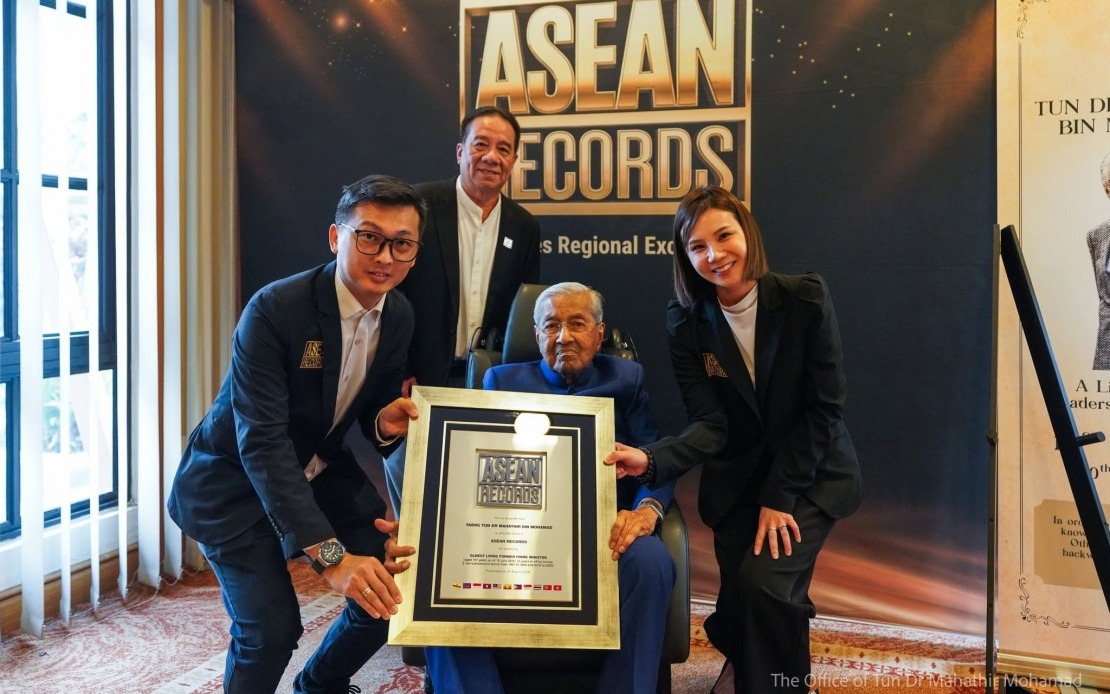
Former Prime Minister Tun Dr Mahathir Mohamad and his wife Tun Dr Siti Hasmah Mohd Ali have achieved a distinctive historical marker by becoming the subject of three separate record recognitions honouring their remarkable longevity and their significance as a political and personal partnership spanning seven decades. The achievement underscores the couple's unique position within Asia's contemporary political landscape, where few former heads of government have reached such advanced years alongside their spouses in good health and public visibility.
The recognition came through dual record-keeping bodies: ASEAN Records formally acknowledged Dr Mahathir, at 101 years old, as the Oldest Living Former Prime Minister across the entire ASEAN region, a distinction reflecting both his advanced age and the comparative youth of most regional governments. Separately, Dr Siti Hasmah, who celebrated her centenary in July, received designation as the Oldest Living Spouse of a Former Prime Minister, establishing her own category of historical significance. The third record, issued jointly by ASIA Records, recognises the couple as the First Former Head of Government and Spouse to Both Achieve Living Centenarian Status simultaneously, a milestone that highlights not only individual longevity but the exceptional rarity of both partners in a marriage surviving into their second century.
The formal presentation of these certificates occurred at a ceremony held at the Perdana Leadership Foundation in Kuala Lumpur, marking the culmination of a month of considerable personal significance for the household. The timing held particular resonance: Dr Mahathir had observed his 101st birthday on July 10, with Dr Siti Hasmah following just two days later on July 12, creating a condensed celebration of consecutive centenarian milestones. The couple's public acknowledgment of these events has maintained their presence in national consciousness even in their retirement from direct political engagement.
The third element of their record-breaking month arrived on August 5, when the couple commemorated their 70th wedding anniversary. This longevity of marriage, now spanning more than seven decades, represents itself a remarkable achievement in contemporary terms and adds depth to the recognition of their joint centenarian status. The combination of personal milestone celebrations—two birthdays in immediate succession and an anniversary shortly thereafter—created an extended period of reflection on a partnership that has transcended generations of Malaysian politics and social change.
The verification process undertaken by the adjudication teams from both ASEAN Records and ASIA Records involved comprehensive research to establish that no comparable achievement had been publicly documented throughout the ASEAN region and across major Asian markets. This methodological rigor distinguishes the recognition from informal acknowledgments, providing statistical and historical verification of the couple's unique position. The finding itself merits consideration: among the dozen ASEAN nations and the broader Asian continent encompassing billions of people, no other former national leader and spouse had simultaneously achieved centenarian status in documented records.
Tan Sri Danny Ooi, serving as chairman of the ASEAN Records Advisory Board, presided over the certificate presentation, working alongside chief adjudicators Gillian Ooi and Eldrick Koh. These officials carry responsibility not only for verifying individual records but for maintaining the credibility and standards of regional record-keeping bodies that increasingly serve as arbiters of achievement and longevity across Asia. The formal nature of the adjudication process reflects the genuine historical significance of the couple's achievement rather than treating it as a superficial honour.
Dr Mahathir's public acknowledgment of the recognition through a Facebook post maintained the former leader's established practice of communicating directly with his constituency and the broader Malaysian public. The post framed the recognition not as personal vanity but as a reflection of broader milestones that the couple had achieved collectively. This approach characterises much of Dr Mahathir's engagement in the post-political phase of his life, where commentary on current events and acknowledgment of personal matters have become intertwined.
The significance of these records extends beyond mere numerical achievement. Dr Mahathir's tenure as Prime Minister—spanning two discontinuous periods totalling over two decades—makes his status as the oldest living former holder of that office a living link to multiple eras of Malaysia's modern political development. His survival to this age, combined with Dr Siti Hasmah's presence as a conscious partner throughout, creates a historical continuity that few nations can claim. The couple represents institutional memory of political, social, and economic transitions that have reshaped Malaysia and the broader region.
For Malaysian audiences and broader Asian observers, the recognition holds subtle implications about healthcare, longevity trends, and the changing demographics of Asia's aging leadership class. That a former prime minister and his spouse can achieve centenarian status together speaks to advances in medical care, lifestyle factors, and the social circumstances of Malaysia's elite. It also raises questions about succession planning and the prolonged influence that senior political figures can exert even in ostensible retirement, particularly when their health permits continued public engagement and commentary on contemporary affairs.
The records also highlight the gendered dimension of historical recognition. While Dr Mahathir's achievements have always been extensively documented and celebrated, the specific designation of Dr Siti Hasmah as the Oldest Living Spouse of a Former Prime Minister creates a category that, while fitting her circumstances, implicitly defines her historical significance through her relationship to her husband's political role. This reflects broader patterns in how historical records sometimes categorise women, though the recognition itself ensures that her centenary milestone receives formal acknowledgment rather than remaining overshadowed by her husband's more prominent public profile.
Looking forward, the couple's continued wellbeing and the maintenance of these records remain subjects of interest not only for Malaysia but for the broader ASEAN region and Asia more generally. Their achievement provides a benchmark against which the longevity of other political figures and their spouses might be measured. Should either partner pass away, it would terminate the joint record, emphasizing the delicate and precious nature of what the adjudicators have recognised. For now, however, the records stand as testament to an extraordinary partnership that has endured through multiple centuries, witnessed transformative historical periods, and maintained sufficient public presence to secure formal historical recognition.

