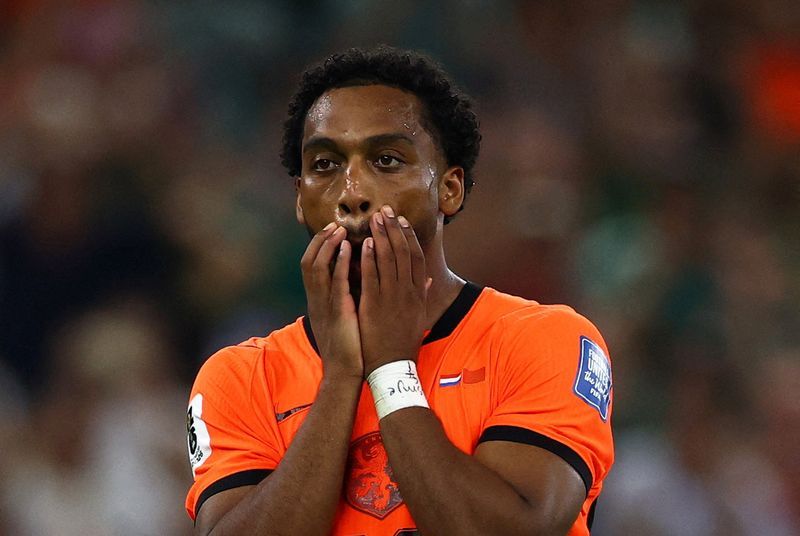
The Netherlands football association has condemned a wave of racial harassment directed at three players who failed to convert their spot-kicks during the country's dramatic World Cup elimination to Morocco. Justin Kluivert, Quinten Timber and Crysencio Summerville each missed their penalties as Morocco prevailed 3-2 in the shootout following a tightly contested last-32 encounter in Monterrey that remained level at 1-1 after extra time. The immediate aftermath of the match brought not just sporting disappointment but a barrage of hateful comments across social media platforms, prompting the Dutch football governing body to take swift action against the perpetrators.
The KNVB has announced plans to escalate the matter through established channels designed specifically to combat online discrimination. By filing reports with Meld Online Discriminatie—the Netherlands' dedicated platform for reporting digital hate speech—the association is triggering a formal investigation process that extends beyond social media platforms themselves. This institutional response recognizes that digital racism requires more than community reporting; it demands legal intervention and potential criminal consequences for those responsible. The organization's legal team will examine each reported instance to determine whether the posts constitute punishable offences under Dutch law, a threshold that distinguishes serious cases from mere incivility.
Should the legal assessment confirm criminal conduct, the matter proceeds to the Public Prosecution Service, which possesses authority to launch formal investigations and pursue charges. This multi-tiered approach reflects growing international recognition that online hate speech targeting athletes cannot be dismissed as mere trolling or the inevitable price of public performance. The KNVB's willingness to pursue institutional remedies demonstrates a commitment to holding perpetrators accountable through the justice system rather than relying solely on social media companies' content moderation policies, which have been criticized as inconsistent and often inadequate.
This incident represents the latest chapter in a troubling pattern where high-pressure sporting moments become catalysts for racist attacks directed at players of color. The memory remains fresh from the 2020 European Championship final when England's Marcus Rashford, Bukayo Saka and Jadon Sancho endured similar abuse following their unsuccessful penalty attempts in Italy's victory. Those cases demonstrated both the scale of the problem and the capacity of authorities to respond decisively. British police conducted extensive investigations that resulted in multiple arrests, leading to prison sentences for two individuals and a suspended custodial sentence for another. The coordinated law enforcement response in Britain established a precedent that online racism carries real legal consequences, not merely platform-based account suspensions.
The 2021 England precedent offers both encouragement and context for the Dutch response. That investigation's breadth revealed how organized some online hate movements can be, with coordinated campaigns targeting specific players. The criminal convictions that followed sent an unambiguous message that racial abuse would be prosecuted as seriously as offline hate crimes. However, the persistence of similar incidents despite those convictions also underscores the limitations of reactive legal action. As long as algorithmic amplification rewards engagement and cultural attitudes toward player abuse remain permissive in some quarters, isolated prosecutions may deter some perpetrators without fundamentally shifting online behavior.
For Malaysian and Southeast Asian observers, these Dutch-English experiences carry particular relevance. Professional football in the region has similarly grappled with online racism, including abuse directed at players based on ethnicity, nationality and religion. The regional football associations have generally been slower than their European counterparts to formalize legal complaint procedures, often defaulting to social media platform reporting or internal disciplinary measures. The Dutch and English examples suggest that creating dedicated institutional pathways—with clear legal backing and prosecution authority—may be necessary to meaningfully address the problem.
The KNVB's statement positioning football as inherently opposed to discrimination strikes at the philosophical core of the issue. The association notes that sport's fundamental purpose involves uniting diverse populations across differences, making racism fundamentally antithetical to football's values and social function. This framing rejects the notion that online abuse should be tolerated as an unavoidable accompaniment to elite sport. Instead, it asserts that maintaining football's inclusive character requires active defense against those who would use sporting platforms to promote hatred. The statement represents an explicit rejection of arguments that players must simply accept abuse as part of their public status.
The timing of racist abuse immediately following penalty failures adds another dimension worth examining. Missed penalties represent moments of maximum emotional intensity for both fans and players, potentially lowering inhibitions against expressing prejudices that might normally remain dormant. This psychological reality suggests that targeted prevention campaigns during major tournaments—educating fans about consequences and encouraging reporting—might prove more effective than waiting for abuse to occur before responding. Some European clubs have begun implementing such proactive strategies, training supporters to recognize racist behavior and report it in real time rather than after the fact.
Looking forward, the Dutch case will likely influence how football associations across Europe and beyond approach online harassment. If prosecutions follow and convictions result, it will reinforce the 2021 England precedent that digital racism faces serious legal consequences. Conversely, if investigations stall or convictions prove elusive, it may embolden perpetrators by demonstrating that formal complaint procedures lack enforcement power. The outcome will matter not only for the affected Dutch players but for establishing whether the infrastructure created to combat online discrimination can actually function as intended. For football-loving Malaysia and the broader Southeast Asian region, watching how these cases develop provides crucial lessons about the practical challenges of translating commitments against racism into measurable deterrent effects.

