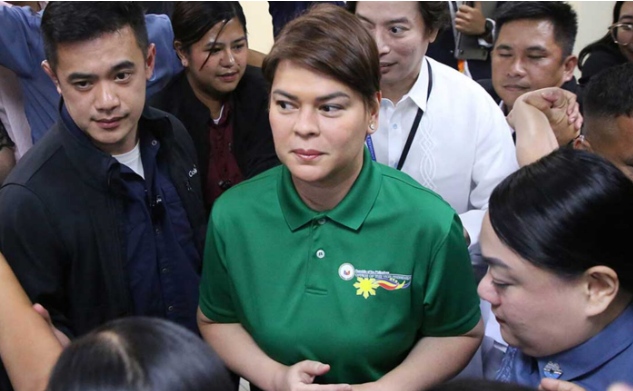
Vice President Sara Duterte doubled down on her assertion on Tuesday that the impeachment complaint centring on an alleged assassination plot against President Ferdinand R. Marcos Jr, First Lady Liza Marcos and former House Speaker Martin Romualdez stands on shaky evidentiary ground. Speaking before the Senate impeachment court commenced its fourth day of hearings, Duterte characterised the prosecution's case as fundamentally hollow, a pattern she claims has become increasingly apparent as proceedings unfold.
Duterte's statement came as her chief of staff, Zuleika Lopez, prepared to take the witness stand as the prosecution's third witness to testify about the alleged murder conspiracy. The timing of Duterte's rebuttal underscores the intensity of the political battle now consuming Manila's highest echelons, with the Vice President choosing to speak publicly rather than remain silent during what amounts to an existential constitutional challenge to her political future.
The Vice President's defence team seized upon apparent documentary discrepancies identified during cross-examination of the prosecution's second witness, Jeremy Lotoc, the National Bureau of Investigation's regional director for the Bangsamoro Autonomous Region in Muslim Mindanao. Defence lawyer Mark Vinluan highlighted inconsistencies between dates recorded in affidavits and corresponding docket numbers in NBI files, suggesting sloppy investigative work or worse. These gaps, Duterte's team argues, undermine the foundation upon which the entire prosecution rests.
In her statement, Duterte characterised the complaint as a construction of fiction masquerading as fact. She accused the prosecution of repeatedly invoking threats she insists never materialised, conjuring an assassin from thin air, and assembling a patchwork of fabricated evidence to lend credibility to narratives divorced from reality. For Duterte, these transgressions carry consequences extending far beyond her own legal predicament. She framed the trial as a test case for whether the Philippine justice system will permit institutional integrity to be sacrificed on the altar of political convenience.
The broader implications Duterte draws are stark: she contends that manufacturing allegations, inventing evidence, and abandoning evidentiary standards do not magically transform falsehood into truth, no matter how many times prosecutors repeat their claims. Rather, such conduct corrodes public faith in institutions, squanders national resources on trivial prosecutions, and corrupts the fundamental search for truth that courts and investigative bodies should serve. For a nation still rebuilding democratic institutions, Duterte suggests, this moment matters profoundly.
Central to Duterte's defence strategy is an insistence that impeachment—a drastic constitutional remedy designed to remove a sitting president or vice president—must rest exclusively on proven facts rather than conjecture, manufactured narratives, or unsubstantiated accusations. This represents a significant rhetorical shift in Philippine impeachment jurisprudence, challenging the political branch's traditional latitude in impeachment matters. Duterte is essentially arguing that constitutional accountability must still answer to evidentiary discipline, a proposition that resonates beyond the Senate chamber.
The impeachment court is currently working through Article IV of the charges, which concerns the assassination plot allegations that Duterte herself had initially disclosed. Paradoxically, the Vice President's own revelation of the murder conspiracy—comments she made publicly about threats to Marcos and his family—forms the foundation of the impeachment complaint now arrayed against her. This unusual dynamic reflects the chaotic nature of Philippine high-level politics, where yesterday's allies become today's mortal enemies with disconcerting speed.
Progress through the proceedings has been deliberately measured. The prosecution team has presented only two witnesses thus far and has consumed minimal time from the eleven days allocated specifically for Article IV testimony. Given this glacial pace, completing even the current article of impeachment appears distant. The entire trial framework anticipates approximately 92 days of proceedings, suggesting that final resolution may not arrive until early 2027, an outcome that would stretch this constitutional crisis across multiple years and numerous political cycles.
Notably, Duterte has maintained her absence from the Senate courtroom throughout the trial, choosing instead to mount her defence through statements and her legal team's courtroom presence. This strategy contrasts sharply with the typical approach of impeached officials, many of whom use their personal appearance to sway public opinion and senatorial sentiment. Whether Duterte's absence reflects calculated confidence in her lawyers' capabilities or signals concerns about how her demeanour might play before cameras and the television-watching public remains unclear, but it represents a significant gamble in a proceeding where narrative and perception matter as much as technical legal arguments.
For Malaysian observers and Southeast Asian analysts, the Philippine impeachment saga underscores the precarious position of democratic institutions across the region. Unlike Malaysia's parliamentary system, where prime ministers rely on legislative confidence and can be replaced through confidence votes, the Philippine presidential system creates rigid constitutional structures that can only remove executives through the extraordinary remedy of impeachment. The current trial illustrates both the importance of such mechanisms as checks on executive excess and the danger that they become weapons in factional struggles, potentially delegitimising the very institutions they are meant to strengthen.
The unfolding trial also reflects Philippine society's deep political polarisation. Duterte's defence portrays the impeachment as politically motivated persecution masquerading as constitutional accountability, a narrative that finds considerable purchase among her political supporters. Conversely, the prosecution frames the trial as a necessary mechanism to hold the Vice President accountable for grave allegations. This fundamental disagreement about the trial's legitimacy—whether it represents proper constitutional governance or political vendetta—cannot be resolved through evidence alone, making the months ahead politically treacherous for the Philippines.
As the impeachment proceedings grind forward, Duterte's insistence on evidentiary rigor and factual precision will likely define defence strategy throughout the remaining articles of complaint. Her repeated emphasis on the rule of law depending on facts rather than fiction suggests she intends to challenge not merely the substance of specific accusations but the very foundation of the prosecution's case. Whether the Senate ultimately accepts this argument—and whether the Filipino public perceives the proceedings as legitimate constitutional accountability or destructive political warfare—will shape Philippine governance for years to come.

