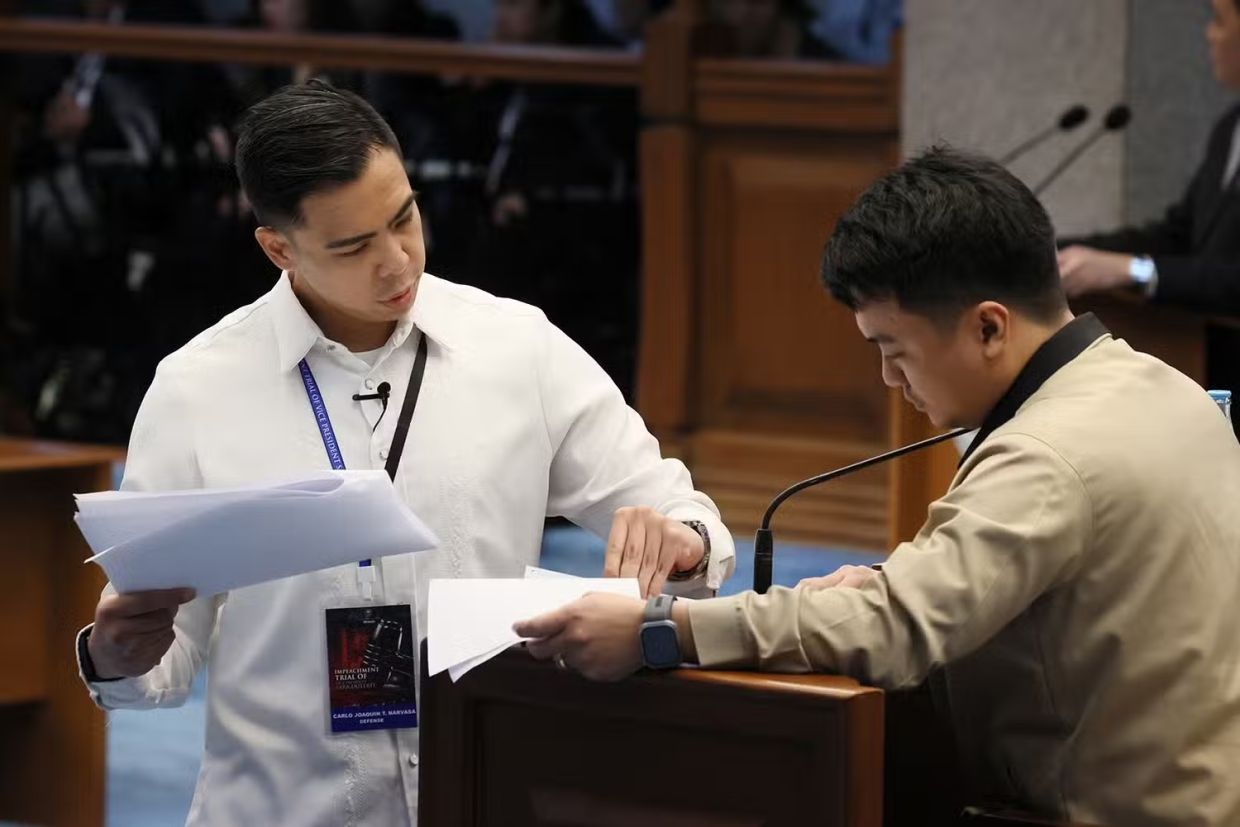
The constitutional foundation of the case against Philippine Vice President Sara Duterte came under sustained scrutiny during the third day of her Senate impeachment trial as her legal team mounted a forceful challenge to the prosecution's core allegations. Rather than disputing the fact that she made threatening statements in November 2024, Duterte's defence shifted the battleground to the legal question of whether such remarks, even if provocative, could properly be classified as an impeachable offence under the 1987 Philippine Constitution.
Defence counsel Mark Vinluan presented an argument that hinged on a subtle but legally significant distinction: that Duterte's controversial statements, made during an online press briefing on November 23, 2024, targeted at President Ferdinand Marcos, First Lady Liza Araneta-Marcos, and former Speaker Martin Romualdez, fell short of constituting "other high crimes" as enumerated in Article XI, Section 2 of the Constitution. That constitutional provision lists specific grounds for impeachment, including culpable violation of the Constitution, treason, bribery, graft and corruption, and betrayal of public trust. Vinluan's position effectively conceded the rhetorical quality of Duterte's utterances while denying their legal classification as impeachable conduct, a distinction with profound implications for how Philippine law treats political speech and presidential accountability.
The defence strategy revealed itself most clearly during cross-examination of National Bureau of Investigation senior agent John Mark Calilung, the prosecution's opening witness. Rather than dwelling on the substance of what Duterte said, defence lawyers methodically exposed what they characterised as gaping holes in the government's investigative foundation. Vinluan repeatedly emphasised that the prosecution had failed to produce concrete evidence demonstrating that Duterte had actually hired an assassin, instead relying on her recorded words as circumstantial indication of intent. This framing transformed the trial into a debate about evidentiary standards and the threshold required to convert intemperate speech into criminal conduct, a framework that advantages the defence by forcing prosecutors to prove something beyond mere utterance.
The contextual narrative offered by the defence team painted Duterte not as a rogue official issuing uncalculated threats but as a person under siege, responding protectively to what she and her circle perceived as systematic government persecution. Vinluan cited what he described as "unauthorised intelligence and surveillance operations" targeting Duterte's family, alleged profiling of her residences in Davao and Manila, and the removal of trusted security personnel. More immediately, the defence anchored Duterte's statements to the detention and contempt citation of her chief of staff Zuleika Lopez, whose breakdown during a House committee proceeding was presented as the emotional trigger for the Vice President's subsequent outburst. By reconstructing the timeline and the psychological atmosphere surrounding the statements, the defence sought to reframe what prosecutors characterised as menace into what it portrayed as a desperate family member's reaction to what it claimed was coordinated institutional harassment.
This contextualisation carried particular weight because it highlighted the involvement of Representative Joel Chua, now serving as one of the House prosecutors, in the very investigations and committee proceedings that Duterte's team characterised as oppressive. Defence lawyer Carlo Narvasa invoked the phrase "systematic oppression" by the House committee in its handling of Duterte and her staff, contending that the legal proceedings against her must be understood against this broader backdrop of institutional conflict. The implication was direct: Duterte was not a rogue actor threatening government officials on a whim but rather a political figure responding, however unconventionally, to what her team framed as coordinated executive and legislative action against her and her associates. This meta-political argument, if accepted by the Senate court, could substantially alter how her statements are legally evaluated, shifting focus from the words themselves to the environment in which they were uttered.
Senator Francis Escudero, the court's presiding officer, at one point intervened to note that the proceedings had crystallised around the central question before the impeachment court: whether Duterte's conduct amounted to impeachable offences under the Constitution. This observation underscored the fundamental tension in the trial. The prosecution relies principally on the evidentiary power of Duterte's own words, recorded during the November 23 briefing, as establishing her intent and dangerousness. Yet the defence refuses to accept that threatening language, regardless of its venom, automatically crosses into constitutionally impeachable territory. The defence further contends that without direct evidence of an actual assassination plot or hiring of an assassin, the statements remain at the level of inflammatory rhetoric rather than criminal conspiracy.
When Senator Risa Hontiveros pressed prosecution counsel Amando Ligutan on whether the recorded statements conclusively proved that Duterte had contracted an assassin, Ligutan's acknowledgement that the recordings did not constitute definitive proof became a critical concession that the defence weaponised throughout its cross-examination. Ligutan's explanation that the statements formed part of a pattern demonstrating intent could not overcome the logical gap the defence identified: aggressive words do not necessarily evidence criminal action. This evidentiary deficit became even more apparent when the defence questioned the NBI investigation itself, with Narvasa highlighting significant procedural irregularities. The NBI conducted the investigation on its own initiative without a formal complainant, and notably, none of the three alleged targets—Marcos, Araneta-Marcos, or Romualdez—filed criminal complaints with the bureau or appeared before it personally.
The absence of sworn statements from the targets of Duterte's threats, combined with the lack of formal complaints from the offended parties, created a procedural vulnerability in the prosecution's case that the defence relentlessly exploited. Calilung's acknowledgement that his revised affidavit of February 10, 2025, did not include testimonies from the alleged victims or from journalists who attended the press briefing further underscored the investigative gaps. When Narvasa pointedly asked whether a genuine investigation had been conducted at all, the defence succeeded in casting doubt on the thoroughness and legitimacy of the government's factual foundation, even before the legal question of whether the conduct constituted impeachable conduct reached the foreground of judicial consideration.
What emerged from this phase of the trial is a bifurcated legal strategy on the part of the defence. First, it challenges the empirical underpinnings of the case by questioning whether the evidence actually demonstrates the criminal conduct the prosecution alleges. Second, it contests the constitutional classification of the conduct, arguing that even if the statements were made and even if they were provocative, they do not satisfy the constitutional definition of impeachable high crimes. This two-pronged approach, if effective, could persuade the Senate court that the impeachment rests on insufficient factual and legal foundations, making conviction unlikely. The strategy also subtly shifts political dynamics by suggesting that Duterte has been subjected to persecution rather than representing a danger to constitutional order, a narrative that resonates with her political base and may influence the calculations of senator-judges mindful of the broader political implications of their votes.
The trial's trajectory now hinges significantly on whether the Senate accepts the defence's framework that not all grave threats by public officials constitute impeachable high crimes, or whether it adopts a more expansive view of constitutional accountability. The prosecution must ultimately prove that Duterte's statements crossed from intemperate speech into conduct so fundamentally incompatible with her constitutional duties as to warrant removal from office. Whether a Senate dominated by varying political alignments will view that threshold as satisfied remains the central unanswered question as the trial proceeds toward closing arguments and a final vote on her removal.

