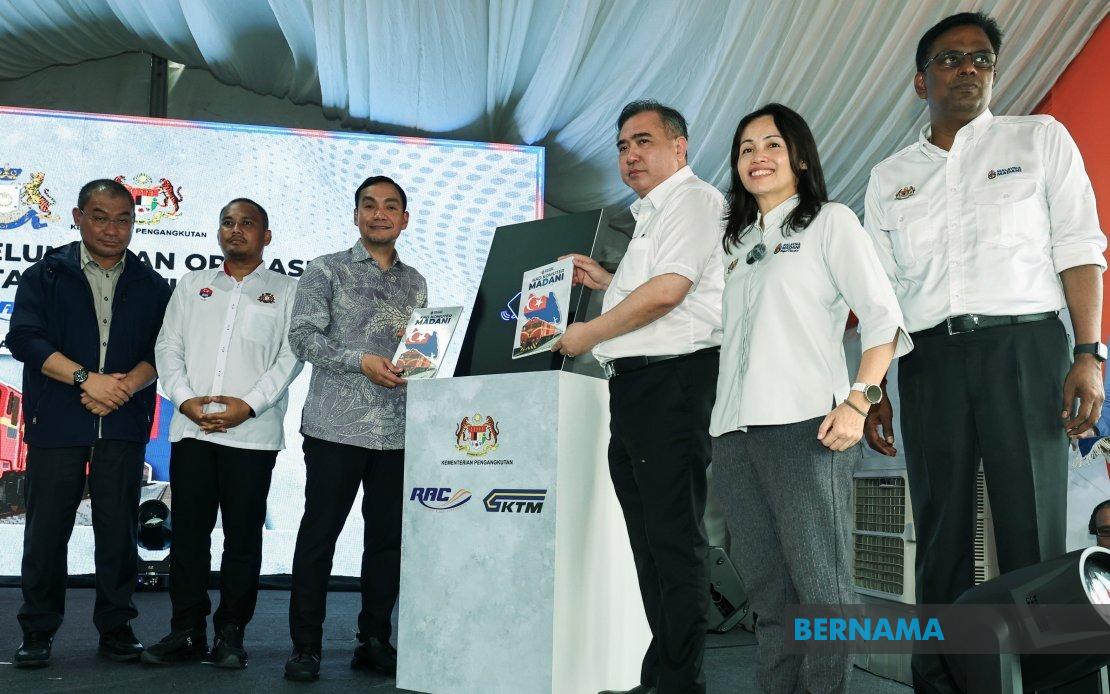
Johor Menteri Besar Datuk Seri Onn Hafiz Ghazi has underscored the importance of the Elevated Autonomous Rapid Transit (E-ART) project in managing anticipated traffic pressure across Johor Bahru once the Johor Bahru-Singapore Rapid Transit System (RTS) Link becomes operational next year. Speaking at the Southern Shuttle train service launch at KTM Kulai Station, Onn Hafiz stressed that without this ambitious infrastructure initiative, the state risks experiencing substantial road congestion as cross-border commuter flows intensify following the RTS Link's commencement.
The Menteri Besar's remarks reflect growing concern among state and federal authorities that existing transportation infrastructure and interim measures may prove insufficient to accommodate the surge in passenger movement anticipated after the new rail connection opens. The RTS Link represents a watershed moment for Johor Bahru's status as a crucial regional economic hub, but its operational success depends significantly on how well the state manages downstream traffic distribution and modal shift from private vehicles to public transport.
According to Onn Hafiz, the range of interim measures currently being rolled out—principally the expansion of Park & Ride facilities and the implementation of sophisticated traffic management systems at JB Sentral—can only provide temporary relief from congestion challenges. These short and medium-term interventions, while necessary and beneficial in the near term, represent holding operations rather than comprehensive solutions to the mobility demands that will emerge once the RTS Link fully opens its operations to the travelling public. The E-ART project, by contrast, addresses the fundamental need for high-capacity, grade-separated rapid transit that can shift significant volumes of passengers away from the congested surface road network.
The critical gap between current capacity and projected demand underscores why authorities view the E-ART as strategically essential rather than merely desirable. Johor Bahru's population, which stands at approximately 1.8 million residents, rivals that of Penang, Malaysia's second-largest metropolitan area. This demographic scale, combined with the state's role as the nation's primary international gateway with substantial cross-border movement, creates transportation pressures that demand sophisticated, multi-layered solutions rather than single-mode interventions.
Onn Hafiz articulated the broader context for his advocacy, emphasising that Johor Bahru requires an integrated public transport ecosystem characterised by efficiency, substantial capacity, and seamless connectivity across different modes and services. The convergence of residential growth, increasing commercial activity, and international transit flows positions the state's urban centres as facing transportation challenges comparable to those confronting other major Southeast Asian cities grappling with rapid urbanisation and motorisation. Without proactive investment in mass rapid transit infrastructure, these pressures can quickly translate into congestion that undermines economic competitiveness and quality of life.
The Menteri Besar appealed directly to the federal government to prioritise expediting the E-ART project, framing its completion and operation as a demonstration of tangible central government commitment to regional development. By characterising this infrastructure investment as a form of federal intervention capable of delivering measurable improvements to residents' daily lives, Onn Hafiz positioned the E-ART beyond technical transportation planning and into the realm of political legacy and public trust. He suggested that swift, effective implementation would resonate with Johor communities as evidence of responsive, outcome-focused governance.
Transport Minister Anthony Loke and Deputy Communications Minister Teo Nie Ching, who holds the Kulai parliamentary seat, attended the Southern Shuttle launch, underscoring federal engagement with Johor's transportation agenda. Their presence at the event alongside the Menteri Besar signalled alignment between state and federal authorities on the urgency of addressing transport infrastructure deficits, though the statement itself did not elaborate on timelines or funding arrangements for the E-ART project.
The Southern Shuttle service launch itself represents a modest but symbolically significant step in enhancing rail connectivity within Johor, complementing the broader slate of transport initiatives aimed at increasing public transport mode share ahead of the RTS Link opening. However, such incremental improvements, while valuable, cannot substitute for the transformative capacity that an autonomous rapid transit system would provide in managing the anticipated surge in cross-border passenger volumes.
For Malaysian policymakers and urban planners monitoring Johor Bahru's development trajectory, the emphasis on E-ART reflects a recognition that integrated transport planning requires simultaneous attention to both immediate operational bottlenecks and longer-term structural solutions. The state's experience will offer important lessons for other Malaysian cities anticipating growth pressures or major transport infrastructure additions, particularly regarding the criticality of ensuring adequate distributional capacity before demand surges overwhelm existing networks.
Onn Hafiz's advocacy for accelerating the E-ART project indicates that senior state leadership views the window for preparing Johor Bahru's transportation infrastructure as narrowing as the RTS Link's opening approaches. The challenge now centres on translating this political will into concrete implementation timelines, funding commitments, and technological frameworks capable of delivering a functional autonomous rapid transit system that can meaningfully alleviate congestion and improve urban mobility across the state's major population centres.