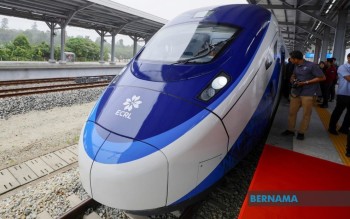
The East Coast Rail Link, a transformative RM50.27 billion infrastructure initiative spanning 665 kilometres, is forecast to inject between RM80 and RM90 billion into Malaysia's cumulative gross domestic product by 2047. Deputy Economy Minister Datuk Mohd Shahar Abdullah outlined this projection recently in Kuantan, framing the project not as a standalone transportation artery but as a comprehensive economic development platform that will reshape investment and employment patterns across peninsular Malaysia's eastern seaboard.
The backbone of this growth projection rests on 21 Economic Accelerator Projects strategically positioned along the corridor, each designed to catalyse localised economic activity and attract regional and international investment. These initiatives move beyond the traditional railway construct, transforming the ECRL into an integrated logistics and industrial ecosystem. The government's vision reflects a broader understanding that modern infrastructure projects must serve multiple concurrent functions: moving passengers and freight, yes, but equally important, anchoring supply chains and enabling business clusters to flourish in previously underserved regions.
Three designated logistics hubs stand out as critical anchors within this framework. Pasir Puteh in Kelantan will occupy 213 acres, positioning itself as a northern gateway for East Coast commerce. Kemaman in Terengganu claims 68 acres, strategically located to serve the resource-rich central coastal region. Temerloh in Pahang, meanwhile, will develop a 50-acre facility, potentially serving as a junction point between the ECRL network and broader domestic logistics corridors. Each hub has been deliberately sited to leverage local geographic advantages and existing industrial concentrations, converting railway stations into multimodal transportation nodes that can handle containerised cargo, light manufacturing inputs, and consumer goods destined for regional markets.
A flagship example of this logistics strategy is the Perodua hub at Paya Besar in Kuantan, where the automotive supplier and manufacturer has committed to a phased development. The first phase is slated for completion by 2029, positioning Perodua to leverage ECRL connectivity for both domestic distribution and potential export orientation. This alignment between private sector expansion and public infrastructure delivery signals a maturation in how Malaysian policymakers approach public-private coordination. Rather than building infrastructure and hoping industry follows, the government and anchor corporations are effectively choreographing development timelines.
Mohd Shahar, who represents the Paya Besar constituency, articulated a crucial strategic principle: the ECRL should be understood as complementary to, rather than competitive with, existing international maritime routes. This framing addresses legitimate concerns from port operators and established logistics players who might otherwise view the rail project as a threat. By positioning the ECRL as an enhancement to Malaysia's overall logistics ecosystem rather than a replacement for established shipping corridors, the government is attempting to build broader stakeholder consensus. The rail link can absorb domestic inter-regional cargo, reduce truck congestion on key highways, and create redundancy in national supply chains—all without cannibalising existing port infrastructure or international shipping volumes.
The project represents a deliberate effort to narrow developmental disparities between Malaysia's prosperous west coast and its comparatively underdeveloped east coast. Historically, the east coast has suffered from geographic isolation, limited industrial diversification, and dependence on primary sector activities. The ECRL aims to fundamentally alter this calculus by reducing transit times, lowering logistics costs, and creating agglomeration advantages that attract manufacturing and services investment. In this sense, the project embodies principles outlined in the MADANI Economy framework, which prioritises inclusive growth and regional balance as central economic objectives.
The ECRL's physical specifications underscore its dual-purpose design. The project has allocated 11 six-car electric multiple unit train sets for passenger services, acknowledging that even in freight-dominant corridors, urban commuter demand justifies simultaneous investment in passenger capacity. Additionally, 12 electric locomotives have been earmarked for dedicated cargo operations, ensuring that the network can handle the industrial and commercial volumes anticipated from the Economic Accelerator Projects. This balanced approach reflects lessons learned from earlier Malaysian rail investments and international best practice regarding infrastructure utilisation.
Implementation is being guided by the 13th Malaysia Plan, which employs the Malaysia Development Composite Index and MyRMK system to ensure investment allocations reach areas with greatest need and development potential. This methodological approach attempts to move beyond political patronage in infrastructure spending, instead grounding decisions in objective measurements of regional capacity and growth constraints. For East Coast stakeholders, this represents a commitment that ECRL-linked development will be informed by rigorous assessment of local conditions rather than ad-hoc decision-making.
The timeline for the ECRL's completion and operational commencement is equally significant. Scheduled for completion in December 2026 and expected to commence operations in January 2027, the project is approaching a critical juncture. These dates represent not merely symbolic milestones but the threshold at which long-term economic projections begin materialising. The transition from construction phase to operational phase will reveal whether anticipated logistics benefits and employment creation actually materialise or whether implementation challenges have diluted the original vision.
For Malaysian policymakers and the broader Southeast Asian business community, the ECRL serves as a test case for whether integrated infrastructure-development strategies can meaningfully alter regional economic trajectories. The RM80–90 billion GDP projection by 2047 is neither modest nor guaranteed. It depends on the 21 Economic Accelerator Projects delivering measurable returns, on private sector entities like Perodua following through on expansion commitments, and on the broader East Coast business environment becoming sufficiently attractive to sustain investment momentum across two decades. If realised, however, the ECRL could establish a template for how infrastructure investment can drive regional rebalancing in an increasingly competitive Southeast Asian economic landscape.

