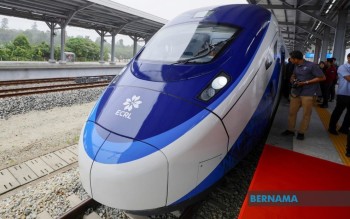
The East Coast Rail Link represents far more than a transportation infrastructure project for Malaysia's eastern peninsula. According to Deputy Minister of Economy Datuk Mohd Shahar Abdullah, the mega-project is fundamentally reshaping the region's economic architecture by fostering an integrated ecosystem that touches every stage of commercial activity, from initial supply chain operations through to final delivery and maintenance.
Mohd Shahar, speaking recently in Kuantan, articulated a vision in which ECRL development serves as a catalyst for entrepreneurial expansion across Pahang, Terengganu, Kelantan and Selangor. The infrastructure's value extends beyond moving cargo efficiently; it enables the creation of entire business clusters centred around the rail corridor. These clusters encompass warehousing facilities, industrial parks, and logistics hubs that will generate employment and attract investment across multiple sectors simultaneously.
The economics underlying this expansion are compelling for Malaysian business operators. Entrepreneurs currently constrained by geography or prohibitive transport costs will find their addressable market suddenly enlarged. The reduction in logistics expenditure coupled with faster delivery times means small and medium enterprises can compete on more equitable terms with larger established competitors. A manufacturer producing batik textiles or food products in Terengganu, for instance, can now service buyers in Selangor with speed and cost efficiency previously unimaginable.
Datuk Mohd Shahar, who represents Paya Besar in parliament, specifically highlighted the production economics angle. Higher output volumes become feasible when access to expanded customer bases reduces unsold inventory risk. The transition from producing ten thousand to twenty thousand units annually transforms unit costs fundamentally. Manufacturing competitiveness depends not solely on operational efficiency but on achieving sufficient scale to negotiate favourable input prices and absorb fixed costs across larger production runs. ECRL removes the geographic constraints that previously capped achievable volumes for regional producers.
The logistics sector itself emerges as a major beneficiary. Warehouse operators, freight forwarders, and supply chain management companies will proliferate along the corridor. These are not merely service providers but integrators who understand local business ecosystems and can offer customised solutions for regional entrepreneurs. The development of strategically positioned industrial parks transforms raw transportation capacity into comprehensive business infrastructure where manufacturing, distribution, and value addition occur seamlessly.
Tourism represents an often-overlooked dimension of ECRL's economic impact. Improved accessibility enhances visitor flows to cultural and natural attractions throughout the East Coast, benefiting an entire ecosystem of micro-enterprises. Small traders, handicraft artisans, food vendors, and local product manufacturers gain exposure to tourist markets. Batik producers, particularly those in Terengganu, stand to expand beyond domestic souvenir markets into organised tourism channels with reliable customer flows and structured supply arrangements.
However, Datuk Mohd Shahar issued a calibrated warning to entrepreneurs: infrastructure alone does not guarantee success. Businesses must actively adapt their operational models to leverage new technological capabilities available through improved connectivity. This includes e-commerce integration, real-time inventory management systems, and digital marketing approaches. The ECRL era demands entrepreneurial evolution beyond traditional business practices that succeed through geographic protection or limited competition.
The project timeline remains critical to these commercial calculations. Pahang recorded 97.33 per cent completion progress as of the most recent reporting period, whilst the overall mega-project stood at 93.66 per cent completion as of April, with December targeted for full commissioning. This timeline allows businesses to plan capital investments and operational restructuring in anticipation of the facility becoming operational.
For Malaysian policymakers and regional observers, ECRL exemplifies how infrastructure investment extends beyond construction metrics. The project represents a deliberate architectural approach to regional economic balance, consciously designed to redistribute economic opportunity beyond traditional Klang Valley concentration. By creating business ecosystems rather than merely building transport corridors, Malaysian authorities signal commitment to inclusive growth where East Coast entrepreneurship becomes viably competitive against larger established enterprises operating from more developed regions.
The broader regional implication carries significance for Southeast Asia. As Indonesia, Thailand, and Vietnam pursue comparable rail development initiatives, Malaysia's ECRL approach demonstrates practical methodologies for translating infrastructure into tangible entrepreneurial opportunity. The integration of logistics, industrial development, and tourism economics offers a replicable model for nations seeking to activate underutilised regional capacity.
Ultimately, ECRL's success hinges on whether entrepreneurs across the East Coast genuinely seise the opportunities Datuk Mohd Shahar describes. The infrastructure removes structural barriers that previously limited market access and logistics efficiency. What remains is the entrepreneurial imperative to innovate, scale operations, and embrace technological modernisation. For businesses prepared to evolve beyond traditional models, the ECRL era represents genuine transformational potential.

