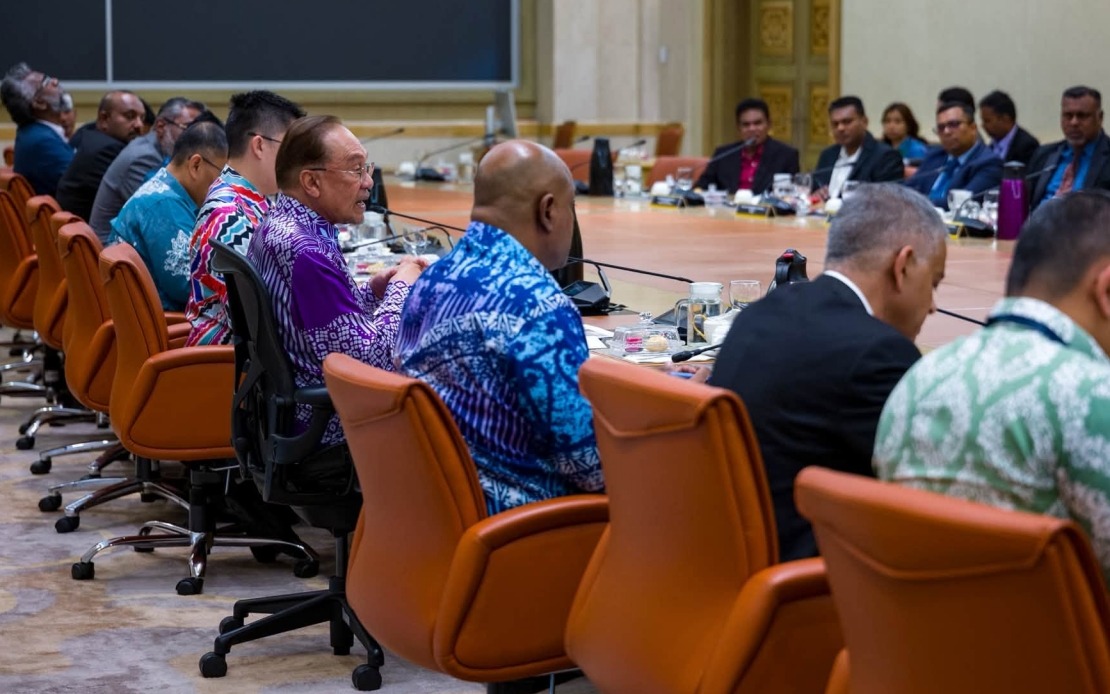
Prime Minister Datuk Seri Anwar Ibrahim has set out an agenda placing education, comprehensive social welfare, skills development and employment prospects at the heart of efforts to advance Malaysia's Indian community. Speaking after meeting with leaders from the Indian community, Anwar underscored the necessity of tackling structural barriers that have historically limited opportunities within the demographic, signalling a commitment to addressing longstanding grievances through targeted intervention rather than broad-based initiatives.
The Prime Minister, who concurrently holds the Finance Ministry portfolio, highlighted the role of the Malaysian Indian Transformation Unit (MITRA) as a critical vehicle for implementing community-centred policy. His emphasis on MITRA's responsibility reflects recognition that dedicated institutional structures are essential for translating political commitment into measurable outcomes. The agency has been tasked with moving beyond centralised policy-making to develop programmes rooted in real community conditions and articulated needs.
Anwar's call for a more proactive grassroots approach signals frustration with the gap between policy design and ground-level execution. He specifically urged MITRA and affiliated government bodies to intensify engagement with Indian communities, moving away from top-down models that may misallocate resources or overlook emerging concerns. This grassroots emphasis is particularly significant given Malaysia's history of uneven development across demographic lines, where communities in smaller towns and rural areas have often received disproportionately less attention and funding than their urban counterparts.
A core element of Anwar's framework is the identification of genuine community needs through sustained dialogue and consultation. He stressed that MITRA must develop robust mechanisms for understanding local conditions, identifying gaps in existing provisions, and designing interventions that address specific, rather than generalised, challenges. This approach suggests acknowledgment that cookie-cutter solutions frequently fail to account for the diversity within community groups, and that the Indian community in Malaysia faces distinct challenges across different regions and socioeconomic strata.
The Prime Minister emphasised accountability, requiring that government programmes deliver tangible benefits to those most vulnerable. This language reflects broader governance concerns about wastage and misalignment between intended and actual beneficiaries—issues that have dogged Malaysian social programmes. By explicitly linking resource allocation to verified need, Anwar has set a standard against which MITRA's performance can be measured, potentially creating political consequences for agencies that fail to demonstrate impact.
Education emerged as the paramount priority in Anwar's formulation, reflecting understanding that schooling quality functions as a foundational determinant of economic mobility and social integration. Investment in primary, secondary and tertiary education within Indian communities directly influences employment prospects, income levels, and intergenerational wealth accumulation. This focus aligns with international evidence suggesting that education gaps correlate strongly with persistent economic disparities across demographic groups in multi-ethnic societies.
Skills development constitutes an equally critical component of the strategy, particularly given labour market dynamics requiring workers to adapt to technological change and evolving economic structures. By prioritising vocational and technical training alongside traditional academic pathways, the government signals recognition that not all community members will follow conventional educational trajectories, and that alternative routes to employability must be strengthened. This is especially relevant in Malaysia's context, where skills gaps in emerging sectors have constrained employment growth in some communities.
Employment opportunities form the ultimate objective, with education and skills functioning as enabling mechanisms. Anwar's framing acknowledges that government investment in human capital remains incomplete without corresponding efforts to expand job markets accessible to trained workers. This may implicitly reference concerns within the Indian community regarding under-representation in certain sectors and occupational levels, and the need for deliberate efforts to create pathways into better-remunerated and more stable employment.
The Prime Minister's invocation of compassion, accountability and good governance as guiding principles reflects an attempt to ground policy in moral philosophy whilst maintaining operational discipline. Compassion justifies prioritising vulnerable segments; accountability ensures resources are deployed efficiently; and good governance demands transparency and rule-based decision-making. Together, these principles establish a framework within which disparities should be addressed through fair, consistent, and evidence-based approaches rather than patronage or ad-hoc interventions.
Anwar's vision of ensuring no segment of society is left behind positions Indian community advancement within a broader inclusive development narrative. This framing matters for broader social cohesion, as it suggests that demographic progress is not zero-sum but rather conducive to overall national prosperity. By securing better futures for historically marginalised groups, Malaysia enhances social stability, economic dynamism, and political legitimacy across its diverse population.
The announcement carries implications for Malaysian Indian community organisations, which will likely expect concrete resource allocations and measurable timelines for MITRA initiatives. It also signals to other marginalised groups that similar frameworks may be applied to their circumstances, potentially establishing precedent for how the government addresses persistent inequalities. For regional observers, the approach reflects thinking about social cohesion in plural societies, where demographic grievances, if unaddressed, risk undermining stability.
Implementation will prove crucial to assessing whether these principles translate into improved conditions. MITRA will face pressure to demonstrate that its engagement genuinely influences resource allocation, that community voices shape programme design, and that beneficiaries experience tangible improvements in educational access, welfare support, and employment prospects. The coming months will reveal whether this represents a genuine reorientation toward community-centred governance or a rhetorical gesture lacking substantive institutional change.

