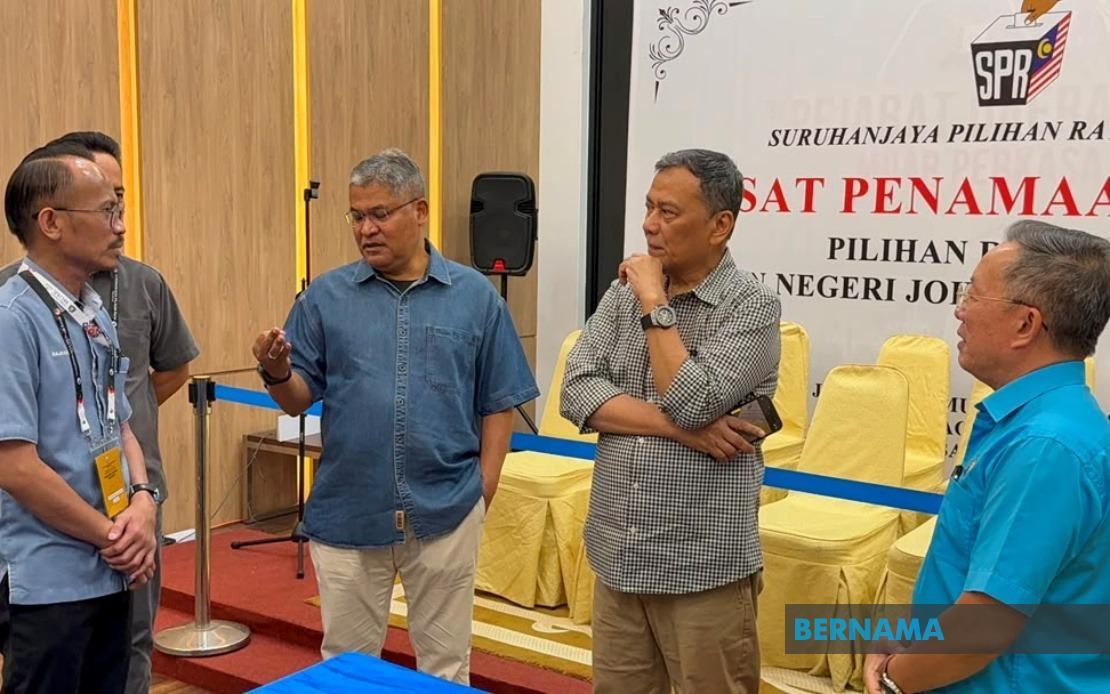
With the Johor state election nomination process set to commence tomorrow morning, the Election Commission has wrapped up intensive final preparations across all designated nomination centres in the state capital and surrounding constituencies. Surveys conducted by election officials at multiple Candidate Nomination Centre locations confirm that technical arrangements and logistical frameworks are substantially complete, positioning the electoral authority to manage what promises to be a busy and closely watched nomination phase for Malaysia's southern heartland.
The returning officer for the Perling state constituency centre, positioned at Dewan Jubli Intan Hall, expressed confidence that all systems are operational. Nazatul Shima Mohamad highlighted that the venue layout has been finalised and simulation exercises involving all participating agencies have concluded successfully. She emphasised the collaborative spirit guiding preparations, noting that all stakeholders have demonstrated equal enthusiasm for ensuring seamless execution of the nomination procedure. Her message to prospective candidates stressed the importance of arriving early, bringing all required documentation, and ensuring that nomination deposits are prepared in advance to facilitate efficient processing.
Security arrangements have emerged as a central consideration given the anticipated convergence of candidate supporters at nomination centres. The returning officer overseeing the Kota Iskandar centre, situated at the Main Hall of Iskandar Puteri City Council in Medini, outlined comprehensive crowd management protocols being implemented in coordination with police authorities. These measures include strategic road closures in the immediate vicinity of each centre, establishment of a 50-metre exclusion zone separating supporters from the actual nomination hall, deployment of temporary tent structures outside venues for assembling party workers, and installation of physical barriers to maintain spatial separation between supporters of competing political factions.
The staggered positioning of supporters' gathering areas represents an attempt to balance electoral freedom with public order maintenance. Election authorities recognise that nomination days historically attract animated party activism, with candidates requiring visible backing from their respective organisations. However, the deliberate physical separation of rival groups aims to minimise potential flashpoints and prevent the kind of inter-party confrontations that could undermine the credibility of the electoral process itself. Such precautions reflect lessons learned from previous nomination exercises and a recognition that the intensity of electoral competition in Johor can occasionally spill into public disorder if left unchecked.
The public has been advised to exercise restraint and maintain decorum throughout the nomination process. Election officials have specifically counselled candidate supporters to remain vigilant against provocative behaviour and to resist engagement in confrontations with rival party representatives. This appeal reflects the Election Commission's interest in projecting neutrality and demonstrating that democratic procedures can proceed without descending into acrimony or disorder, particularly important given the visibility of state elections within Malaysia's broader political ecosystem.
Nomination proceedings tomorrow will operate across all 56 designated centres simultaneously, with the two-hour window from 9 to 10 am serving as the official filing period for candidates wishing to contest the Johor state election. Following the closure of the nomination period, returning officers will conduct verification of candidate eligibility and compliance with regulatory requirements. Official announcement of candidates cleared to proceed to the general election campaign phase is scheduled to occur after this verification period concludes. This sequential approach allows the Election Commission to filter out any non-compliant nominations before the campaign proper commences.
The electoral mathematics underlying this contest are substantial. According to Election Commission figures, the Johor electorate comprises 2,727,926 registered voters, a cohort that encompasses 2,703,175 ordinary voters alongside 12,041 military personnel and their spouses and 12,710 police personnel and their spouses. This voter population represents one of Malaysia's larger state electorates, underscoring the political significance of Johor within the national landscape. The inclusion of military and police votes within a broader franchise reflects Malaysia's constitutional framework, though voting patterns among these cohorts have occasionally diverged from general population trends.
The timeline governing this election cycle has been firmly established following the dissolution of the Johor State Legislative Assembly on June 1. Tomorrow's nomination day initiates an electoral calendar that proceeds through early voting scheduled for July 7, before culminating in general polling on July 11. This compressed timeline, spanning approximately six weeks from dissolution to final polling, is relatively standard for Malaysian state elections, though it places considerable pressure on campaign organisations and election administration machinery to maintain operational readiness throughout the period.
The significance of the Johor contest extends beyond the state itself given the peninsula's economic weight and its traditional role as a political battleground between Malaysia's major coalitions. State-level elections frequently serve as barometers of shifting electoral sentiment, and the results in Johor could carry implications for federal politics and broader coalition dynamics. The Election Commission's determination to execute a flawless nomination process reflects official acknowledgement that the procedural legitimacy of elections underpins their political acceptance, regardless of ultimate outcome. Any procedural irregularities at this early stage could generate disputes that reverberate throughout the campaign and potentially undermine public confidence in the final result.
The deployment of comprehensive security and logistical frameworks also reflects recognition that Malaysia's electoral system must accommodate diverse political actors competing within a framework of rules. Unlike some jurisdictions where certain parties face systematic disadvantages, the Malaysian system ostensibly treats all registered organisations equally in terms of nomination rights and ballot access. The elaborate arrangements being put in place tomorrow are designed to reinforce that equality while managing the inherent turbulence that accompanies democratic competition in a context of genuine political contestation.
Election Commission officials have made available dedicated informational resources for participants and observers, directing those seeking additional details regarding the Johor election to dedicated online platforms. These digital resources aim to reduce confusion about procedural requirements and candidate eligibility criteria, potentially streamlining the nomination process by ensuring that prospective candidates arrive adequately prepared. Clear communication of requirements reduces the administrative burden on returning officers and election staff, allowing them to focus on verification and compliance checking rather than fielding procedural questions.
The completion of final preparations represents a critical juncture in the electoral cycle. Tomorrow's nomination day will transform the abstract possibility of electoral competition into concrete reality as candidates formally stake their claims to state assembly seats. The Election Commission's confidence in its readiness suggests that procedural obstacles are unlikely to impede the nomination process itself, though the subsequent campaign and polling phases will present distinct operational and security challenges. For Malaysian observers and regional analysts tracking the state's political trajectory, tomorrow marks the formal opening of a contest that will significantly influence Johor's governance trajectory and potentially broader peninsular political alignments.

