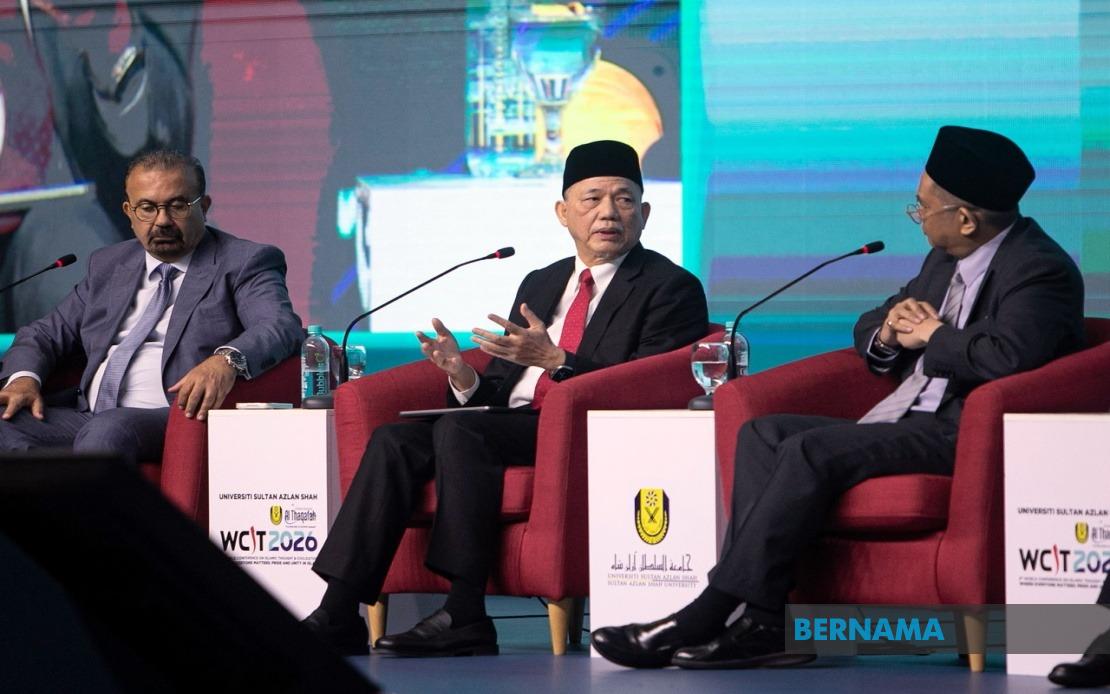
Deputy Prime Minister Datuk Seri Fadillah Yusof has underscored the increasingly complex relationship between energy security and maritime stability, cautioning that recent international tensions—particularly escalating hostilities between the United States and Iran—have blurred traditional boundaries between these two critical domains. Speaking as a panellist at the 8th World Conference on Islamic Thought and Civilisation (WCIT) in Ipoh alongside Sultan Nazrin Shah of Perak, Fadillah, who also holds the portfolio of Energy Transition and Water Transformation Minister, painted a sobering picture of how distant geopolitical crises now reverberate across interconnected global systems.
The interconnectedness Fadillah describes reflects a fundamental shift in how economies function in the modern era. Developments unfolding thousands of kilometres away—whether in the Persian Gulf, the Red Sea, or other strategic waterways—no longer remain isolated incidents confined to regional actors. Instead, they transmit shockwaves through electricity grids, fuel supply chains, and commercial corridors that sustain economies worldwide. For Malaysian consumers and businesses, this means that decisions made in distant capitals or military actions in faraway seas can swiftly translate into higher utility bills, reduced fuel availability, and inflationary pressures that penetrate household budgets and corporate balance sheets.
The Strait of Hormuz, through which approximately one-third of global seaborne traded oil passes, has become a focal point for these interconnected vulnerabilities. When tensions rise in that strategic chokepoint, the ramifications extend far beyond Middle Eastern oil producers and consumers. Malaysia, as a maritime nation and a significant player in global trade, faces direct exposure to disruptions in this crucial shipping corridor. Fadillah highlighted how recent developments in the Strait of Hormuz have already reverberated through Malaysia's economy and rippled across the entire global supply chain, demonstrating the vulnerability of contemporary commerce to regional instability.
The Deputy Prime Minister detailed the cascading economic consequences that flow from maritime insecurity linked to energy disruptions. Beyond the immediate impact on energy markets and fuel prices, the effects extend into logistics, international shipping operations, and the cost structure of goods moving across borders. Insurance premiums for vessels transiting contested waters climb sharply, reflecting heightened risk assessments. Transportation costs surge as shipping companies demand higher rates to compensate for increased insurance burdens and operational hazards. Supply chain expenses balloon as companies seek alternative routes or pay premiums for faster delivery through riskier passages. These incremental costs accumulate throughout production and distribution networks, ultimately landing on the shoulders of consumers who purchase final goods.
Malaysia's geographical position in the Strait of Melaka—one of the world's most critical maritime thoroughfares—positions the country at the intersection of these vulnerabilities. With roughly one-third of global maritime trade transiting through this narrow waterway, any destabilisation carries profound implications not only for Malaysia but for the entire international community. The country's dependence on open, stable, and rules-based trading systems stretches back over a century, underpinning its development trajectory and current economic prosperity. Disruptions to this carefully balanced framework threaten the foundation upon which Malaysia's trade-dependent economy rests.
Fadillah articulated Malaysia's measured response to these mounting pressures, emphasizing the government's commitment to navigating these challenges through diplomatic engagement and calm deliberation rather than confrontational posturing. This approach reflects a pragmatic recognition that Malaysia, while vulnerable to disruptions in global energy and maritime systems, lacks the capacity to unilaterally alter geopolitical dynamics. Instead, the strategy focuses on maintaining equitable relationships across major powers and international actors, positioning Malaysia as a neutral intermediary rather than an aligned partisan in great power competitions.
The emphasis on Malaysia's historical friendship with all nations carries particular weight given contemporary geopolitical bifurcation. As the United States and China compete for influence across Asia, and Middle Eastern tensions persist, smaller powers like Malaysia face pressure to choose sides. Fadillah's reiteration of Malaysia's commitment to universal friendship signals resistance to this binary framing, suggesting instead that the country's interests lie in preserving the multilateral, rules-based international order that has enabled its prosperity.
The convergence of energy security and maritime security represents a challenge that transcends traditional sectoral boundaries and demands integrated policy responses. Energy transition efforts—increasingly central to Malaysia's development agenda under Fadillah's stewardship—must account for maritime vulnerabilities and geopolitical uncertainties. Conversely, maritime security initiatives cannot proceed in isolation from energy considerations, as fuel scarcity or price volatility creates conditions for regional competition and potential conflict.
For Southeast Asian nations more broadly, Fadillah's warnings highlight the region's collective vulnerability to forces largely beyond its control. The Association of Southeast Asian Nations (ASEAN), which includes Malaysia, depends heavily on secure maritime passage and stable energy supplies. Regional stability in the South China Sea, freedom of navigation through international waterways, and uninterrupted energy flows from the Middle East and other suppliers form the backbone of Southeast Asian prosperity. Any significant disruption threatens not only individual economies but the entire regional architecture built upon shared prosperity and peaceful competition.
Looking forward, Malaysia's approach suggests that regional actors must invest in diplomatic infrastructure, crisis prevention mechanisms, and multilateral forums capable of addressing cross-cutting security challenges. The country's active participation in international conferences, such as WCIT, reflects an understanding that intellectual exchange and dialogue among civilisations can contribute to conflict prevention and mutual understanding. By framing these challenges within a broader context of Islamic thought and civilisation, the conference itself underscores the importance of values-based diplomacy in addressing material security concerns.
The interdependence between energy markets, maritime routes, and global stability means that Malaysia cannot achieve security in isolation. Instead, the nation must advocate for international rules and norms that govern both energy commerce and maritime conduct, while building partnerships with like-minded countries committed to maintaining the open trading system upon which regional prosperity depends. Fadillah's message ultimately reflects a clear-eyed assessment of modern geopolitical realities: Malaysia's security and prosperity are bound inextricably to global developments, and the country's best defence lies not in military posturing but in diplomatic skill, economic resilience, and principled engagement with the international community.

