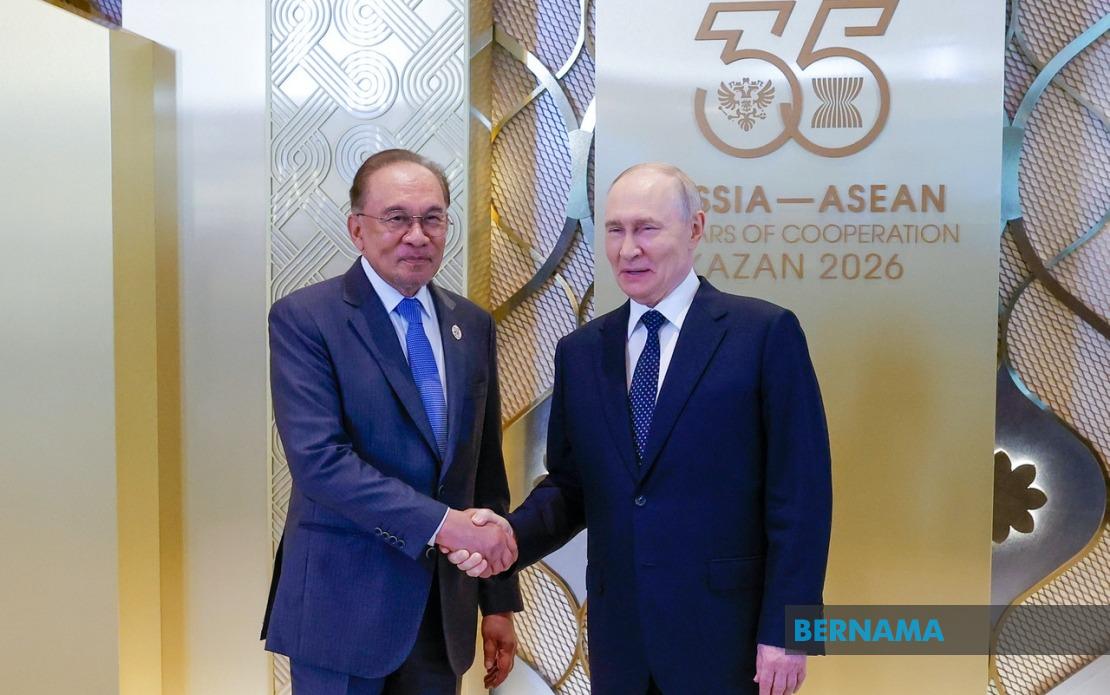
Prime Minister Datuk Seri Anwar Ibrahim has stressed that in an increasingly complex global environment marked by persistent challenges and volatility, structured platforms for high-level dialogue serve as essential mechanisms for building deeper understanding between nations. Speaking after attending a gala dinner hosted by President Vladimir Putin at the ASEAN-Russia Commemorative Summit in Kazan, the Malaysian leader emphasized that such forums go beyond ceremonial value to create meaningful opportunities for strengthening bilateral and multilateral relationships.
The ASEAN-Russia Commemorative Summit, held in Kazan from June 17 to 18, represents precisely the type of engagement mechanism that Anwar believes the region needs. The gathering, which brought together Southeast Asian and Russian leadership, functioned as both a diplomatic showcase and a substantive platform for exploring shared interests. According to Anwar, these summits facilitate the construction of mutual trust—a foundation without which genuine cooperation remains elusive in international relations.
Beyond trust-building, Anwar identified concrete benefits that flow from such engagement forums. He noted that these platforms enable participating nations to identify and develop collaborative opportunities capable of generating tangible advantages for all stakeholders. For ASEAN member states and Russia specifically, the summit provided a venue to discuss cooperation frameworks that reflect the interests and capabilities of both sides, whether in economic, cultural, security, or developmental dimensions.
The Malaysian Prime Minister emphasized the cultural and historical dimensions of the summit, observing that the event effectively showcased Russia's considerable cultural heritage and historical significance. This broader presentation of national context serves an underappreciated diplomatic function: it humanizes policy discussions by reminding leaders of the deeper civilizational foundations underlying their nations' foreign policies. When leaders understand not merely the strategic calculations but the historical narratives and cultural values of their counterparts, negotiations often become more nuanced and productive.
Anwar's remarks reflect a particular diplomatic philosophy that emphasizes dialogue and mutual understanding as antidotes to conflict and misunderstanding. This approach carries particular resonance in Southeast Asia, a region characterized by significant diversity and where platforms for constructive engagement have historically helped navigate differences. The ASEAN-Russia summit exemplifies this commitment to maintaining channels of communication even amid geopolitical complexities.
The attendance of Malaysia's Prime Minister at the Kazan summit underscores Kuala Lumpur's commitment to maintaining balanced engagement with major powers. As a non-aligned nation with strategic interests spanning multiple regions, Malaysia benefits from relationships with both Western and Eastern powers. The summit provided an opportunity for Anwar to reinforce Malaysia's role as a bridge-builder capable of facilitating understanding between ASEAN and Russia, a relationship that has historically been less intensive than ASEAN's ties with other major powers.
In his capacity as both Prime Minister and Finance Minister, Anwar brought a dual perspective to the discussions. The financial dimension of ASEAN-Russia relations—including trade, investment, and development cooperation—warrants high-level attention. Economic engagement often provides more stable foundations for bilateral relationships than security or ideological considerations, making forums that address both political and economic dimensions particularly valuable for sustained cooperation.
The gala dinner hosted by President Putin served not merely as ceremonial occasion but as an informal setting where leaders could engage in candid conversation. Such settings often generate the most productive diplomatic outcomes, as they permit discussion of sensitive topics outside formal meeting structures. Anwar's reference to the opportunity to "exchange views with fellow leaders in attendance" hints at the substantive nature of these private interactions, which frequently yield agreements and understandings later formalized in official communiqués.
Anwar's emphasis on engagement platforms speaks to a broader strategic recognition that in contemporary international relations, isolation or confrontation rarely serves national interests. Even when nations have significant disagreements, maintaining dialogue channels preserves the possibility of future cooperation and reduces risks of miscalculation. For Malaysia and ASEAN more broadly, this principle has proven valuable in managing relationships with diverse partners across the Indo-Pacific region.
The ASEAN-Russia Commemorative Summit itself carries symbolic weight, marking a milestone in relations between the regional grouping and Moscow. By characterizing such summits as "highly meaningful," Anwar validated not only the event itself but the broader diplomatic practice of regular, high-level engagement. This consistency in dialogue represents an investment in long-term relationships capable of weathering periodic tensions or divergences in strategic interests.
Looking forward, Anwar's comments suggest that Malaysia will continue championing engagement-based approaches to regional diplomacy. As geopolitical competition intensifies in the Indo-Pacific and Southeast Asia finds itself at the intersection of great power interests, the ability of regional nations to maintain balanced relationships and encourage dialogue among major powers becomes increasingly valuable. The ASEAN-Russia summit exemplifies this diplomatic function, demonstrating that platforms for engagement remain essential instruments of statecraft in a multipolar world.