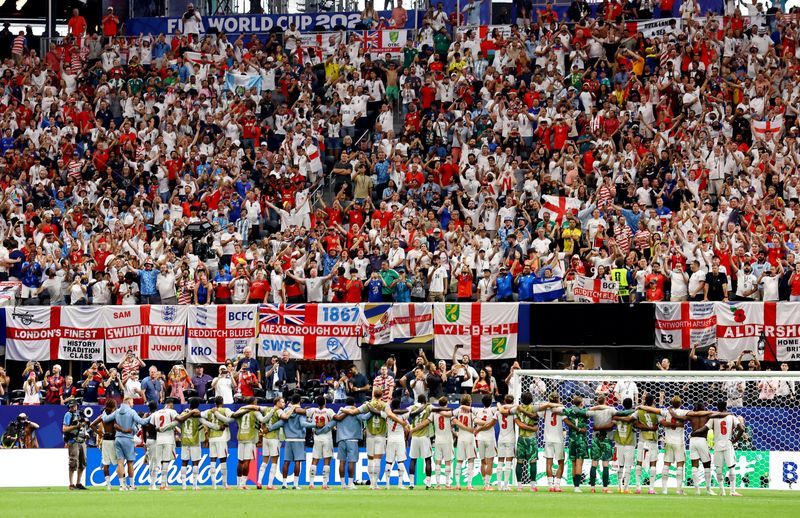
England's path through the World Cup knockout stages proved far more treacherous than their group phase performances suggested when they faced DR Congo in Atlanta on Wednesday evening. What should have been a straightforward progression into the last 16 instead became a nerve-shredding battle that left travelling fans and coaching staff visibly shaken by the underdogs' determined resistance and the hosts' persistent inability to convert attacking opportunities into goals.
The Three Lions had begun their campaign promisingly enough with a 4-2 victory over Croatia, yet subsequent matches against Ghana and Panama raised uncomfortable questions about their solidity in defence. A goalless draw and a laboured 2-0 win demonstrated that Thomas Tuchel's squad lacked the convincing performances required to justify their status as tournament contenders. The DR Congo encounter amplified these concerns immediately when Brian Cipenga's strike inside the opening ten minutes stunned England into silence. For the first time in the tournament, England found themselves trailing on the scoreboard, and the psychological impact proved considerable given their complete absence of experience in recovering from such a position at World Cup level.
The atmosphere in Atlanta Stadium shifted dramatically following Cipenga's breakthrough. England supporters, many displaying St. George's flags painted across their faces, descended into anxious silence as the Congolese side displayed remarkable organisational discipline and tactical composure. DR Congo's defensive structure proved remarkably difficult to penetrate, with goalkeeper Lionel Mpasi emerging as a formidable obstacle to England's increasingly desperate attacking efforts. The visitors' single shot on target had yielded a goal, whilst England's attacking players struggled repeatedly to breach the wall of bodies organised with impressive discipline by their opponents determined to upset the tournament favourites.
The first-half tension reached its crescendo when Yoane Wissa struck the post moments before the interval, a chance that could have inflicted catastrophic damage to England's tournament ambitions. Harry Kane's subsequent penalty appeals were dismissed by the referee, compounding the sense of frustration as England trudged away at halftime facing the unwelcome prospect of becoming only the second team to fail recovering from a first-half deficit in World Cup history. The locker room discussions during the interval clearly proved consequential, as England emerged with noticeably enhanced attacking intent during the second half.
The transformative moment arrived in the 75th minute when Kane produced a glancing header that deceived Mpasi and kissed the goal line to equalise. The noise generated from England's support reflected the profound relief at avoiding the tournament's historical ignominy, yet the job remained unfinished as Mexico awaited the victors. Kane's second goal two minutes before full-time secured the 2-1 victory and England's advancement, though the manner of the performance suggested deeper vulnerabilities that emerging knockout opponents might systematically exploit.
Tuchel's tactical adjustments during the match reflected the mounting desperation, with midfielder Eberechi Eze introduced to freshen England's midfield and defender Declan Rice repositioned to right back in search of additional creative impetus down the flanks. The German manager's visible frustration along the technical area demonstrated the gap between his expectations and his team's execution, particularly regarding their capacity to dictate play against inferior opposition. His post-match assessment emphasised the importance of mental resilience and collective belief, qualities he insisted his squad had demonstrated during their comeback, though the performance metrics suggested more foundational defensive deficiencies requiring urgent rectification.
England's comeback represented their first successful recovery from a deficit since defeating Cameroon in the 1990 World Cup quarter-finals exactly 36 years prior, a statistical curiosity that underscored just how uncomfortable Wednesday's experience had become for supporters and staff alike. The victory provided passage into the knockout rounds, yet the complications were only beginning, as the squad now confronted Mexico in a fixture presenting entirely different tactical challenges. Whereas DR Congo had prioritised defensive compactness and counter-attacking opportunities, Mexico promised a more assertive attacking approach capable of exposing the defensive frailties England had again demonstrated.
The geographical context surrounding the Mexico fixture introduced yet another complicating factor wholly absent from the Atlanta encounter. Mexico City's Azteca Stadium sits at an elevation exceeding 2,200 metres above sea level, fundamentally altering the physical and physiological demands placed upon competing teams. The reduced oxygen levels and atmospheric conditions significantly affect player conditioning, particularly during the intense pressure of knockout football where substitutions become increasingly critical and fatigue management determines outcomes. The altitude transforms the ball's aerodynamic properties, causing it to travel faster and behave less predictably than teams accustomed to sea-level competition had prepared themselves for.
Kane's assessment of England's immediate challenges provided essential clarity regarding the squad's mentality entering the Mexico encounter. The captain acknowledged the qualitative differences between facing defensive opponents and confronting attacking threats, recognising that knockout football demands mental fortitude regardless of stylistic variations. England's experience against DR Congo, whilst ultimately successful, had exposed the psychological brittleness that emerges when teams fall behind against determined opponents lacking the technical refinement of traditional World Cup contenders. The Mexico fixture represented a different examination of similar vulnerabilities, potentially determining whether England possessed the tactical flexibility and emotional resilience required to sustain a serious World Cup challenge.
The immediate path forward demanded England's coaching staff undertake comprehensive technical analysis of their defensive positioning, goalkeeper distribution patterns, and transition efficiency from defensive to attacking phases. DR Congo's success in breaching England's defensive structure suggested systemic vulnerabilities extending beyond individual player performance, potentially rooted in the spacing of defensive units and the coordination between back line and midfield pressure. Mexico's superior technical quality and organised attacking patterns threatened to expose these same weaknesses at an intensity level England had yet experienced, making the period between the DR Congo and Mexico matches crucial for tactical refinement and psychological recalibration.

