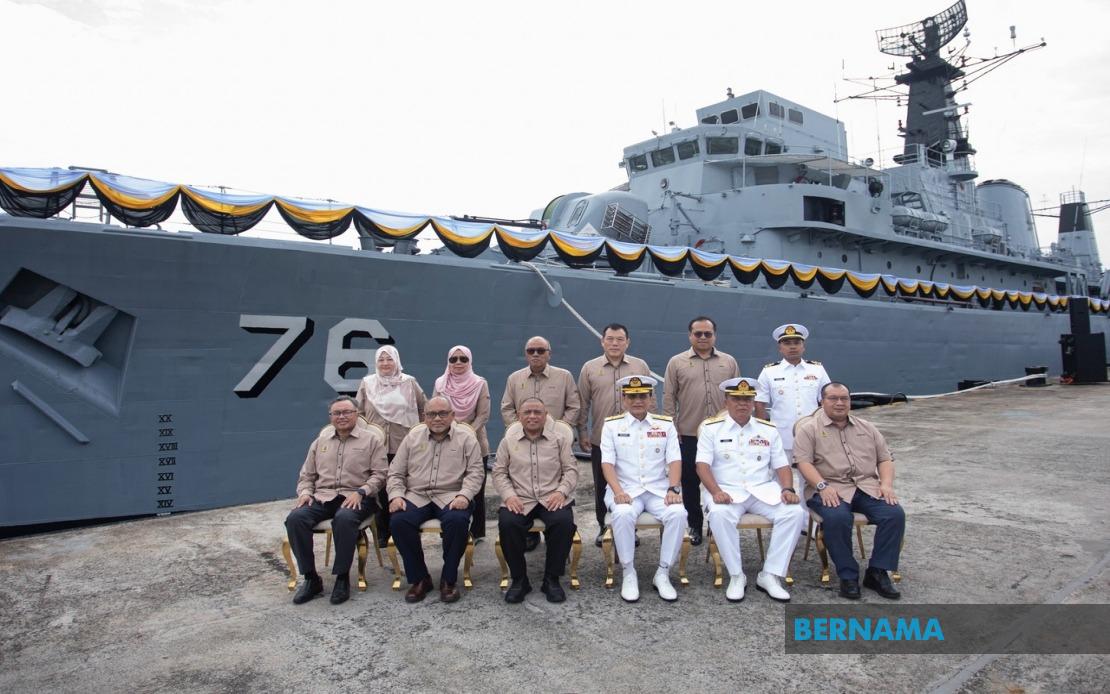
The Royal Malaysian Navy has formally transferred the decommissioned Ex-Hang Tuah vessel to the Perak state government, marking a significant milestone for a heritage preservation initiative that will reshape maritime tourism in the region. The handover ceremony, conducted at Lumut Naval Base on July 27, represents the beginning of an ambitious project to convert the historic ship into the Royal Ship Hang Tuah Memorial Museum, expected to welcome visitors by 2027 and establish itself as a distinctive cultural landmark along Malaysia's western coast.
Menuti Besar Datuk Seri Saarani Mohamad outlined the comprehensive vision underpinning the transformation, emphasizing that the initiative extends far beyond simple maritime heritage preservation. The project synthesises multiple developmental objectives—historical conservation, educational advancement, tourism expansion, and community engagement—into a cohesive strategy designed to honour the vessel's naval legacy while delivering tangible economic benefits to the surrounding Lumut municipality. This multi-faceted approach reflects broader state development priorities and positions the memorial museum as a catalyst for broader regional revitalisation.
The implementation framework involves a collaborative public-private partnership structure between Menteri Besar Incorporated (MB Inc) Perak and Aero Art Sdn Bhd, a commercial entity tasked with coordinating project execution and overseeing developmental phases. This partnership model enables the state government to leverage private sector expertise and capital efficiency whilst maintaining strategic oversight of how the heritage asset is managed and presented to the public, ensuring that commercial considerations do not compromise the vessel's cultural significance.
The physical development plan encompasses a diversified landscape of complementary facilities designed to create a comprehensive visitor experience. Beyond the memorial museum occupying the vessel itself, the project incorporates a public park offering unrestricted access, designated commercial zones intended to generate entrepreneurial opportunities for local business operators, and multipurpose spaces for family recreation and community gatherings. These ancillary facilities are deliberately designed to extend the economic impact across the broader waterfront precinct rather than concentrating benefits solely within the museum structure.
Phased implementation commencing with an initial RM30 million capital investment will develop the project in sequential stages, allowing for adaptive management and phased revenue generation as visitor numbers grow. This staged approach reduces upfront financial burden on the state budget whilst enabling stakeholders to refine operational procedures and visitor management protocols based on early operational experience. The timeline extending to 2027 provides adequate preparation for professional museum operations and infrastructure readiness.
Saarani articulated specific expectations regarding broader economic revitalisation of Lumut's Marina Wing and Esplanade precincts, projecting that increased tourist arrivals generated by the museum will catalyse expanded commercial activity throughout surrounding commercial establishments. Employment generation for local residents represents another explicit objective, with the anticipation that museum operations, associated hospitality services, and supporting retail activities will create sustained livelihood opportunities for Lumut's workforce. This attention to local economic distribution distinguishes the project from heritage initiatives that generate revenue without proportionally benefiting resident communities.
The initiative directly aligns with the Perak Sejahtera 2030 Plan, the state government's strategic development blueprint emphasising environmentally sustainable growth trajectories. By positioning heritage preservation and tourism development as complementary rather than competing priorities, the memorial museum exemplifies how historical assets can function as engines for contemporary economic activity. The project demonstrates commitment to expanding income-generating opportunities beyond traditional primary sectors whilst delivering direct tangible benefits to ordinary residents.
The military tourism dimension introduced through the memorial museum represents a deliberate diversification strategy within Perak's maritime tourism offerings. Rather than limiting attractions to natural coastal features or commercial port facilities, the state government is cultivating niche military heritage tourism that appeals to visitors interested in Malaysia's naval history and contemporary maritime operations. This thematic positioning differentiates Perak's tourism portfolio from competing regions whilst acknowledging the Royal Malaysian Navy's historical and contemporary contributions to national maritime security.
The handover ceremony itself carried symbolic significance, with Vice Admiral Datuk Baharudin Wan Md Nor representing the RMN's formal recognition and support for the transformation initiative. This naval endorsement legitimises the project within military circles and suggests ongoing cooperation regarding historical interpretation and operational protocols governing the vessel's public access. Such institutional alignment proves crucial for heritage projects involving sensitive security infrastructure or classified operational details.
For Malaysian regional observers, the Ex-Hang Tuah transformation exemplifies broader trends whereby Southeast Asian governments are monetising military heritage assets through carefully curated public access initiatives. As military modernisation programmes result in vessel decommissioning across regional navies, converting these assets into cultural attractions offers governments mechanisms to recoup infrastructure investments whilst contributing to national narrative-building and civilian appreciation of defence forces. Perak's approach provides a potential template for other Malaysian states or neighbouring countries contemplating similar heritage conversions.
The project's emphasis on sustainable development principles and community-centred benefit distribution distinguishes it from purely extractive commercial approaches to heritage tourism. By mandating free public park access, reserving commercial zones for local entrepreneurs rather than external corporations, and explicitly targeting employment creation for residents, the state government is attempting to ensure that heritage commodification generates inclusive prosperity rather than concentrating wealth amongst external investors. This approach acknowledges growing public expectations that development projects demonstrate tangible commitment to equitable distribution of benefits.
Looking forward, the 2027 opening timeline provides Perak with an opportunity to establish itself as a serious maritime heritage destination within Southeast Asia's expanding cultural tourism sector. As visitor expectations regarding educational content, interpretive quality, and experiential immersion continue rising, the memorial museum's success will depend on sophisticated curatorial practices, multilingual interpretation, and programming that appeals to diverse demographic cohorts. The initial RM30 million investment should be perceived as foundation funding enabling subsequent refinement and expansion as operational experience accumulates and visitor demand patterns become evident.

