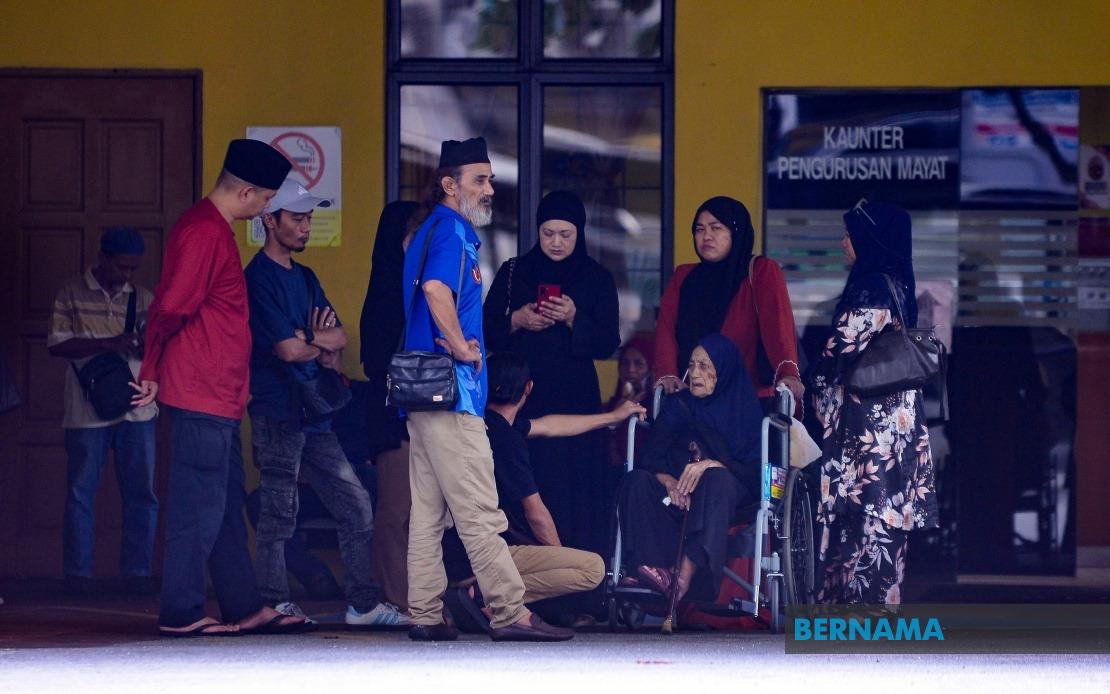
A grieving family member of those killed in the Maju Junction collision involving a Malaysian Immigration Department lorry has called for a comprehensive and transparent investigation into the circumstances surrounding the early-morning crash that claimed three lives. Speaking from his home in the Kampar area, Mohd Nadzri Razali, 69, expressed his determination to seek justice for his relatives, particularly his brother-in-law Shaik Mohd Firdaus Shaikh Yahya, who perished in the incident that unfolded around 1 am on what would become a day of profound family tragedy.
The crash occurred as an empty Isuzu Black Maria vehicle operated by Malaysia's Immigration Department was en route from the Kuala Lumpur Immigration Office to Chow Kit to conduct an enforcement operation against undocumented migrants. According to accounts of the incident, the lorry proceeded through the Maju Junction intersection while its traffic signal indicated red, though its beacon lights and siren were activated at the time. A Proton Saga approaching on a green light could not avoid collision with the larger vehicle, resulting in a violent impact that sent the lorry spinning out of control across the intersection.
The uncontrolled lorry then struck four pedestrians belonging to the same family who were crossing the junction, as well as an Inokom Matrix vehicle. Three members of the pedestrian group were pronounced dead at the scene: Shaik Mohd Firdaus Shaikh Yahya himself, along with his two daughters, Siti Nor Sazlin, 25, and the younger Siti Darwisyah Auni, 12. The fourth member of their group, the girls' mother Norhayati Razali, 55, sustained severe injuries and remains hospitalized in the Intensive Care Unit at Kuala Lumpur Hospital undergoing treatment for her condition.
Mohd Nadzri has become the voice of the grieving family during this distressing period, articulating the household's need for clarity regarding the crash's causation. He indicates that reports circulating among family members suggest the Immigration Department lorry may have violated traffic regulations at the moment of collision, proceeding through the red light rather than yielding to oncoming traffic. "I hope for a full investigation, because it is claimed that the traffic light was red," he explained to journalists visiting the family residence. The family's insistence on transparent procedures reflects broader concerns about accountability and the conduct of government vehicles in high-speed operations within urban areas populated by civilians.
The family's grief has been compounded by circumstances beyond the crash itself. Norhayati's condition remains precarious, and the family holds cautious hope regarding her recovery prospects, though her exact prognosis remains uncertain pending medical evaluation. Mohd Nadzri indicated that should hospital authorities determine she is fit for transfer, the family intends to relocate her to Hospital Ipoh or the medical facility in Teluk Intan for continued rehabilitation and treatment closer to their home district. The family has already begun making funeral arrangements, having decided to lay all three deceased to rest together in a single grave at the Muslim Cemetery located in Kampung Air Hitam Labu within Kampar, reflecting a desire to maintain family unity even in death.
The loss carries particular poignancy given recent family history. Mohd Nadzri recounted that the household had suffered another bereavement on May 30, meaning the family was already in a period of mourning when this catastrophic event unfolded. The sudden death of three family members simultaneously represents an almost incomprehensible tragedy for those left behind. Mohd Nadzri, who resides in the same residential area as his sister's family in Mambang Di Awam, emphasized how the shock of losing so many loved ones in a single, violent moment continues to reverberate through the entire household and extended family network.
The investigation into the crash has been formally initiated under Section 41(1) of the Road Transport Act 1987, the statutory framework governing serious motor vehicle incidents in Malaysia. This legal provision typically applies to cases involving fatalities or severe injuries resulting from motor vehicle collisions, particularly where questions of driver negligence or violation of traffic laws may be involved. The involvement of a government vehicle operated by a federal agency adds complexity to the inquiry, as authorities must examine not only the immediate circumstances of the collision but also whether proper protocols were followed regarding the use of the lorry for enforcement operations and the manner in which the driver navigated through the junction.
For families affected by such tragedies, the pursuit of a transparent investigation represents both a matter of justice and closure. In this case, the specific allegation that the Immigration Department vehicle may have proceeded on a red light despite operating with emergency signals activated raises questions about the balance between law enforcement urgency and public safety obligations. The fact that the occupants of the Proton Saga could not avoid the collision despite traveling on a green light strengthens the inference that the lorry's right of passage was questionable. Road safety advocates and legal observers will likely scrutinize the investigation's findings carefully, as such cases can influence how government agencies operate emergency vehicles in busy urban intersections.
The incident underscores an ongoing tension in Malaysian traffic management and law enforcement practices: the legitimate needs of agencies conducting urgent operations against the imperative to protect ordinary civilians using public roads. When sirens and beacon lights are activated, drivers may believe they have implicit permission to override normal traffic rules, yet civilian road users depend on traffic signals functioning predictably. This collision appears to exemplify a breakdown in that system, with catastrophic human consequences. The family's call for transparency resonates beyond their personal circumstances, touching broader public concerns about accountability and the safety of urban thoroughfares where government vehicles routinely operate.
Mohd Nadzri's appeals for justice also reflect the family's awareness that administrative action alone may not suffice. Beyond any investigation conclusion, the family may pursue civil remedies or seek policy changes that could prevent similar incidents. The loss of a breadwinner and two young children, combined with a survivor facing potentially lengthy recovery, will impose lasting financial and emotional burdens on the household. In this context, the call for a transparent probe becomes not merely an exercise in determining facts but a means of honoring the deceased and protecting other families from suffering comparable tragedy through enhanced oversight of high-speed government operations in populated areas.

