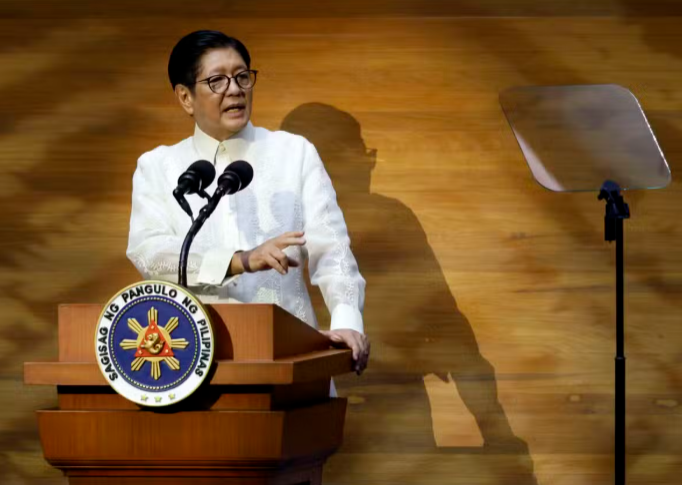
Philippine President Ferdinand Marcos declared during his fifth State of the Nation Address that his family members and political associates would receive no preferential treatment in the government's aggressive anticorruption campaign, using the case of his cousin, former Speaker and Leyte Representative Martin Romualdez, as a defining example of that commitment. The Office of the Ombudsman has launched a formal investigation into Romualdez's involvement in a sprawling flood control scandal valued in the billions of pesos, with charges expected to follow. Addressing Congress on 27 July, Marcos framed the matter as a test of institutional integrity, emphasising that personal relationships could not supersede the demands of public accountability and the rule of law.
The President's remarks carry particular weight in Philippine politics, where family networks and dynastic interests have historically shaped governance and policy outcomes. By publicly acknowledging the pain that action against Romualdez would inflict on his own family while proceeding nonetheless, Marcos sought to demonstrate that his antigraft rhetoric translates into tangible political will. He stated plainly: "I am not the President of my family. I am not the President of my friends. I am the President of the Philippines, and my duty is to you, my fellow Filipinos." The statement signals a departure from decades of Philippine political practice in which kinship often trumped institutional norms.
Romualdez, a longtime political ally and first cousin of the President, responded with measured dignity. In a statement, he acknowledged the difficulty of the situation for their family while affirming his respect for Marcos's position and his own commitment to due process. Rather than attacking or defending himself aggressively, Romualdez emphasised that he had never sought special treatment and pledged to let evidence guide the proceedings. His measured tone appears designed to avoid deepening family tensions while maintaining his innocence and signalling confidence in his eventual vindication through the judicial system.
The flood control scandal that sparked this crisis originated in infrastructure projects overseen by the Department of Public Works and Highways over the previous decade. During his 2025 State of the Nation Address, Marcos publicly exposed what he characterised as systematic anomalies in these projects, issuing the memorable rebuke "Mahiya naman kayo (Have some shame)" to those implicated. Following that speech, he established Executive Order No. 94, creating an Independent Commission for Infrastructure tasked with investigating the alleged irregularities comprehensively. The commission completed its fact-finding mandate in February and produced nine referrals recommending both criminal and administrative charges against 65 lawmakers, contractors, and officials from the Public Works Department and the Commission on Audit.
The scale of the investigation and its consequences have been substantial. At least 45 individuals now face criminal charges in the Sandiganbayan and regional trial courts, a cohort that includes two sitting lawmakers, two former representatives, 33 former Public Works officials, and eight contractors. Among those detained are Senator Jinggoy Estrada and former Senator Ramon Revilla Jr., individuals with prominent family names and political histories in their own right. The inclusion of these high-profile figures alongside contractors Curlee and Sarah Discaya and numerous departmental officials demonstrates that the investigation has not spared any category of suspect based on rank or influence.
Financial recovery has constituted a parallel achievement of the anticorruption campaign. The government has recovered, frozen, or preserved approximately 25 billion Philippine pesos in funds and assets connected to the accused parties, with more than 800 million pesos already returned to the National Treasury. Marcos emphasised that payments for defective, counterfeit, or entirely fictitious projects have been blocked, preventing public resources from flowing to corrupt officials and favoured contractors. This financial dimension underscores that the campaign addresses not merely political accountability but also the restoration of public resources to their intended use for genuine development and citizen benefit.
The investigation also exposed systemic vulnerabilities within the Public Works Department that successive administrations had failed to address. Secretary Vince Dizon has implemented comprehensive reforms including the recruitment of new graduates and contract workers, alongside a thorough review of infrastructure projects spanning planning, costing, and implementation phases. These structural changes aim to prevent future anomalies by introducing fresh personnel, modernised processes, and enhanced oversight mechanisms. The reforms signal that tackling corruption requires not only prosecuting individuals but also transforming institutional cultures and procedures that may have enabled wrongdoing.
For Southeast Asian observers, particularly those from Malaysia and other regional democracies grappling with corruption, the Philippine case presents instructive lessons about both promise and limitations. Marcos's willingness to publicly pursue family members and political allies suggests that institutional mechanisms and popular pressure can constrain even leaders with personalised power bases. However, the progress depends significantly on his sustained political will and the functioning of judicial institutions. The fact that prosecutions continue despite political costs demonstrates that anticorruption campaigns need not collapse under pressure from connected individuals, yet the region's history shows that such campaigns can lose momentum if leadership changes or if courts face pressure.
The broader anticorruption message permeated Marcos's one-hour-and-26-minute address, marking his longest State of the Nation speech since assuming office in 2022. The emphasis on graft prosecutions, asset recovery, and institutional reform reflected a governing priority that extended beyond the immediate flood control scandal to encompass the administration's overall approach to public probity. By dedicating substantial time to these matters and by framing them as central to his presidential mandate, Marcos signalled that anticorruption would remain a defining feature of his administration's identity and reputation.
Looking forward, the remaining cases now rest with the Office of the Ombudsman and the Department of Justice's National Prosecution Service, shifting responsibility from investigative bodies to prosecutorial and judicial institutions. The success of these cases will depend on the competence of these agencies, the quality of evidence presented, and the independence of the courts hearing them. Marcos stated that he placed trust in "the fair judgment of the courts" and assured citizens that "the wheels of justice are turning." These assurances matter because they frame judicial outcomes as separate from presidential influence, a distinction essential to the appearance and reality of rule of law.
The flood control scandal and its prosecution represent a pivotal moment for Philippine democracy and institutional development. If prosecutions proceed without political interference and yield convictions commensurate with evidence, the case could establish important precedents about the limits of privilege and the reach of accountability. Conversely, if prosecutions stall, convictions prove elusive despite apparent evidence, or if Marcos later extends clemency or pardons, the episode would reinforce cynicism about anticorruption campaigns as theatre rather than transformation. For Malaysian and other Southeast Asian audiences monitoring Philippine developments, the unfolding narrative offers a crucial test case about whether even personalised democratic systems can subordinate family interest to institutional demands.
The international dimension also merits attention, particularly as China's state media produced an artificial intelligence-generated video portraying Filipinos as monkeys, which Marcos publicly rebuked during his address. This digression into foreign interference allegations occurred alongside his anticorruption pronouncements, suggesting that his administration views both domestic institutional reform and external pressure as interconnected challenges to Philippine sovereignty and national dignity. Whether the anticorruption campaign maintains momentum and credibility will significantly influence the Philippines' capacity to address external challenges while managing internal institutional pressures and expectations.

