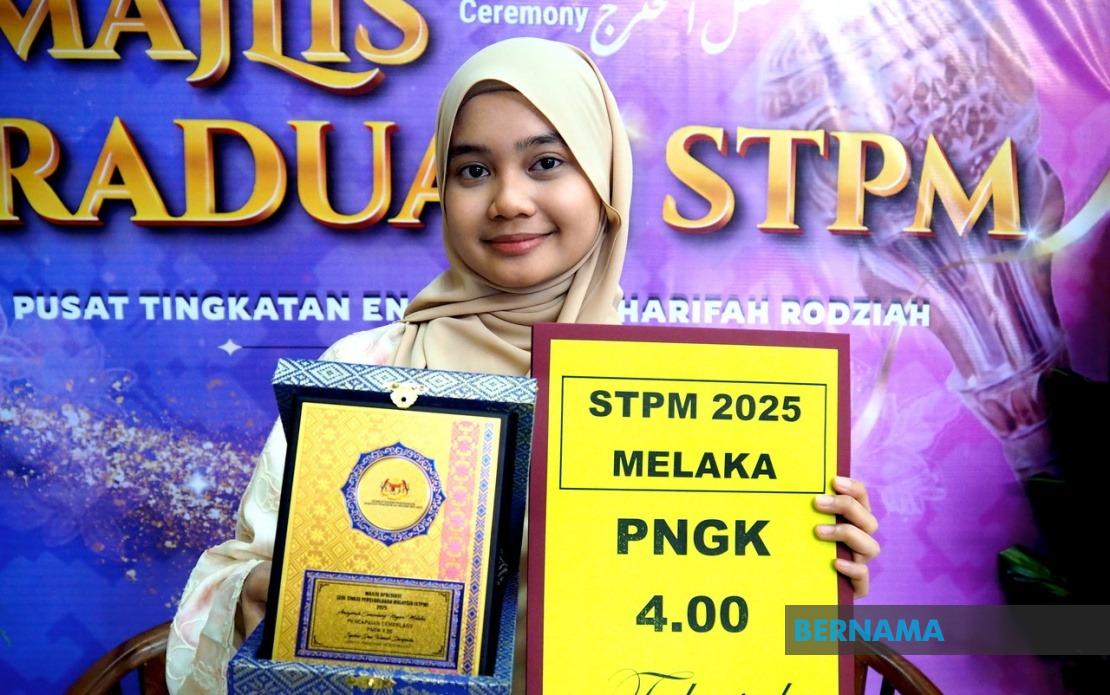
Nurfariesya Nasywa Hamedee, 21, from Sekolah Menengah Kebangsaan Agama Sharifah Rodziah in Melaka, has demonstrated the transformative power of parental guidance by attaining a flawless Cumulative Grade Point Average of 4.00 in the 2025 Sijil Tinggi Persekolahan Malaysia examination. The achievement stands as a poignant testament to her resolve in the face of profound personal tragedy, having lost her father to a heart attack just days before her SPM trial examination some years ago.
The impact of her father Hamedee Asri's passing weighed heavily on the young scholar at a critical juncture in her academic journey. Confronted with grief and the financial pressures facing her family, she seriously considered abandoning her education to seek employment and contribute household income. However, her mother Yusnita Ruslan conveyed a final piece of counsel that her late father had imparted—an exhortation not to squander her intellectual capabilities. This message became the cornerstone of her determination to persevere, transforming what could have been a derailment into a catalyst for exceptional achievement.
Recognising the broader significance of academic excellence in Malaysian education, Nurfariesya's accomplishment was formally celebrated during the 2025 Melaka State STPM Results Announcement ceremony, presided over by Datuk Rosli Abdullah, the State Deputy Exco for Education, Higher Education, and Religious Affairs. Her perfect score places her among an elite cohort of high achievers in the state and underscores the calibre of students emerging from religious secondary institutions in Malaysia's education system.
What renders her performance particularly noteworthy is the margin by which she surpassed her own expectations. Based on her trial examination results and preliminary calculations, she had anticipated a CGPA in the region of 3.92, making the actualisation of a perfect score an unexpected triumph. This gap between projection and outcome highlights both the unpredictability of examinations and the potency of sustained effort applied without the assumption of guaranteed results. As the third of four siblings, she also carries the weight of family expectations whilst maintaining her individual aspirations.
Her academic foundation proved robust, having obtained seven distinctions in her SPM examination. Beyond raw examination performance, Nurfariesya had cultivated a substantive intellectual interest in Islamic jurisprudence from her secondary schooling years, a passion that sustained her motivation through the demanding STPM curriculum. Her subject selection—General Studies, Arabic, Usuluddin, History, and Shariah—reflects a coherent trajectory toward specialised study in Islamic law rather than a scattergun approach to subject choice.
Ambitious in her university aspirations, Nurfariesya has set her sights on Universiti Malaya to pursue a Bachelor's degree with the ultimate professional objective of becoming a Shariah lawyer. She has already navigated the university's interview process for her desired programme, positioning herself competitively within Malaysia's higher education landscape. The pursuit of Shariah law represents a specialised professional path that demands not only intellectual rigour but also deep cultural and religious grounding, qualities her examination results suggest she possesses in abundance.
When asked to distil her formula for success, Nurfariesya eschewed mystique in favour of pragmatism. She attributed her achievements to diligent study habits, psychological resilience against setbacks, and unwavering spiritual conviction. These three pillars—intellectual effort, mental fortitude, and faith—constitute a philosophy of personal development that extends well beyond examination technique. Her recognition that STPM provides an efficient gateway to university study and diverse tertiary opportunities indicates strategic thinking about educational pathways, a consideration increasingly important as Malaysian students navigate multiple routes to higher qualifications.
Nonfeless, Nurfariesya was not the sole beacon of excellence in Melaka's 2025 STPM cohort. Ng Zhen Hong, 20, a student from Kolej Tingkatan Enam Tun Fatimah, earned the National-Level Best Student Award for the Science Stream, representing Melaka's competitive standing in Malaysia's examination landscape. Ng's achievement garnered particular distinction by winning recognition at the national level rather than merely state level, underscoring the quality of science education provision in the state. Having secured ten distinctions in his SPM examination, Ng demonstrates the consistency expected of top-tier students who maintain excellence across secondary and post-secondary phases.
Ng attributes his success to an ecosystem of familial support and pedagogical guidance, alongside an intrinsic enthusiasm for scientific disciplines that centre on quantitative reasoning and analytical problem-solving. As the eldest of two siblings, he exhibits the characteristic of many high-achieving firstborn children who internalise family expectations and translate them into academic momentum. His disciplined approach—dedicating one to two hours daily to revision—suggests that sustainable excellence emerges not from sporadic intensive effort but from cumulative engagement. His perspective on scientific challenges as motivational stimuli rather than obstacles reveals a psychological resilience mirroring Nurfariesya's own philosophical outlook.
Looking toward tertiary study, Ng aspires to Chemical Engineering or Electrical Engineering at Universiti Malaya, fields that promise substantial career prospects within Malaysia's industrialisation trajectory and growing emphasis on advanced manufacturing. His unexpected emergence as the national science stream leader suggests that even accomplished students often underestimate their capabilities, a psychological phenomenon with implications for student confidence and aspiration-setting. The fact that both Nurfariesya and Ng target Universiti Malaya underscores that institution's continued magnetism for high-achieving Malaysian students.
The twin achievements of these Melaka students illustrate several enduring truths about academic success in the Malaysian context. Personal adversity need not determine educational outcomes; familial encouragement remains instrumental even when channelled through loss; and intrinsic intellectual motivation—rooted in genuine interest rather than external incentive—sustains achievement across demanding curricula. Furthermore, their trajectories underscore the continued vitality of the STPM pathway as a vehicle for accessing premier Malaysian universities and preparing students for specialised professional training.
For Malaysian policymakers and educators, these student narratives provide currency in ongoing discussions about examination reform, pastoral support in schools, and the psychological dimensions of academic achievement. The STPM system, despite periodic proposals for alternatives, continues to produce graduates capable of competing for places at leading universities and pursuing demanding professional courses. Melaka's strong showing in the 2025 results cycle reflects well on both the religious secondary school network and the conventional sixth form college system, suggesting healthy competition and complementarity rather than institutional hierarchy.
As Nurfariesya and Ng progress toward their university studies and ultimate professional aspirations, they carry forward not merely examination credentials but demonstrated capacities for sustained effort, strategic thinking, and resilience—qualities that will prove equally valuable in tertiary education and beyond. Their success speaks to the potential that remains latent within Malaysia's student population when structured by institutional frameworks, familial encouragement, and personal determination.

