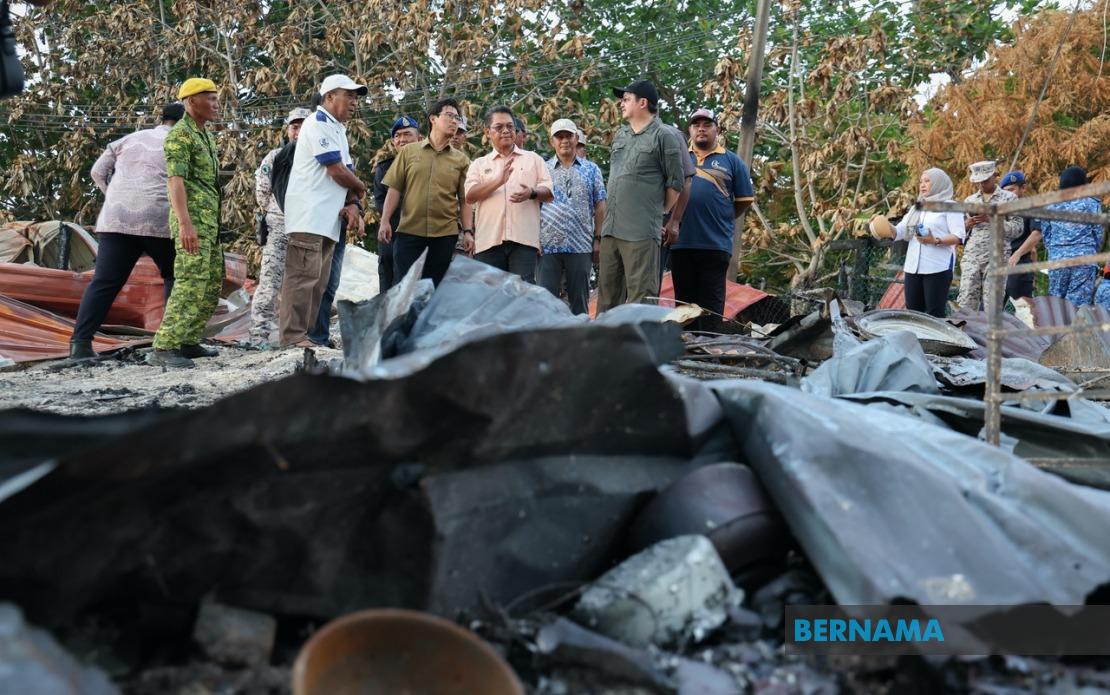
The Federal Government has moved swiftly to support residents displaced by a catastrophic fire that swept through Pulau Nunuyan Laut in Sandakan, with the Prime Minister's Department providing immediate assistance to 29 household heads affected by the disaster. The blaze, which erupted at approximately 3 am on the previous day, consumed 28 residential structures and left more than 100 people without shelter, marking one of the more significant residential fires in the eastern Malaysian state in recent months.
Datak Mustapha Sakmud, Minister in the Prime Minister's Department responsible for Sabah and Sarawak affairs, emphasised the government's commitment to rapid response and comprehensive support for the affected community. During a visit to the fire site alongside Sandakan Municipal Council president Datuk Walter Kenson, Mustapha outlined the immediate steps already underway through the Implementation Coordination Unit, which has begun distributing essential supplies and assistance packages tailored to individual household circumstances.
Among the initial interventions, the government has prioritised the needs of elderly residents by providing mobility aids such as wheelchairs to those requiring assistance. This targeted approach reflects recognition that disasters disproportionately affect vulnerable populations, and the government's assessment process aims to identify and address such specific vulnerabilities within the affected population.
Critical infrastructure damage has emerged as a secondary concern requiring urgent remediation. The fire destroyed a jetty that serves as the primary transportation link for schoolchildren commuting to educational institutions, presenting a potential disruption to the academic year if not swiftly repaired. Mustapha stressed that preventing educational interruption constitutes a priority, requesting that the municipal council and relevant government agencies identify all infrastructure requiring emergency restoration and submit such needs through official channels for rapid implementation.
The coordination framework involving multiple stakeholders reflects the complexity of disaster response in island communities where accessibility and logistical constraints complicate relief operations. The municipal council, through Datuk Walter Kenson, has committed to collaborating with the Rural Development Department to determine optimal relocation strategies for displaced residents. This process requires careful consideration of available land, property ownership arrangements, and long-term community sustainability.
A particularly intricate dimension of the relocation challenge involves the tenure situation affecting the affected residents. According to Kenson, the displaced families had been residing on private land encompassing two separate titles or plot divisions, necessitating negotiations with the private landowners regarding future arrangements. This property rights complication adds layers of administrative complexity to the relocation process, as solutions must accommodate both the residents' housing needs and the legal interests of the property owners.
Long-term reconstruction planning extends beyond emergency shelter provision to encompass fundamental amenities and infrastructure required for sustainable community living. The proposed relocation framework includes provisions for electricity supply, water infrastructure, and transportation facilities such as the jetty, recognising that temporary displacement cannot indefinitely substitute for permanent residential solutions. By addressing these systemic needs during the reconstruction phase, authorities aim to prevent recurring vulnerabilities and establish more resilient living conditions.
The disaster underscores persistent challenges facing Malaysian coastal and island communities, where informal settlements frequently occupy marginal land and remain vulnerable to natural hazards. The Pulau Nunuyan incident demonstrates how inadequate housing infrastructure and precarious land tenure arrangements intersect to magnify disaster impacts, affecting not only immediate shelter but also access to essential services and economic opportunities. For Southeast Asian policymakers monitoring informal urbanisation patterns, the incident provides instructive lessons regarding the interconnection between land tenure security, infrastructure investment, and disaster resilience.
The government's multi-agency coordination approach, encompassing the Prime Minister's Department, municipal authorities, rural development specialists, and landowner engagement, reflects contemporary best practices in disaster response management. Rather than treating relief as a temporary intervention, the framework positions reconstruction as an opportunity to address underlying vulnerabilities and establish more sustainable settlement patterns. This holistic perspective, if successfully implemented, could establish a model for similar disasters affecting other Malaysian communities facing comparable circumstances of inadequate infrastructure and uncertain land tenure.
The Pulau Nunuyan response also highlights the importance of rapid initial assessment and needs identification in disaster contexts, where delays in understanding victim circumstances can result in misaligned relief efforts and prolonged hardship. By requesting comprehensive needs evaluations from municipal authorities and engaging with multiple stakeholder groups, federal agencies demonstrate recognition that effective disaster response requires detailed understanding of affected populations' heterogeneous requirements rather than standardised relief packages.

