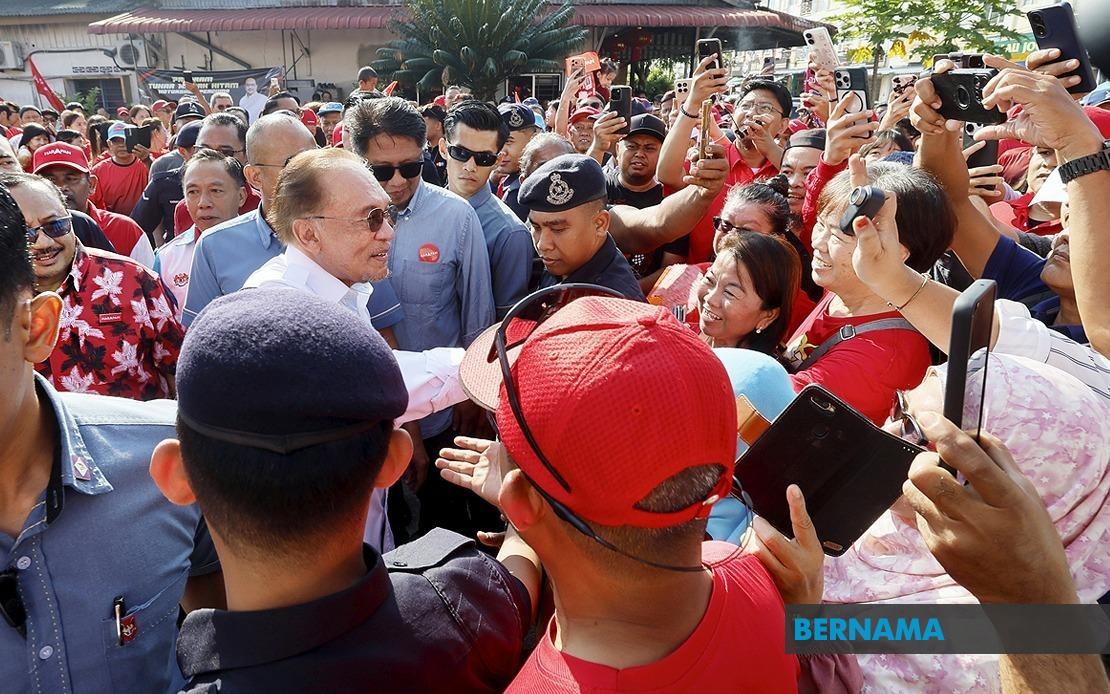
Prime Minister Datuk Seri Anwar Ibrahim has defended the federal government's approach to state development, asserting that allocation decisions are made on the basis of need rather than political considerations. Speaking during a campaign event in Batu Pahat on July 9, Anwar emphasised that since taking office, his administration has prioritised delivering tangible development outcomes for communities regardless of whether those states are governed by ruling coalition partners or opposition parties.
The Prime Minister's comments came during the 'Yok! Meriahkan Johor! Undi Harapan' programme in Senggarang, a platform organised to support Pakatan Harapan candidates contesting the 16th Johor state election. As both Prime Minister and chairman of the Pakatan Harapan coalition, Anwar positioned federal spending as an exercise in impartiality, contrasting the current approach with what he characterised as past electoral tactics involving promises made only during campaign periods.
Anwar cited specific examples of federal investment to substantiate his position. In Johor, the federal government has advanced the Johor-Singapore Special Economic Zone project, a major infrastructure initiative designed to strengthen regional economic integration and trade. Beyond this flagship development, the federal administration has approved multi-billion ringgit allocations for flood mitigation infrastructure in the Segamat and Muar districts, addressing longstanding concerns about seasonal flooding that affects thousands of residents across the state.
The emphasis on flood mitigation spending is particularly significant for Malaysian readers given the country's recurring battles with monsoon-season inundation. Segamat and Muar have both experienced substantial flood damage in recent years, causing economic disruption and affecting livelihoods. The scale of federal commitment to these areas demonstrates how infrastructure priorities reflect vulnerability rather than political geography. Such investments form part of broader national efforts to enhance climate resilience, a matter increasingly urgent for Southeast Asian economies facing intensifying weather volatility.
Beyond Johor, Anwar referenced development commitments in Kelantan and Kedah to illustrate the geographic breadth of federal spending. Kelantan has been governed by opposition-aligned parties for extended periods, yet Anwar's framing suggests that developmental support has nonetheless been extended. This claim invites scrutiny and provides potential fodder for ongoing political debate about resource allocation fairness, a perennial tension in Malaysia's federal structure where state and federal governments sometimes operate under different political umbrellas.
The federal system in Malaysia creates inherent challenges regarding equitable development distribution. State governments depend heavily on federal transfers and approvals for major infrastructure projects, creating potential leverage points for political influence. Opposition-governed states periodically allege marginalisation in federal funding decisions, while the ruling coalition similarly disputes these claims. Anwar's explicit statement therefore addresses a core concern about Malaysia's multi-level governance architecture and the relationship between electoral politics and resource distribution.
Communications Minister Datuk Fahmi Fadzil's presence at the Senggarang event underscored the coordinated messaging effort around this development narrative. The participation of Pakatan Harapan candidates for multiple seats—Onn Abu Bakar in Senggarang, Mohd Khuzzan Abu Bakar in Semerah, and Felicia Poh Rui Ling in Penggaram—framed the development discussion within the context of state-level electoral competition. For Malaysian voters assessing coalition performance, Anwar's claims about development equity represent a key campaigning assertion requiring independent verification through available budget documents and project implementation records.
The timing of these remarks during state election campaigning invites consideration of political strategy alongside substantive policy. Johor remains significant within Malaysian politics as a traditionally influential state with substantial electoral weight. Demonstrating federal responsiveness to Johor's infrastructure needs serves multiple purposes: it addresses immediate state-level concerns, it underscores federal competence and responsiveness, and it provides material evidence for coalition candidates to deploy in local contests. Understanding this layered political context helps readers interpret both the underlying policy substance and the strategic communication surrounding it.
Anwar's assertion that his government does not restrict assistance to election seasons counters a historical Malaysian political pattern where development announcements often correlate with electoral cycles. If accurate, this would represent a shift toward more consistent annual resource allocation divorced from campaign calendars. The specific mention of billions of ringgit in approved flood mitigation funds—a measurable, concrete commitment—provides testable grounds for this claim. Johor residents can evaluate whether such projects materialise as promised, offering tangible validation or refutation of the Prime Minister's equity assertions.
For Malaysian readers across the federation, these statements touch on fundamental fairness questions about how national resources flow through federally structured governance. Whether one accepts Anwar's characterisation depends partly on documented evidence of actual spending patterns and project implementation rates across different state administrations. The broader principle—that development should respond to need rather than political alignment—enjoys theoretical support across the Malaysian political spectrum, even as practitioners frequently dispute whether this principle is observed in practice.
The implications extend beyond immediate Johor state politics. Federal-state dynamics influence economic development trajectories, infrastructure quality, and public service delivery throughout Malaysia. If federal governments systematically favour allied states, this creates long-term divergence in regional development outcomes and potentially exacerbates economic inequality. Conversely, maintaining development equity across political boundaries strengthens national cohesion and demonstrates democratic governance effectiveness. These considerations underscore why Anwar's claims warrant serious scrutiny and transparent tracking of actual resource allocations across Malaysia's diverse political landscape.

