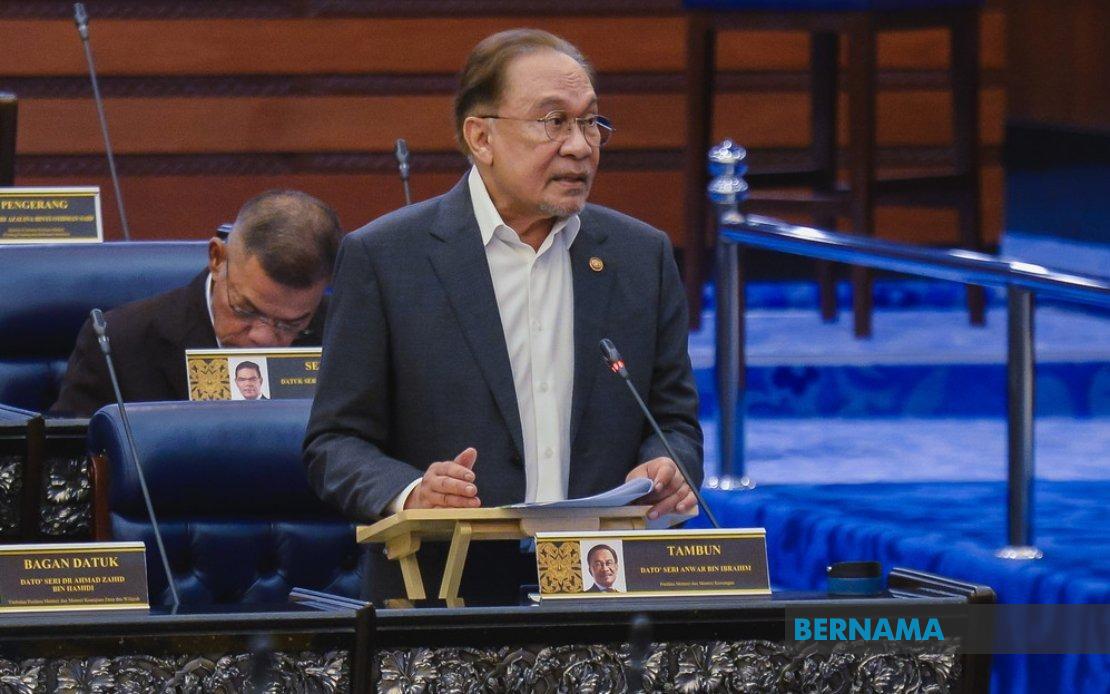
Prime Minister Datuk Seri Anwar Ibrahim has made clear that the Federal Government will not automatically approve additional funding requests from state administrations whenever development projects encounter cost escalations, particularly those requiring Notice of Change approvals. Speaking in Parliament during Minister's Question Time, Anwar underscored that any such requests must undergo fresh negotiations and assessment before federal authorities commit to releasing extra allocations or providing loans.
The Prime Minister's statement addresses a critical tension in Malaysia's federal system: the distinction between state-level project decisions and federal financial responsibility. When a Notice of Change is issued for any development initiative, it carries substantial budgetary implications that cannot be treated as routine administrative matters. Anwar emphasised that the moment such a notice is issued, triggering additional funding requirements, the matter must be formally renegotiated between state and federal authorities rather than processed as an automatic approval.
A key concern underlying this position relates to determining accountability for cost increases. Anwar outlined that determining the contractor's role and identifying the root cause of budget overruns must be the first step in any renegotiation process. This reflects growing federal scrutiny of project management practices, as cost escalations can stem from various sources including poor initial estimation, design modifications, material price fluctuations, or contractor performance issues. Understanding which party bears responsibility directly influences how the federal government approaches additional funding obligations.
The Prime Minister's remarks were prompted by a specific case: Kedah's request for supplementary funding for the Pulau Bunting Water Treatment Plant project, which requires Notice of Change approval. This project exemplifies the broader challenge facing Malaysia's infrastructure development landscape, where initial project costs frequently prove inadequate. Water treatment facilities are capital-intensive undertakings with complex engineering requirements, making them particularly susceptible to cost revisions.
Anwar's position reflects a fundamental principle of fiscal federalism: the Federal Government cannot be bound by unilateral decisions made by state authorities, particularly when those decisions automatically trigger federal financial obligations. This distinction matters considerably in Malaysia's context, where central government revenue sources substantially exceed state-level fiscal capabilities. Without clear protocols on renegotiation, states might have incentives to underestimate initial project costs, knowing they can subsequently petition federal authorities for supplementary funding.
The emphasis on renegotiation rather than automatic approval also serves as an indirect policy signal regarding project discipline across state administrations. By requiring fresh assessment each time additional funding becomes necessary, the federal government creates accountability mechanisms that incentivise more rigorous initial planning and cost estimation. States cannot simply expect that federal coffers will absorb budget overruns without scrutiny or justification.
Deputy Prime Minister and Energy Transition and Water Transformation Minister Datuk Seri Fadillah Yusof was designated to provide further detailed explanation regarding the Notice of Change procedures and their handling. Fadillah's involvement is particularly relevant given his ministerial portfolio covering water transformation, a sector where Malaysia has witnessed numerous infrastructure projects requiring budget amendments. His clarification is expected to outline specific criteria guiding federal assessment of state funding requests and the procedural steps required for renegotiation.
For state governments and project developers, this pronouncement carries important implications. The federal government's insistence on renegotiation rather than automatic approval means that state authorities must strengthen their project management frameworks, ensuring more accurate initial budgeting and robust contractor oversight. States that fail to do so face potential delays in securing supplementary funding, as additional federal scrutiny processes will inevitably extend project timelines.
The broader infrastructure sector in Malaysia should take note of this federal stance. Many ongoing and planned projects across various states are susceptible to cost adjustments due to supply chain complexities, labour availability fluctuations, and material price volatility. The federal government's clarified position suggests that project sponsors must build stronger contingency planning into initial budgets and develop more sophisticated cost management systems rather than relying on federal rescue funding.
This approach also reflects contemporary global trends in infrastructure financing, where development banks and multilateral lenders increasingly require robust project cost controls and accountability mechanisms before committing funds. By adopting similar standards, Malaysia's federal system aligns with international best practices while protecting taxpayer interests across all states.
The renegotiation requirement underscores that federal funding, while substantial, remains finite and must be allocated strategically. By refusing automatic approvals, the federal government ensures that available resources are directed toward projects demonstrating superior planning, execution, and value-for-money outcomes. States demonstrating weaker project management will face delays and additional scrutiny, creating natural incentives for institutional improvement.
Moving forward, state administrations should anticipate that federal authorities will subject Notice of Change requests to comprehensive reviews examining not only the cost increase magnitude but also the circumstances precipitating the revision. This heightened scrutiny represents a maturing approach to infrastructure governance in Malaysia, one that balances state autonomy with federal fiscal stewardship and ultimately aims to deliver better development outcomes for Malaysian citizens.

