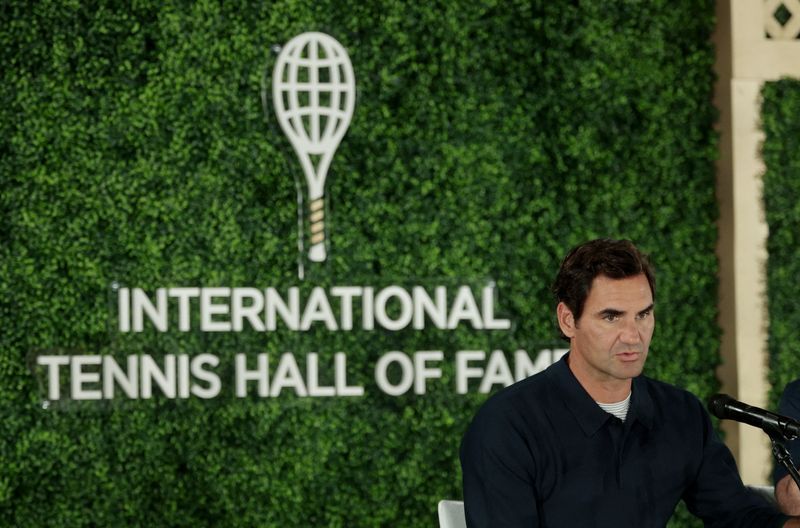
Roger Federer has marked his induction into the International Tennis Hall of Fame in Newport as an opportunity to step back from the numbers that defined his career and contemplate a more expansive legacy within professional tennis. The 45-year-old Swiss champion, being honoured alongside broadcaster Mary Carillo, described the recognition as fundamentally different from the tangible measures of success—trophies and rankings—that shaped his competitive years. At a news conference moderated by Hall of Fame president Patrick McEnroe, Federer characterized the induction as reaching a pinnacle of recognition unique to the sport.
Federer's playing resume remains staggering in its scope. His eight Wimbledon titles represent a men's record at the grass-court major, complemented by six Australian Open victories, five U.S. Open crowns, and a 2009 French Open triumph that completed his career Grand Slam collection. Beyond singles dominance, he captured Olympic doubles gold alongside Stan Wawrinka in 2008 and played a crucial role in Switzerland's 2014 Davis Cup victory. By the time he retired in 2022, Federer had accumulated 103 ATP Tour titles and spent an unprecedented 310 weeks holding the world number one ranking. For Malaysian and Southeast Asian tennis enthusiasts, these achievements represent the apex of what modern professional tennis can achieve, setting benchmarks against which current players are measured.
Yet Federer has consciously positioned his career evaluation beyond this statistical framework. He expressed hope that his contributions to tennis would be remembered not primarily through his signature one-handed backhand or trophy cabinet, but through the structural improvements he helped facilitate within the sport's governance. Working collaboratively with ATP leadership, Grand Slam organizers, and player councils, Federer invested considerable personal time in discussions aimed at advancing the sport's health and sustainability. This collaborative approach resonates particularly in Southeast Asia, where player development and retention often depend on the economic viability of professional tennis careers.
Central to Federer's broader legacy is the expansion of earning opportunities across all competitive levels. He highlighted how prize money has grown not only for tournament champions—the traditional headline figures—but also for players competing in early-round matches. This democratization of financial rewards means substantially more professionals can sustain themselves through tennis, reducing reliance on external funding or sponsorship to continue competing. Such structural changes have particular relevance for developing tennis nations in the region, where expanding the economic base of professional tennis can encourage greater participation and talent development from grassroots upward.
Federer also pointed to improvements in tournament infrastructure and player services that extend beyond the playing surface. Enhanced medical facilities, better working conditions for media personnel, improved stadium amenities, and upgraded support services have collectively transformed the professional tennis environment. These incremental improvements reflect a philosophical shift in how tennis organizations view their responsibility to stakeholders beyond the paying spectators. For emerging tennis markets in Southeast Asia seeking to host professional tournaments, understanding this evolution in tournament standards provides valuable guidance for infrastructure planning.
The question of managing external pressure formed another dimension of Federer's reflection. From his breakthrough as a talented teenager from Switzerland to his elevation as a global sporting icon, Federer navigated the immense expectations accompanying elite athletic success. He acknowledged gravitating naturally toward high-pressure environments, actively seeking prominent venues and championship moments rather than avoiding them. This psychological orientation—embracing rather than fleeing pressure—shaped both his competitive psychology and public persona.
Simultaneously, Federer offered candid observations about the psychological toll that intense scrutiny can exact. The constant commentary surrounding elite athletes, particularly the reductive framing that judges players solely by win-loss records, creates what Federer described as cognitive noise resembling a storm within one's consciousness. Players risk losing the fundamental joy that originally drew them to competition when external judgments overwhelm internal motivation. This insight carries implications for young Asian players navigating increasing international exposure, where maintaining psychological balance amid mounting expectations remains essential.
Federer emphasized that despite these pressures, he maintained relative emotional equilibrium throughout his career, attributing this partly to conscious mental discipline and partly to his genuine love for competitive tennis. Traveling extensively while competing at the highest levels, he retained enthusiasm for the sport and found ways to preserve the playfulness that characterizes athletic excellence. His approach suggests that sustained peak performance at the professional level requires not merely technical mastery and physical conditioning, but also psychological resilience and maintained intrinsic motivation.
Looking toward his post-playing future, Federer has not closed any doors regarding continued involvement with professional tennis. He suggested potential roles as a Laver Cup captain, mentor to emerging players, or commentator—positions that would allow him to remain connected with the sport while sharing accumulated knowledge and experience. He has committed to attending three to four events annually, maintaining familiarity with contemporary professional tennis and identifying meaningful ways to contribute.
Federer's approach to retirement differs markedly from immediate disengagement from professional tennis. Rather than severing ties upon retiring, he deliberately cultivates ongoing involvement with the sport, describing this connection as mentally rejuvenating. The prospect of mentoring younger players and potentially shaping tennis's future direction appeals to him substantively. For Southeast Asian readers, Federer's model of retirement—remaining engaged, continuing to develop relationships within professional tennis, and seeking avenues to contribute expertise—offers an alternative vision to complete departure from the sport.
The Hall of Fame induction ultimately provides Federer with a platform to articulate a career philosophy extending beyond individual achievement. His emphasis on structural improvements, player welfare, economic sustainability, and the broader health of professional tennis suggests that elite athletes can meaningfully influence their sport's evolution beyond their playing contributions. As professional tennis continues developing throughout Southeast Asia and other emerging markets, Federer's emphasis on creating sustainable economic models and improved tournament conditions provides valuable lessons for administrators and organizers building tennis infrastructure in the region. His legacy demonstrates that sporting greatness encompasses not only what athletes accomplish on the court, but how they shape the institutions and systems that support athletic excellence for future generations.

