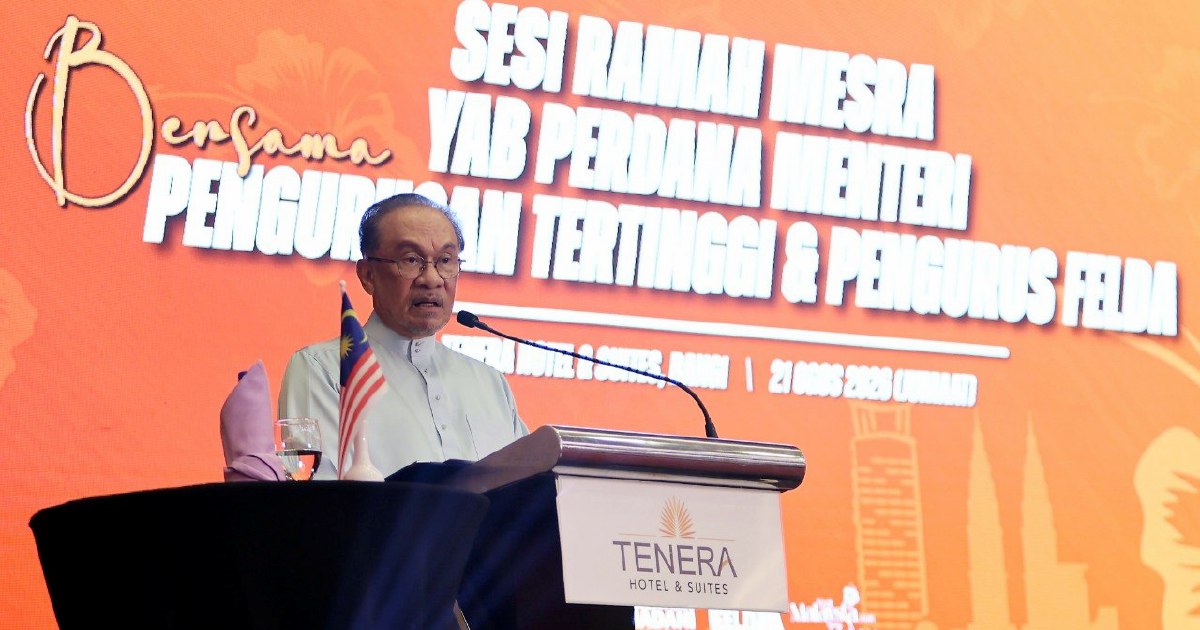
Prime Minister Datuk Seri Anwar Ibrahim has confirmed that a specially-established task force examining matters concerning the Federal Land Development Authority (Felda) has begun its investigative work. Addressing reporters in Bangi today, the Prime Minister indicated that comprehensive findings from the probe will be released to the public following the completion of the inquiry process.
The formation of the task force signals the government's commitment to addressing longstanding concerns surrounding Malaysia's largest agricultural development agency. Felda, which oversees nearly 4 million hectares of land across the country and affects the livelihoods of hundreds of thousands of smallholder farmers and their families, has faced mounting scrutiny regarding its operational efficiency and financial management in recent years. The establishment of this investigative mechanism represents a fresh attempt to systematically examine these issues at the highest levels of government.
Felda's history reflects the transformation of Malaysia's rural development landscape since its establishment in 1956. Originally conceived as a scheme to develop underpopulated land and improve the socioeconomic conditions of rural Malaysians, the authority expanded dramatically throughout the latter half of the twentieth century. However, the organisation has increasingly come under examination for its administrative practices, sustainability of schemes, and returns to settler-farmers who form the backbone of its operations.
The decision to establish a dedicated task force acknowledges that surface-level scrutiny has proven insufficient to address the complexity of Felda's challenges. These issues span multiple dimensions: the financial viability of aging settler schemes, land management practices, debt levels, governance structures, and the competitive positioning of Felda within Malaysia's evolving agricultural sector. A comprehensive investigative approach is therefore essential to diagnose root causes rather than merely treating symptoms.
For Malaysian readers and stakeholders, the implications are substantial. Hundreds of thousands of Felda settlers depend on the authority's operations for their agricultural income and social support systems. Meanwhile, the broader rural economy and food security considerations rest partly on Felda's productive capacity. Any findings that emerge from this task force will likely influence policy direction for years to come and potentially reshape how the government approaches large-scale agricultural development and settler welfare.
The timing of this investigation also reflects broader governance priorities under the current administration. Enhanced oversight and systematic examination of major public institutions have featured prominently in the government's agenda. Felda, as a substantial state-linked entity with significant economic and social responsibilities, naturally falls within this scope. The task force represents both an accountability mechanism and a diagnostic tool to identify where structural improvements are needed.
From a Southeast Asian perspective, Felda's situation resonates with challenges faced by agricultural agencies across the region. Many neighbouring countries grapple with similar questions about how to balance settler welfare, environmental sustainability, economic efficiency, and food production within large-scale development schemes. The thoroughness of Malaysia's investigative approach may offer insights or lessons applicable to agricultural governance more broadly across the region.
The public announcement of the task force's commencement serves a confidence-building function as well. By making clear that investigations are underway and findings will be disclosed, the government signals its willingness to confront difficult issues transparently. This contrasts with approaches that might handle institutional problems behind closed doors. Such openness can help maintain public trust in both Felda as an institution and in government institutions more generally.
The timeline for the task force's work remains unclear from the initial announcement. Given the breadth of potential issues to investigate and the need for thorough examination, stakeholders should anticipate that meaningful findings will require considerable time to compile. However, the government has effectively committed itself to public disclosure of results, which creates accountability pressure to deliver substantive conclusions rather than superficial reviews.
As the task force advances its work, it will likely examine both historical patterns and current operational challenges. Understanding how decisions made decades ago continue to affect Felda's current position will be as important as assessing present-day management. This historical context is essential for recommendations to have lasting impact and for any proposed reforms to address underlying structural issues rather than merely adjusting at the margins.
The establishment of this task force reflects recognition that Felda's future cannot be assured through incremental adjustments alone. Whether the investigation ultimately recommends governance reforms, operational restructuring, financial interventions, or some combination of these measures, the systematic examination now underway signals that Malaysia's leadership is taking the authority's challenges seriously. For the hundreds of thousands of people whose livelihoods depend on Felda, and for Malaysia's broader agricultural and rural development objectives, the thoroughness and integrity of this investigation will prove consequential.

