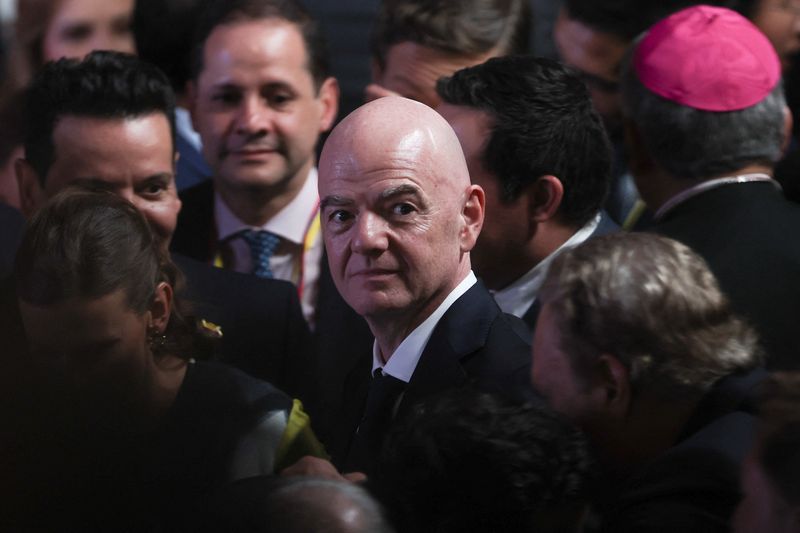
FIFA has issued a combative statement warning against what it characterises as a "concerted and ongoing effort" to undermine President Gianni Infantino, insisting that any challenges to his authority must strictly adhere to the organisation's established statutes and democratic processes. The defensive posture from world football's governing body reflects mounting pressure on the Swiss administrator following the spectacular collapse of his ambitious plan to raise approximately $4.2 billion by selling a commercial stake in the World Cup and other major tournaments.
The botched proposal has triggered a cascade of institutional criticism that extends far beyond typical political disagreement. UEFA, the European confederation that oversees football across the continent, has withdrawn its confidence in Infantino, while several national associations and senior FIFA insiders have publicly demanded his resignation. The intensity of the backlash forced FIFA to convene an emergency leadership gathering in Morocco this week, where the governing body's inner circle attempted to stabilise the situation by reaffirming collective support for the embattled president.
Infantino's difficulties have been compounded by separate allegations concerning payments made by UEFA to a former employee during his tenure as the European body's general secretary, a position he held before ascending to FIFA's top job. The Daily Telegraph first reported these claims, which Infantino has categorically denied and which FIFA has dismissed as lacking any factual foundation. The convergence of the failed commercial initiative and these historical allegations has created a perfect storm for the FIFA president, forcing the organisation into an unusually aggressive defensive posture.
In its statement, FIFA avoided naming specific critics or identifying which allegations and media reports it considered problematic, instead deploying broadly sweeping language to delegitimise what it frames as an orchestrated campaign. The organisation accused recent reporting of containing "unsubstantiated assertions and demonstrably false claims" and pledged to challenge inaccurate narratives "directly and vigorously." This rhetorical strategy reflects FIFA's apparent calculation that naming opponents would only amplify their platforms and lend credibility to their grievances.
The political mathematics surrounding Infantino's future remain genuinely fluid, with the FIFA president maintaining substantial backing across multiple continental confederations even as European opposition hardens. The Confederation of African Football unanimously endorsed his leadership on Thursday, while South America's CONMEBOL signalled that any removal attempt lacking a full member vote would lack legitimacy. Mexico's football federation similarly declared its support, though notably its parent confederation CONCACAF had previously called for comprehensive examination of Infantino's presidency, revealing fault lines even within regional blocs.
Norwegian Football Federation President Lise Klaveness emerged as perhaps the most prominent individual voice calling for Infantino's departure, arguing on Friday that he has forfeited the "institutional trust required to govern FIFA." Her intervention carries particular symbolic weight given Scandinavia's traditional emphasis on governance integrity and the region's international standing regarding administrative transparency. Yet Klaveness's call has not translated into organised pressure from other northern European nations, suggesting limits to the European opposition.
Infantino's re-election bid will be tested at the FIFA Congress scheduled for March in Morocco, where he is seeking an unprecedented fourth consecutive term. The absence of any clearly articulated alternative candidate represents a critical advantage for the incumbent, as FIFA's membership has demonstrated reluctance to embrace wholesale leadership change without an obvious successor presenting a coherent governing vision. This structural advantage may ultimately prove decisive even as his reputation has sustained considerable damage from the botched commercialisation strategy.
For Malaysian and Southeast Asian football stakeholders, the unfolding governance crisis carries tangible implications. The FIFA presidency effectively shapes the distribution of tournament hosting opportunities, the allocation of development funding to emerging confederations, and the evolution of football's commercial ecosystem. The proposed World Cup financing scheme would have restructured how major competitions generate revenue, with potential consequences for how revenues and opportunities filter through to smaller member associations. The plan's failure does not resolve underlying tensions about equitable distribution within global football's governance hierarchy.
The broader institutional question underlying this crisis concerns whether FIFA can reconcile its democratic rhetoric with the practical concentration of power within its presidential office and executive structures. FIFA's insistence that challenges to Infantino must proceed through formal democratic channels rings somewhat hollow to observers who note that incumbent advantage in elections, combined with support from numerically dominant confederations, creates structural impediments to meaningful competition for the presidency. The governance framework that FIFA invokes to defend Infantino simultaneously constrains the ability of reform-minded members to organise effective opposition.
The timing of these conflicts also creates scheduling pressures for football's global calendar. World Cup qualifying campaigns are intensifying across multiple confederations, and the eligibility disputes, administrative changes, and political uncertainties swirling around FIFA's leadership could disrupt preparations at the confederation and national association levels. Several member federations now face the awkward situation of maintaining working relationships with an administration whose legitimacy they question, creating potential friction points during the administrative negotiations that accompany international competition scheduling.
Infantino's survival through this particular crisis, should it occur, would likely require substantial reformation of FIFA's governance culture and decision-making processes to restore confidence among sceptical confederations and associations. The failed $4.2 billion proposal was evidently developed without adequate consultation with key stakeholders, a procedural failure that has proven almost as damaging as the commercial proposal itself. Any path forward for FIFA would necessarily involve rebuilding trust through more inclusive planning processes and clearer mechanisms for member input on major institutional decisions.
The coming months will test whether FIFA's democratic institutions possess genuine authority or primarily serve to legitimise predetermined outcomes determined by senior leadership. The outcome of Infantino's leadership battle will reverberate through football's global governance structures and shape how international football confederations approach the distribution of resources, opportunities, and decision-making authority for years to come.

