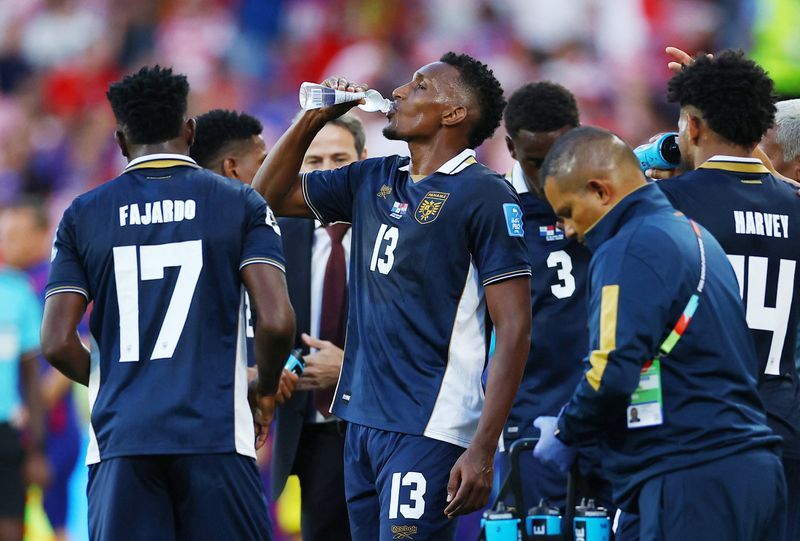
FIFA President Gianni Infantino has pushed back firmly against accusations that hydration breaks introduced at the World Cup are fundamentally about expanding commercial advertising windows, insisting instead that the sporting benefits for competitors take precedence over any broadcasting considerations. The mandatory three-minute stoppages, strategically placed in the 22nd and 67th minutes of every match, have become a lightning rod for controversy since the tournament began, with detractors spanning from elite coaches to casual viewers questioning both their necessity and their impact on the sport's traditional flow.
The introduction of these breaks reflects FIFA's attempt to manage a significant physical challenge created by hosting the tournament across North America during hot summer months. However, the decision has inadvertently created fresh advertising slots for broadcasters, a consequence that has fuelled widespread speculation about FIFA's true motivations. Critics have seized upon this commercial benefit as evidence that financial considerations drove the rule change, despite assurances from the governing body that no additional revenue accrues to FIFA itself. The organisation maintains that all broadcasting contracts were negotiated and finalised well before this rule was implemented, rendering any incremental advertising value peripheral rather than central to the decision-making process.
From a sporting perspective, the breaks provide legitimate advantages to coaching staff during matches, offering structured opportunities to deliver tactical instructions and make in-game adjustments. This tactical dimension has emerged as a central concern among high-profile managers who argue that the stoppages fundamentally alter competitive conditions and disrupt the sport's essential character. Thomas Tuchel, managing England, articulated this concern by noting that the interruptions change the match's identity entirely, while Marcelo Bielsa of Uruguay argued that fragmenting games into shorter segments strips away a core element that defines football as a sport.
Yet support for the hydration breaks has not been entirely absent from the coaching fraternity, though backing tends to be qualified rather than wholehearted. Luis de la Fuente of Spain and Virgil van Dijk, the Netherlands captain, have acknowledged the legitimate safety rationale underpinning the rule, particularly in genuinely oppressive heat conditions. These officials have nonetheless queried whether the rule's uniform application across all venues makes practical sense, given that some stadiums feature climate control and regional temperature variations mean certain matches occur in markedly cooler conditions than others. This middle-ground position suggests that opposition to the breaks stems less from outright rejection and more from concerns about their blanket implementation regardless of actual environmental circumstances.
Infantino addressed the tactical dimension directly, emphasising that the primary motivation remains player protection during an unusually demanding tournament schedule. The World Cup spans 39 days with teams potentially competing eight times during that compressed window, a gruelling schedule that creates genuine fatigue management challenges. The FIFA president contended that providing a structured rest interval represents a rational response to these exceptional circumstances, enabling players to recover briefly and preventing heat-related medical emergencies. The competitive fairness angle adds another dimension to FIFA's defence: permitting hydration breaks ensures that no team gains unfair advantage through a coach's tactical adjustments simply because weather conditions in one match differ from another.
This competitive equity argument carries particular weight in international tournaments where determining a legitimate champion requires that all participants operate within identical frameworks. Infantino reasoned that a coach operating in oppressive heat could manipulate match outcomes through tactical adjustments, whereas another coach in cooler conditions would lack equivalent opportunity for mid-match intervention. Standardising the break across all matches theoretically eliminates this source of competitive imbalance, though critics counter that the standardisation itself creates problems by imposing stoppages that may be entirely unnecessary in certain environments.
Performance data appears to support FIFA's contention that the breaks have not diminished match intensity or player output. Infantino observed that players have maintained high performance levels throughout games despite the interruptions, suggesting that the tactical pause does not translate into measurably reduced competitive effort. This observation challenges the perception that the breaks fundamentally weaken the quality of play or create dead time that undermines entertainment value. From a Malaysian and Southeast Asian perspective, this debate carries relevance beyond the immediate tournament context, as tropical climates and outdoor sports infrastructure across the region mean that heat management represents an ongoing challenge for regional football administrators.
The broader implications extend to how international football governing structures balance player welfare against sporting tradition and commercial interests. The hydration break controversy reflects the increasingly complex ecosystem surrounding elite sport, where medical science, broadcasting economics, competitive fairness, and traditional values intersect. For Malaysian football stakeholders, the outcome of this World Cup experiment will likely influence future tournament planning and may establish precedents for how the sport accommodates environmental and physical challenges in major competitions. The controversy ultimately mirrors a wider tension between modernising sport for safety and health reasons while preserving the essential characteristics that have defined the game historically.

