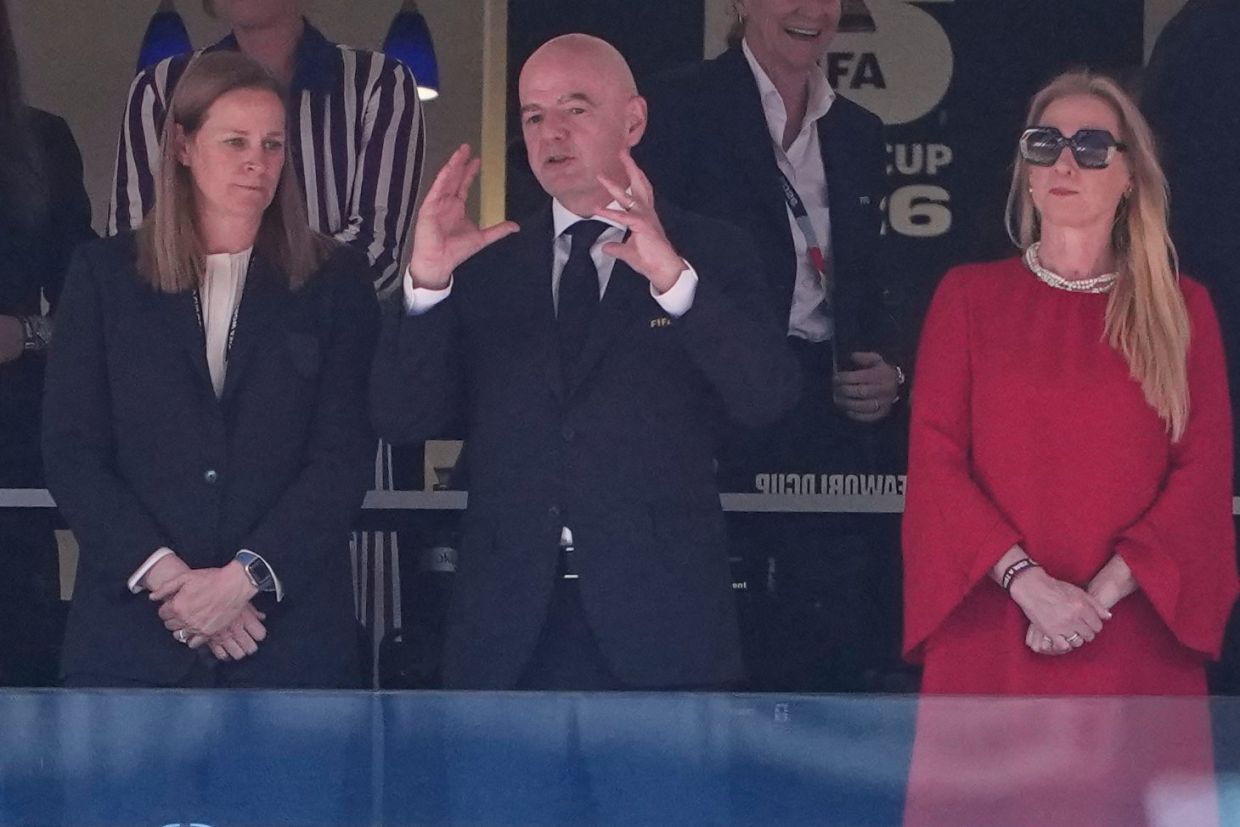
Football's governing body FIFA stands to rake in approximately $9 billion from the 2026 World Cup, cementing its financial dominance even as the tournament has been battered by a succession of disputes that have tested the sport's integrity. Chief executive Gianni Infantino appears politically unassailable and poised for re-election, with the avalanche of criticism that threatened to derail the competition already fading as play progresses. The tournament has become a masterclass in how a powerful international body can weather controversy by simply waiting for the news cycle to move on.
The controversies that have shadowed this World Cup paint a portrait of an organization that prioritizes revenue generation over regulatory consistency. The most explosive dispute involved the decision to allow a suspended American player to participate following alleged pressure from US President Donald Trump, an intervention that prompted vocal condemnation from football figures including former Liverpool manager Jurgen Klopp and political leaders from Belgium and the United Kingdom. The reversal of the disciplinary decision suggested that political leverage could override established sporting rules, fundamentally undermining FIFA's credibility as a neutral arbiter of football's laws. Yet within days of that player's team being eliminated, media attention dissipated almost entirely, illustrating how individual controversies become subsumed into the broader spectacle of tournament play.
The financial architecture underpinning this World Cup reveals how deeply the competition has become intertwined with commercial interests rather than sporting principles. The $9 billion haul represents a $2 billion increase compared to the 2022 Qatar edition, demonstrating FIFA's relentless pursuit of revenue growth regardless of external criticism. This expansion of the prize pool—now reaching $871 million with every participating nation guaranteed a minimum $12.5 million simply for attendance—functions as a powerful incentive mechanism that keeps member federations aligned with Infantino's leadership. For smaller nations like Cape Verde, which earned over $21 million from its historic tournament run representing approximately 0.75 percent of the country's gross domestic product, FIFA's financial distribution remains economically transformative.
The 2026 tournament's expansion from 32 to 48 teams epitomizes how Infantino has restructured FIFA's competitions to maximize both revenue streams and geopolitical influence. This format change creates more participation opportunities for smaller nations, generating gratitude among football associations worldwide that might otherwise question FIFA's governance practices. The expansion simultaneously increases commercial slots, broadcast rights, and sponsorship opportunities, allowing Infantino to present financial generosity and sporting inclusivity as complementary objectives rather than tensions requiring resolution. By engineering a system where increased participation directly translates to increased financial rewards for participating federations, Infantino has created constituencies with vested interests in his continued leadership.
The commercial ecosystem surrounding the World Cup extends far beyond FIFA's direct revenue, creating networks of economic beneficiaries invested in the tournament's perceived success. Stadium concessionaires have reported unprecedented spending patterns, with some venues recording per-capita consumer expenditures reaching $100 during matches—nearly double the spending rates observed during National Football League games. Host cities, many of which expressed cost concerns before the tournament commenced, have already witnessed measurable economic gains. Bank of America data tracking spending patterns from mid-June showed that credit and debit card transactions in World Cup host cities increased 6.3 percent year-on-year, with spending by non-local visitors surging 16.7 percent, evidence that the tournament is delivering tangible economic benefits to host communities regardless of broader governance concerns.
Advertisers have similarly benefited from FIFA's operational decisions, particularly the introduction of mandated hydration breaks that fundamentally alter match rhythm and create additional commercial windows. The transformation of football's traditional two-half structure into an American-style four-quarter format demonstrates FIFA's willingness to reshape the sport's fundamental character to accommodate commercial interests and cater to American broadcasting preferences. Such modifications, while generating predictable complaints from football purists, have become normalized within modern tournament administration, suggesting that regulatory flexibility in service of revenue generation has become institutionalized within FIFA's operating philosophy.
Infantino's political position, despite the mounting criticism, remains extraordinarily robust because he has systematically cultivated support among the 211 FIFA member associations whose votes determine leadership succession. His re-election scheduled for early 2027 in Rabat, Morocco—itself a host nation for an upcoming World Cup—appears essentially predetermined, with federations from Asia, South America, and Africa already pledging support. The Asian Football Confederation's president Sheikh Salman has publicly declared that FIFA occupies its strongest-ever institutional position, while the Royal Moroccan Football Federation has praised Infantino's contributions to football development across Africa and globally. This widespread backing reflects the reality that member federations derive substantial benefits from FIFA's revenue distribution and tournament expansion strategies, creating powerful disincentives to challenge the organization's leadership.
The historical context illuminating Infantino's resilience involves his positioning as FIFA's reformer following the catastrophic corruption scandal that engulfed the organization over a decade ago. When American prosecutors pursued major corruption cases, FIFA became synonymous with institutional decay and ethical failure under Sepp Blatter's leadership. Infantino's appointment represented a break with that disgraced past, and his tenure has involved genuine reforms including marginal transparency improvements alongside the simultaneous expansion of FIFA's tournament portfolio and revenue-generating capabilities. Yet this reformation narrative masks a more troubling reality: Infantino has essentially rehabilitated FIFA's power structure without fundamentally altering its susceptibility to political interference and commercial manipulation, instead merely updating the mechanisms through which power, money, and politics intersect within global football governance.
The tension between FIFA's stated commitment to sporting integrity and its demonstrated prioritization of financial interests reached its apex during the incident involving the suspended American player whose participation was permitted following presidential intervention. Sports lawyer Nick De Marco articulated the fundamental stakes, noting that the controversy transcended the validity of the original disciplinary decision to encompass whether FIFA had fundamentally compromised its authority as football's global regulatory body. The absence of decisive consequences for FIFA leadership despite this challenge to institutional credibility suggests that such authority is increasingly performative—maintained through control over tournament distribution and financial mechanisms rather than through genuine commitment to consistent rule application. For member federations deriving substantial revenue from FIFA's operations, this arrangement proves entirely acceptable.
The broader implications for Malaysian and Southeast Asian football observers involve recognizing that FIFA's governance model increasingly prioritizes growth and member satisfaction through financial distribution over sporting governance principles. The guaranteed participation payments and expanded tournament opportunities have created constituencies throughout Asia supportive of Infantino's leadership, even when controversial decisions threaten football's competitive integrity. Malaysia and other regional nations benefit directly from expanded tournament opportunities and increased financial distributions, creating structural reasons to maintain alignment with FIFA's prevailing power structures. This dynamic helps explain why regional football associations remain steadfastly supportive despite controversies that might theoretically provoke governance reform demands.
As the 2026 World Cup progresses and individual controversies fade from immediate attention, FIFA's fundamental structural position strengthens rather than weakens. Infantino enters his re-election campaign virtually unopposed, commanding support from member federations benefiting from his revenue-maximizing strategies and tournament expansion initiatives. The controversy surrounding political interference in sporting decisions will likely prove episodic rather than catalytic, disappearing from broader discourse as tournament excitement eclipses governance concerns. For a sports organization whose legitimacy increasingly rests on financial capacity to distribute resources to member associations rather than on credible commitment to neutral rule application, this represents optimal outcomes. FIFA's transformation from scandal-ridden institution to fiscally dominant organization appears essentially complete.

